The Great Beauty (La grande bellezza) (Paolo Sorrentino – Italy/France) 140 minutes
The first fifteen minutes of Paolo Sorrentino’s The Great Beauty alone are enough to banish the memory of the fiasco that was This Must Be the Place. Day breaks in Rome, a choir sings on Gianocolo, early risers nonchalantly go about their business, a Japanese tour group is shown about the city’s antique sights. One of their number breaks away for a moment to take a picture of the cityscape, admires the view and then keels over with what appears to be a Stendhal Syndrome-induced heart attack. We then abruptly cut to a rip-roaring rooftop party, where revellers of all ages get their rocks off to pounding trashy Euro house. At the centre of it all is one Jep Gambardella (Toni Servillo), who steps out of the film for a moment to introduce himself. The rooftop patio is his, overlooking the Colosseum, and it will be him we follow for the next two hours and more.
The clear reference here is Fellini, and most explicitly La dolce vita, which Jep, a successful journalist and frustrated novelist, has no difficulty living up. But if the film begins with a heavily loaded sense of déjà-vu, it is an openly avowed one. There is no gradually divulged portrait of the ennui and emptiness beneath the glitz and glamour of mondaine Rome – the emptiness is already a given. This is Berlusconi’s Italy, a country obsessed with reality TV and the trivial. The film itself is complicit in it, having been partly produced by Mediaset Premium, one of the high-end branches of the former Prime Minister’s media empire. Jep says at one point to a Communist novelist friend whom he rather cruelly scorns: "Flaubert wanted to write a novel about nothing; if he had ever met you, he could have written his masterpiece." The Great Beauty does not benefit quite to this extent from such a proximity to the vacuous but it is a great character portrait and has some magnificent set pieces.
Servillo, unrecognisable under mounds of make-up as Giulio Andreotti in Sorrentino’s Il Divo, here shows his true face, as a dapper old roué who begins to have second thoughts about the life he had led when he learns some news out of the blue. A man appears on his doorstep and tells him that his wife, deceased the day before, loved only Jep, whom she nonetheless mysteriously left forty years before. And so the edifice of smug certainty that is Jep’s life begins to be chipped away at. His cynicism starts to desert him, and with it his ability to protect himself from the ravages of time and ageing. He continues nonetheless to womanise, picking up slightly younger women who are themselves desperately trying to ward off physical decline – one, a 42-year-old, works part-time as a stripper in her father’s club to help finance her cosmetic enhancements. Servillo is one of the great actors of his generation, a man with a rubbery fizzog straight out of the Commedia dell’arte; he is at once charming, winsome and melancholy. His Jep is more together than all around him but that only serves to increase his desperate awareness of what has slipped away in his life. Sorrentino and Umberto Contarello’s script builds a fascinatingly complex character, the textures of which deepen as the film progresses, and Servillo’s performance is a tour de force of understated confidence.
Like Il Divo before it, The Great Beauty is flawed – it is overlong and its rhythm flags at times, and Sorrentino has a frustrating penchant for cramming quirks into his story – a disappearing giraffe and a mustering of storks that gathers on Jep’s patio on their way south. But the flaws, as in the previous film, are more than outweighed by its better qualities. Servillo’s performance is the most obvious, but there are fine comic turns throughout, particularly from Carlo Buccirosso (previously brilliant in Il Divo) as Jep’s lonesome playwright friend, Lello Cava. Sorrentino also has a deft touch for the burlesque. His party scenes are throbbing with energy and humour, and show those in Baz Luhrmann’s The Great Gatsby up for the mess they are. The Great Beauty is not going to define this era in the way its illustrious monochrome predecessor did its own but it is a vibrant and literate comedy that is far more substantial than many European films of the moment.
Showing posts with label Italy. Show all posts
Showing posts with label Italy. Show all posts
Sunday, May 26, 2013


Sunday, April 21, 2013
Dormant Beauty – Marco Bellochio
Dormant Beauty (Bella addormentata) (Marco Bellochio – Italy/France) 115 minutes
Marco Bellochio’s first film, Fists in the Pocket (1965) starred Lou Castel as a young malcontent who kills off, one by one, all the members of his family. Bellochio’s latest also involves putting an end to the days of family members though this time the context is less sinister: termination of life support for vegetative patients. The film takes place against the backdrop of the Eluana Eglano case – Italy’s answer to Terri Schiavo – a patient who had been in a permanent vegetative state for 17 years and whose family was fighting for the right to turn off life support. Silvio Berlusconi’s government and the Catholic church led a campaign against termination with Berlusconi saying, with unfailing crassness, that Eglano ‘looked pretty well and could even give birth to a son’.
Though the case is explicitly referred to in the film and the actual nursing home in Udine where Eluana was being treated is used, the action focuses on a number of peripheral, fictional characters. Among them are Roberto and his bipolar brother Pippo, supporters of the family’s right to end the life support; Roberto starts a clandestine romance with Maria (Alma Rohrwacher – previously seen in The Solitude of Prime Numbers), one of the Catholic pro-life protesters. Maria’s father (the ever excellent Toni Servillo, best known outside Italy for his role as Giulio Andreotti in Paolo Sorrentino’s Il Divo) is a Senator in Berlusconi’s People of Freedom party, who is being nagged by an outbreak of conscience that prompts him to refuse the compromise vote his leader has imposed on the party. His wife, and Maria’s mother is also in a vegetative state, as is the daughter of a French actress, splendidly named Divina Madre (Isabelle Huppert), who is similarly opposed to pulling the plug, against her son’s wishes. Finally, there is a young doctor, played by Bellochio’s son and regular collaborator Pier Giorgio, who is watching over Rossa, a thirty-something recidivist junkie, who has sunk into a coma.
If that sounds a bit contrived, it is. Bellochio’s attempt to dramatise the polemic between contemporary secular ethics and a dogmatic Catholic fetish for heart-beats and pulses is intelligent and compelling from a socio-historical point of view. It is far too schematic though, with some of the outlying relationships struggling to come to life – Huppert, in particular, seems to be there only to attract investment to the film. The film is also dramatically sluggish – though Dormant Beauty treats of a matter of life and death, it doesn’t move with an attendant urgency. It is a relatively minor Bellochio, not a patch on his last film Vincere, which told the tale of Mussolini’s criminally neglected mistress Ida Dalser. Dormant Beauty does impart the usual Bellochian chilliness that pervades the grand houses of unhappy bourgeois families, which he has been cultivating ever since Lou Castel was balling up his fists in his pockets.
Marco Bellochio’s first film, Fists in the Pocket (1965) starred Lou Castel as a young malcontent who kills off, one by one, all the members of his family. Bellochio’s latest also involves putting an end to the days of family members though this time the context is less sinister: termination of life support for vegetative patients. The film takes place against the backdrop of the Eluana Eglano case – Italy’s answer to Terri Schiavo – a patient who had been in a permanent vegetative state for 17 years and whose family was fighting for the right to turn off life support. Silvio Berlusconi’s government and the Catholic church led a campaign against termination with Berlusconi saying, with unfailing crassness, that Eglano ‘looked pretty well and could even give birth to a son’.
Though the case is explicitly referred to in the film and the actual nursing home in Udine where Eluana was being treated is used, the action focuses on a number of peripheral, fictional characters. Among them are Roberto and his bipolar brother Pippo, supporters of the family’s right to end the life support; Roberto starts a clandestine romance with Maria (Alma Rohrwacher – previously seen in The Solitude of Prime Numbers), one of the Catholic pro-life protesters. Maria’s father (the ever excellent Toni Servillo, best known outside Italy for his role as Giulio Andreotti in Paolo Sorrentino’s Il Divo) is a Senator in Berlusconi’s People of Freedom party, who is being nagged by an outbreak of conscience that prompts him to refuse the compromise vote his leader has imposed on the party. His wife, and Maria’s mother is also in a vegetative state, as is the daughter of a French actress, splendidly named Divina Madre (Isabelle Huppert), who is similarly opposed to pulling the plug, against her son’s wishes. Finally, there is a young doctor, played by Bellochio’s son and regular collaborator Pier Giorgio, who is watching over Rossa, a thirty-something recidivist junkie, who has sunk into a coma.
If that sounds a bit contrived, it is. Bellochio’s attempt to dramatise the polemic between contemporary secular ethics and a dogmatic Catholic fetish for heart-beats and pulses is intelligent and compelling from a socio-historical point of view. It is far too schematic though, with some of the outlying relationships struggling to come to life – Huppert, in particular, seems to be there only to attract investment to the film. The film is also dramatically sluggish – though Dormant Beauty treats of a matter of life and death, it doesn’t move with an attendant urgency. It is a relatively minor Bellochio, not a patch on his last film Vincere, which told the tale of Mussolini’s criminally neglected mistress Ida Dalser. Dormant Beauty does impart the usual Bellochian chilliness that pervades the grand houses of unhappy bourgeois families, which he has been cultivating ever since Lou Castel was balling up his fists in his pockets.
Wednesday, August 01, 2007
The Other Ingenious Michelangelo

They're dropping like flies in the world of cinema; the latest to go is Michelangelo Antonioni, probably Seanachie's favourite living director (or living until today that is). As with Bergman, Antonioni, 94, had a good innings and was directing until relatively recently; he made Beyond the Clouds ten years ago and contributed an episode to the film Eros two years back along with Steven Soderbergh and Wong Kar-Wai, both directed after he suffered a stroke in the 1980s rendering him mute. The son of a banker, he came to international prominence late enough, being already 44 when his seventh feature Il Grido (The Cry) was a success in Europe. Significantly it was influential enough to dissuade Albert Camus from naming his work in progress Le cri (he settled eventually for La chute or The Fall as we know it in English - who knows, if it weren't for Antonioni, Mark E. Smith might be fronting an entirely different group).
It was L'Avventura three years later that broke Antonioni in a big way, and the tale of a woman who reconciles herself suprisingly serenely to the disappearance of her lover on a Mediterranean island is probably the most influential arthouse film of the past fifty years, and I count the films of Bergman, Godard, Truffaut, Dreyer, Tarkovsky, Fassbinder, Fellini, Kurosawa, Lynch, Ozu and Kiarostami (all directors I greatly admire) among the competition. Pauline Kael might have repeatedly derided Antonioni's films as 'the sick soul of Europe on parade' but they had a chilly rigidity that perfectly befitted the attempted social pacification of post-war Europe. Watch L'Avventura today, or La Notte, or Il Deserto Rosso with a dubbed Richard Harris starring opposite Antonioni's actrice fétiche Monica Vitti, and you have a jarring sense of modernity that few films made since can provide. The trappings might be classic post-war Italian style and the cinematography lush black and white (except, of course, for Il Deserto Rosso) but they look, feel and sound like they might have been made last week. L'Avventura is also one of the most beautifully lit films in cinema history, which is all the more remarkable as its Director of Photography Aldo Scavarda never worked with Antonioni again and drifted into the staple bread-and-butter of Italian exploitation cinema.
Antonioni moved into English-language cinema with Blow Up in 1966, and though many people claimed he got swinging London all wrong, the film endures as an examination of the boredom and disillusion engendered by the nascent empty consumerism that its characters lived in. Zabriskie Point, his first American film, is, without any doubt bad, but it is beautiful to watch and is testimony to Antonioni's consummate filmmaking skill, allowing oneself to suspend the harshest of judgements until the very end. As for The Passenger, his film about identity theft and escape, made with Jack Nicholson in 1975, I posted on it a year ago, and it remains one of the most amazing films I have ever seen, and bears repeated viewing. Antonioni's icy, distant style is still favoured by the more arty elements in film schools and, in the right hands it can be exhilarating to watch, such as in Gus Van Sant's Gerry and Elephant, Nanook Leopold's Guernsey, Mathias Luthardt's Pingpong, Nobuhiro Suwa's M/Other, Nuri Bilge Ceylan's Climates and the films of Tsai Ming-Liang and Todd Haynes. Few people would say that Ingmar Bergman was the second-greatest filmmaker to die this week, but I would be one. May both of them rest in peace.
Monday, January 22, 2007
Climates, Clandestini and Revolutions

There are few film directors that would cast themselves as a rapist in a film, much less resist making the character an out-and-out villain. The Turkish director Nuri Bilge Ceylan, in his latest film Climates, has done just that and what is most disturbing about his character's rape of a female friend is the fact that the woman calls him again and seems to be on good terms with him. Distasteful and morally dubious as this is, it is nonetheless credible, as viewed within the film's narrative. Ceylan's character, a lecturer in architecture, is an untrustworthy, supercilious sort, who lies to his estranged wife in a vain attempt to win her back, only to change his mind again. But, every villain has their reasons, as Jean Renoir once said, and even this unpleasant man's quotidian life, so impressively delineated, is compulsively watchable. The penultimate scene where he lies to his wife and reduces her to tears is both uncomfortable and familiar to anyone who has gone through a painful break-up. There is also a dream-sequence where the younger wife, Bahar - played by the director's real-life wife Ebru - imagines she is being buried in sand by her husband. It is one of the few I have ever seen in a film that is in any way persuasive.
After his previous film, Uzak, which was an arthouse hit a couple of years ago, Ceylan proves himself to be one of cinema's finest chroniclers of human emotions. In Uzak, a depressive Istanbul photographer puts up his country cousin and the relation between them quickly becomes strained. There is a similar air of pessimism in Climates, though one shot through with a beautiful visual texture - Ceylan is also an accomplished photographer - and the performances, though quiet and intimiste, are far from the catatonically mannered ones so familiar from countless arthouse releases. Marital difficulties make up a significant sub-genre of cinema, with classics such as Rossellini's Voyage to Italy, Bergman's Scenes from a Marriage and Antonioni's La Notte and Red Desert. The Japanese director Nobuhiro Suwa, who is also a fine observer of strained relationships disappointed last year with Un Couple parfait, his first French film, which was a bit too talky for my liking. Until his next film, Climates is a more than adequate surrogate, one that confirms Ceylan as one of Europe's most redoubtable filmmakers.
There were two other decent European films I saw last week. One, Italian, entitled Saimir, directed by Francesco Munzi, about an Albanian expat teenager, who lives with his people-trafficking father and who weathers a number of cruel blows before taking things, rather foolishly into his own hands, and extracting a certain justice. It is a tough film that reminds one of the Dardenne brothers' work, La Promesse, though it has a more stately style and it lacks the Dardenne's Hardyesque eye for a crucial event that sets in train an irrevocable, tragic sequence of events. A bit jilted in parts, it is nonetheless an assured film.
The other film is 12:08, East of Bucharest, a political comedy about a local TV station's attempts to mount a televised inquest on the fifteenth anniversary of Ceaucescu's fall into whether the local town actually witnessed a revolution, meaning, did people actually protest before 12:08 on the 22nd of December 1989, at which time the dictator abdicated and dissent became safe once again? The film is a bit lopsided as the second half devotes a bit too much time to the programme itself and the central conceit of erroneously-claimed heroism is a bit jaded, having been used to claim allegiance to everything from the French resistance to participation in the Easter Rising. But there is some sharply mordant humour in the film, particularly in the depictions of the pompous textile-manufacturer-turned-TV-station-owner and the haplessly indebted alcoholic academic, who claims to have been at the fore of the local revolution all those years before. The film won the Caméra d'Or last year for its young director Corneliu Porumboiu, just thirty-one years of age, and he uses his experience as a camera operator on such a local television station for much of the humour. And there is a subtle lyricism in his direction also, such as the two montages of the streetlights turning first off and then on that bookend the film, and which also serve as a metaphor for the hesitant revolution of the town's history. Though, like the superior The Death of Mr. Lazarescu, the film does not make one terribly keen to visit Romania, it is further evidence of a remarkable cinematic renaissance in the beleagured country. Porumboiu is a director to watch out for in the future.
Friday, January 12, 2007
End of Production for Carlo Ponti
I shall say nothing about the new iPhone, which almost everyone I know is yabbering on about, for what reason I cannot fathom, nor the news that traces of cocaine were found on 100% of 45 Irish banknotes (did anyone think of testing them for traces of beer or urine?) Instead I will salute the great Carlo Ponti, the Italian film producer, one of the best ever, and who was better known to most as the husband of Sofia Loren. While emabarking on my quest to watch every film ever made in my early twenties I noticed the name of Ponti pop up in the titles of a lot of disparate films by excellent directors and I have since retained a great deal of respect for him. Like the great Franco-Polish producer Anatole Dauman, who died almost ten years ago, he had an eye for talent and also for making money out of unusually challenging films. His roster included di Sica, Antonioni, Fellini, Godard, Melville, Lean and more; a full list is available on the IMDb. One wonders about the longevity of Italian film producers, Ponti lived till 94, while Dino de Laurentiis and Alberto Grimaldi are still going, and still working. Something in the water, or is it the lifestyle?
Tuesday, December 05, 2006
Libero como uno uccellino

Sunday night at the movies: a film by the very un-Italian-named actor Kim Rossi Stuart (his name is explained by his having an English father). Libero is the story of a ten-year-old boy, who is torn by the marital turmoil of his parents, an intemperate steadicam-operator played by Stuart, and his mother, a philandering gold-digger who loves her children more than the man who sired them, yet who commits herself disastrously to a rekindling of the marriage having returned to the homestead.
Libero is a modest, likeable film that manages to be both tasteful and touching and it is remarkable mainly for the performance of its charming young star Alessandro Morace as Tomasso, the reluctant swimming champion, who is much more interested in taking up football - 'an idiot's game' as his father calls it. The title (which in the original is Anche libero va bene - 'I think Libero would be good') is taken from Italian football's most famous positional creation, and which the father suggests to his son when he finally assents to his change of sport.
The film reminds me of another low-key realistic drama from this year, the German Lucy, which was released earlier this year, and while it shares the limitations of that film, it also shares the dignified bittersweetness and pain of ordinary daily situations such as the son, upon coming home with the family, noticing before everyone else that the lights in the apartment are switched off, thereby indicating that the mother has once again flown the coop. There is also the touching sub-plot of the mute class-mate and the cute girl who befriends Tomasso and whom he quickly falls for. Even the best Italian films these days are compromised affairs and pale shadows of the long-forgotten glory days of Fellini, Risi, Antonioni, Pasolini, Rossellini et al but those folks are the sort whose influence could cripple anyone. There is something inevitable about the dramatic unshowiness of Libero but I cannot say that it is any the worse for that.
Thursday, August 17, 2006
The Holy Seat

Just as some gay men and women know from an early age that they are homosexual so I knew quite young, despite my Catholic upbringing that I was an atheist, or at least inhabiting that ante-room to atheism, agnosticism. (I know that my Dad is going to scroll down through that last sentence way too quickly and cheerily announce to everyone that I have outed myself on the Internet, but alas the Lord is going to have to damn me on lack of faith rather than anything proscribed in Leviticus). That said I am drawn to churches and other places of worship, probably because of their calm and grace and also because, from long before Christ to the present day, temples, mosques and churches have usually been able to guarantee a high standard of architecture. I have many favourites, such as the Romanesque churches of Cologne; a more recent post-war Church of Sankt Jakob in the same city; Sigurd Lewerentz's wonderful Markuskyrkan (pictured) in the suburbs of Stockholm; Chartres Cathedral (one of the most stunning works of art I have ever seen); two beautiful parish churches in Donegal from the 1960s, at Burt and Creeslough and churches I have more recently seen such as the Cathedral of San Giusto in Trieste and the Franciscan Church on Presernov Trg in Ljubljana.
One thing I noticed in Italy however is the religious' real annoyance at their sites of worship being visited for nothing but their artistic merit, or more often simply because of their banal fame. Italian churches famously ban women in halter tops and men in shorts from their premises and in the Church of Santa Maria Maggiore, beside Santa Lucia Station in Venice, one sandwich board posted beside the front door scolded potential visitors in five languages, reminding them that churches are not art galleries or museums. Fair enough, but there are churches that have no problem in charging admission fees to defray parochial and maintenance costs. The Churches have always had a mercantile side to them but they usually prefered gather money from the faithful rather than from uninterested outsiders. The churches' real problem was crystallised in something I saw in Santa Maria Maggiore. I noticed the door to an old oaken confessional ajar and inside I saw, instead of a old wooden bench for the priest to sit on, a standard revolving office chair. It is hard to remain nonchalantly in the sacral domain when quotidian furniture design is itself irreducibly profane.
Wednesday, August 16, 2006
Difficult From Here
As I remarked in the last post, Trieste's second train station, the Campo San Marzio, has been closed for a long time so there is now no direct connection to nearby Ljubljana, save for a nightly train to Budapest that goes via Zagreb, quite a detour. I asked a the man at the enquiries desk at Centrale station if there were any other connections, and he said that in good English, that "it is difficult from here." He told me to take a train to Monfalcone but gave me the impression that there was only one per day, thereby necessitating another afternoon in Trieste.
I decided to get a second opinion at the ticket office, and while waiting for a French-speaking teller to come free, another teller, speaking nothing but Italian succeeded in getting me to buy a ticket for the Slovenian capital via Monfalcone the following morning, as I required. Sometimes not speaking a language at all is more useful than speaking half a language.
I decided to get a second opinion at the ticket office, and while waiting for a French-speaking teller to come free, another teller, speaking nothing but Italian succeeded in getting me to buy a ticket for the Slovenian capital via Monfalcone the following morning, as I required. Sometimes not speaking a language at all is more useful than speaking half a language.
A Quiet City
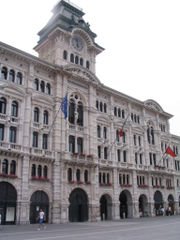
Trieste is a city that willingly chose the quiet life. A vibrant port, the main sea-portal of the Austro-Hungarian Empire until it joined the Kingdom of Italy in 1919, today it is a sleepy, if pleasant city that is not quite dead, but certainly has none of the bustle that it would have had when James Joyce lived there a century ago. In the hands of the Austrians since the fifteenth century, the city remained culturally Italian (though it is also on the border with Slovenia and there is a significant Slovene-speaking minority living in the city's hinterland) and the city's wealthy merchants, made rich by trade with the Hapsburg Empire, were for the most part irredendist, and upon the collapse of that Empire after the First World War, Trieste and the peninsula of Istria to the south rejoined Italy. (It is strange how the word 'irredentist' is not as common in usage in Ireland as it is in Italy, considering how appropriate it is to the Irish situation.) Istria later reverted to Yugoslavia after the next war and now forms part of both Slovenia and Croatia, but Trieste is still Italian.
As the train swung south from Monfalcone, the most familiar Triestine characteristic, the rain, made an appearance and did not stop for another 24 hours. The city is not too eager to attract tourists; there is no tourist office and the only map I could find was so old that Slovenia was referred to as Yugoslavia. It also included the disused Campo San Marzio railway station, detailing its connections to Klagenfurt and Ljubljana. When I finally found the hotel I was staying in, right beside the first of Joyce's many addresses in the city, I found that it was practically empty.
Trieste has a dramatic setting, the hills of the Karst rising to the north and the east and the city itself is quite hilly, with the old Venetian-build castle and the charming Romanesque Cathedral of San Giusto sitting on a height that towers over the seafront streets below. The harbour is practically unused these days, Italy had less urgent use for a new port than the inland Austrians did, a few fishing trawlers and some pleasure boats being the only vessels to be seen. Only in the marina to the south of the Old Port was there a sign of any activity. But the city, apart from the derelict dockyard buildings, does not look like it is suffering too badly. The city has a range of impressive Belle Époque architecture bequeathed it by the Austrians - stout, ornate Central European buildings, and the main square, Piazza de la Unità d'Italia, with the City Hall and a number of old merchant's mansions is beautiful. There is a lot of interesting Fascist-era modern architecture too; it is as if Mussolini was spoiling the lost child that had just returned to the family.
Joyce left Trieste when war broke out in 1914, even though Italy did not enter it until the following year, and when he returned in 1919 he found that the old glory of the city had vanished and he went off again to Paris. He is the writer most closely associated with the city, though the locals, apart from one statue and a small museum in the Municipal Library do not seem too bothered by the connection. Much more revered are the Triestine writers, such as Italo Svevo, who was taught English by the young Joyce and eventually championed in France by the Dubliner, and even more so the poet Umberto Bava. I had a bit of bad luck with the city as many of the museums were closed for the month of August, as was the famous Caffè San Marco, which was frequented by both Joyce and Svevo, and which gets a chapter to itself in the Triestine writer Claudio Magris' superb Microcosms. So instead I took a look at the city's synagogue, built in 1914 and which survived the Nazi occupation. It is reputedly one of the biggest in Europe and I would well believe it, it is a huge edifice, modelled on ancient Syrian temples, that dominates the small street on which it is located. The closest thing I have seen like it is the Portuguese Synagogue in Amsterdam, though this is a neater, more clinical work, though every bit as impressive.
The best museum I saw on my trip was a small one housed in the city's enormous Post Office. It was the Postal Museum of Mitteleuropa, and was a fascinating documentation of the history of Post in the Austro-Hungarian Empire. Even better than the permanent collection, which includes postmen's uniforms from the 19th century and old telegraph machines, was the collection of stamps and first-day issues from around the world that told the story, comic-strip style of the Friulian earthquake of 1976. Also included are postcards to and from the stricken region shortly after the quake, all of them stamped with the haunting 'Zona Torrematta'.
The beer is better in Trieste than elsewhere in Italy because of the historical connections with Central Europe, but the problem is trying to get a place that stays open after 10pm. As I said, they like the quiet life here. Two days was enough. I can't imagine I will be going back, but a pleasant city, one that has stepped into the slow lane of History.
Wednesday, August 09, 2006
High Campanile
Venice was the unwanted child on this trip; I only spent a day here due to the fact that a flight to Treviso was the cheapest way of getting to Trieste and Ljubljana. Not that I don't find the city charming, but in August, overrun as it by tourists it is not near as pleasant as it might otherwise be. I want to save it for another time, like not wanting to know the score before watching the edited highlights of a football game. It will probably be a windy November afternoon when I will be up to my ankles in floodwater from the swollen canals (St. Mark's Square is invaded by water a staggering 250 days per year). But in some way I would find that more enjoyable than standing in the interminable queues for St. Mark's Basilica and the Doge's Palace. The latter being the only thing I wanted to see, because of its marked influence on Ragnar Östberg's Stockholm City Hall, I was a bit dismayed. The queue for the Campanile was much shorter and so I took the lift up. Once up there the meridonal aspect of the city explodes in a mass of terracotta roofs and countless other campaniles that make you really feel that you have been conned into paying 6 euros just to get to the top of this one, until you realise then that the campanile, which has always had architectural cachet in English, means merely 'belltower' in Italian. More fool we.
On the ground I took a more unorthodox approach to exploring the city, by just getting lost. Except that you never really get lost in Venice. There is no point in using a map for anything more than the most basic of landmarks; the streetnames are only to be used as a last resort and in fact do not figure in postal addresses at all, each of the siesti or districts function in that way with the houses individually numbered in a fashion that is indiscernible to the untrained eye. But even so, you are never too far from emerging in a place that you will recognise (for all its labyrithine character the city is very small). And just as one is said to be never more than ten feet away from a rat in London, so you are never more than a street away from a tourist in Venice, no matter how isolated you think the street you are wandering on is. On some of the less glamorous squares in San Polo, where the price of everything suddenly plummets, could be seen people, mainly foreigners sketching. The squares look like a quietly morose di Chirico tableau, with the shadow cast by a crumbling building drawing the campo into its stern geometry. The town is messy, like much of the rest of Italy but it is never ugly. It wears the urban nuisances of fly-posting and grafitti well; they suit it even.
But the expense of Venice is the most frustrating, if hardly surprising thing. Though it is no more costly than most Western European capitals, the fact remains that it is a small provincial city, albeit a unique one. It is hard to filter out the rubbish from the genuine, particularly foodwise (OK, I could have bought a guidebook but I didn't really feel the need for one day, least of all spoiling my unwanted child like that) and the food in the main was mediocre. Passing by one trattoria I saw the blackboard advertising the day's fish special, in English: 'Today. Flounder, Venetian style.' Quite. Hit and miss I suppose, but the Venetians built their city on commerce and, even if the trade these days is less vaunted and less exotic than in the past, they are unlikely to change soon. And why, you can ask yourself, would they? It's not a bad pay-off for having your town overrun by strangers for most the year.
On the ground I took a more unorthodox approach to exploring the city, by just getting lost. Except that you never really get lost in Venice. There is no point in using a map for anything more than the most basic of landmarks; the streetnames are only to be used as a last resort and in fact do not figure in postal addresses at all, each of the siesti or districts function in that way with the houses individually numbered in a fashion that is indiscernible to the untrained eye. But even so, you are never too far from emerging in a place that you will recognise (for all its labyrithine character the city is very small). And just as one is said to be never more than ten feet away from a rat in London, so you are never more than a street away from a tourist in Venice, no matter how isolated you think the street you are wandering on is. On some of the less glamorous squares in San Polo, where the price of everything suddenly plummets, could be seen people, mainly foreigners sketching. The squares look like a quietly morose di Chirico tableau, with the shadow cast by a crumbling building drawing the campo into its stern geometry. The town is messy, like much of the rest of Italy but it is never ugly. It wears the urban nuisances of fly-posting and grafitti well; they suit it even.
But the expense of Venice is the most frustrating, if hardly surprising thing. Though it is no more costly than most Western European capitals, the fact remains that it is a small provincial city, albeit a unique one. It is hard to filter out the rubbish from the genuine, particularly foodwise (OK, I could have bought a guidebook but I didn't really feel the need for one day, least of all spoiling my unwanted child like that) and the food in the main was mediocre. Passing by one trattoria I saw the blackboard advertising the day's fish special, in English: 'Today. Flounder, Venetian style.' Quite. Hit and miss I suppose, but the Venetians built their city on commerce and, even if the trade these days is less vaunted and less exotic than in the past, they are unlikely to change soon. And why, you can ask yourself, would they? It's not a bad pay-off for having your town overrun by strangers for most the year.
Subscribe to:
Posts (Atom)

 Posts
Posts


