Tuesday, August 22, 2006
Monumental
Further to a posting of a few weeks back concerning New York mayor Michael Bloomberg's failure to open a memorial to American Civil war hero Michael Corcoran in Seanachie's homestead, Ballymote, County Sligo, RTÉ reports that the ceremony is going to take place today. The local anti-war movement plan a protest because of Bloomberg's support for Israel's bombing of Lebanon. It should be fun.


Monday, August 21, 2006
Keeping It In The Family
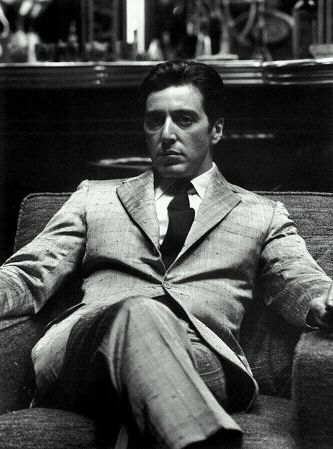
A couple of weeks ago I wrote about The Godfather after having gone to watch it in a new print; two nights ago I saw, at the same cinema, Part II, a film that I had always imagined to be better than the first. Now however I think that there is little qualitative difference between the two: both are very good. Part II is Pacino's film, as his ruthlessness mounts until he becomes a Cosimo Medici-type monster that is far from his apparent principledness of the beginning of the saga. He becomes an even better 'businessman' than his father, simply because he has managed to immerse himself in the crime culture much better, imposing his might as the only rationale and the only argument. The scene in which Diane Keaton's Kay tells him that her miscarriage was an abortion and that she is leaving him is harrowing as much for the implied slight to Corleone and the family as it is for the violence. Family members and old associates are all disposed of as the web of deceit is unravelled. The film has a broader visual palette than the first one, moving from vivid colour in the Sicilian scenes, to brown, almost sepia in the early New York days, to the icy, high-contrast chiaroscuro of the final hour in the snow-bound lakehouse in Nevada. There is a similar escalation of tone and contrast in the first film, but here the effect is more intense, without ever losing control. It is strange how Gordon Willis, who lit both films, and later some of Woody Allen's best work, has for the past twenty years worked as a journeyman technician on largely uninteresting films. His work on both of these films is breathtaking.
The most remarkable quality of the two Godfather films is the way that they appear so mature, so endowed with seriousness of intent, compared to films these days. It is hard to imagine a film with such a persuasive attention to detail and with such an intelligent script and mise en scène coming out of Hollywood today. It is the cinematic equivalent of joined writing, while today's Hollywood produces pretentious, overblown 'quality' films that are littered with ostentatious cultural references and improbable plot turns, a large printed scrawl in comparison to the early cinema of Coppola, Cimino, Scorsese and Malick. I have yet to see Part III as the general consensus is that it tarnishes the earlier films by its association. But I think I might give it a go, out of curiosity if nothing else.
John Berger on Gunther Grass
More on Gunther Grass; a fine defence of him from fellow writer John Berger. I think Berger soft-pedals the question of Grass' possible hypocrisy on concealing his past in the Waffen SS but overall his argument is sound. Modern morality does indeed exist in a vacuum.
John Howard's Lucky Day
A story from the Beeb about the unusually generous attitude of the John Howard government towards ten Sierra Leone athletes who applied for asylum at the Commonwealth Games in Melbourne in March. I do not know what the ranking of Sierra Leone currently is on the list of 'at-risk' countries that is used by Western countries in determining such applications but the swiftness and the willingness of the Canberra powers-that-be to process these ten cases is at odds with their generally unwelcoming attitude towards non-white immigrants. The Sierra Leone government alleges that Australia is acting merely to poach world class athletes, which, at the risk of sounding too crass, is not that far-fetched. The Aussies do like their sport.
Follow Me Up To KKKarlow
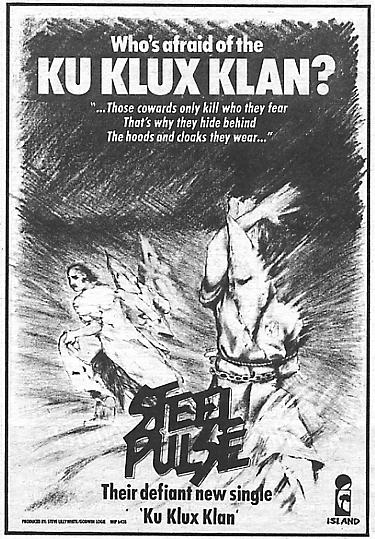
Earlier on today I came across a strange article in the print affair of the Sunday Independant (it's an Irish paper, unfortunately), which claimed that Ku-Klux Klan behaviour in Carlow has enjoyed a particular (re)crudescence in the past month. (Thanks to the legendary Steel Pulse for the picture there). Local 'sources' (i.e. friends of the hacks on duty) have said that locals are terrified by a number of nocturnal raids in the area by people dressed in the famous white hoods, which might suggest that the Klan has sold out like any other radical organization in beginning to terrorize its natural constituency. The Sindo, of course, is the source of news stories as reliable as those that used to tell us every six months back in the late 80s that Richard Dean Anderson (aka McGyver) was dead . And, who knows, perhaps those tall tales originated in no place other than Middle Abbey Street. I have tried to furnish you with a hyperlink to this story but Unison's own search (under standard Boolean principles) reported 1,010 links for 'Carlow+Ku Klux Klan'; it's impossible! I have always felt a certain respect for Ireland's least-known county, but maybe they have a bit of explaining to do, even if local Gardaí have said that it is probably more youthful pranksters than 'genuine' racists at play here.
Another non-story in the Sindo was the tale of a Dublin Fianna Fáil councillor being photographed snorting cocaine (well, Sir AJF O'Reilly is probably a bit too Cavan at heart to pay for pictures of Kate-fucking-Moss, so what do you expect?). Cllr Liam Kelly has claimed that the picture was fabricated, but already head padrino Bertie Ahern doubts him, claiming that Cllr Kelly's claims to be victim of an extortion racket to be 'peculiar'. Very good, Bertie. I don't know what Cllr Kelly would be so afraid of though, surely every mother and father in the Fianna Fáil heartland of Castleknock would know that their under-educated (at an expense) children are already doing it like the hammers of hell. No better a representative for the next generation, I should say.
Saturday, August 19, 2006
Ireland's Quality Daily
The Irish Times, the self-styled 'Ireland's quality daily' has been flying off my radar for a long time, mainly because I don't bother going near it online, as their pompously named Internet service ireland.com, charges €79 per year to use it. Not a huge amount I suppose but €79 more than many better newspapers charge for access to their online editions.
A friend currently visiting from Ireland, who has similar reservations about the 'Old Lady of d'Olier Street, has recently sparked me out of my slumber with news of its considerable rightward turn since the appointment of Geraldine Kennedy, former PD TD (it sounds suitably clinical that double acronym) as editor. Admittedly that is a few years back now, but he did report of hearing a source close to Kennedy recently boast of dispatching legendary do-gooding lefty Fintan O'Toole to a position abroad where his political views might be less troublesome. The Times, it appears, is learning to stop worrying and love the Iraq war. Other lefties have been claiming to feel the pinch too.
To balance all this, the middle-brow reactionary Kevin Myers, a man who has been earning good money off bizarre right-wing blogging since long before blogs existed, has moved to the Irish Independent, where his rants have got lost in the general anonymity of the mediocre Indo, surely the only large circulation daily in the Western world whose regular readers can hardly name one of the journalists they read every day. This has not deterred the Times from pathetically aping both the Indo's layout and typeface three years ago in an effort to stem their falling sales rate. The introduction of that €79 figure dates from the same time. The Times is still in serious debt following years of mismanagement.
Given that the pinko (though it was always a very pale hue of pink) version of the paper was always irritating enough for me in the past, with its uptight, schoolmasterly authorial voice, its idolatry of Bertie Ahern (always at least one promotional photo per week), its many shoddy writers, including one of the world's worst film critics, Michael Dwyer, who systematically whinges about the arthouse films at Cannes every year, its legions of syndicated articles that have already appeared the previous week in a British newspaper half the cover price, the putative new direction does not disturb me too much. At least my lookalike fellow-Connachtman mad John Waters is still there to liven things up (and be right 20% of the time, which is not a bad average for a Times opinion writer). But is there not something wrong with the world when one would sooner read the unspeakable Sunday Independant than 'Ireland's quality daily'? At least the Sindo has Gene Kerrigan, Declan Lynch and the rising star of GAA reporting Eamonn Sweeney.
A friend currently visiting from Ireland, who has similar reservations about the 'Old Lady of d'Olier Street, has recently sparked me out of my slumber with news of its considerable rightward turn since the appointment of Geraldine Kennedy, former PD TD (it sounds suitably clinical that double acronym) as editor. Admittedly that is a few years back now, but he did report of hearing a source close to Kennedy recently boast of dispatching legendary do-gooding lefty Fintan O'Toole to a position abroad where his political views might be less troublesome. The Times, it appears, is learning to stop worrying and love the Iraq war. Other lefties have been claiming to feel the pinch too.
To balance all this, the middle-brow reactionary Kevin Myers, a man who has been earning good money off bizarre right-wing blogging since long before blogs existed, has moved to the Irish Independent, where his rants have got lost in the general anonymity of the mediocre Indo, surely the only large circulation daily in the Western world whose regular readers can hardly name one of the journalists they read every day. This has not deterred the Times from pathetically aping both the Indo's layout and typeface three years ago in an effort to stem their falling sales rate. The introduction of that €79 figure dates from the same time. The Times is still in serious debt following years of mismanagement.
Given that the pinko (though it was always a very pale hue of pink) version of the paper was always irritating enough for me in the past, with its uptight, schoolmasterly authorial voice, its idolatry of Bertie Ahern (always at least one promotional photo per week), its many shoddy writers, including one of the world's worst film critics, Michael Dwyer, who systematically whinges about the arthouse films at Cannes every year, its legions of syndicated articles that have already appeared the previous week in a British newspaper half the cover price, the putative new direction does not disturb me too much. At least my lookalike fellow-Connachtman mad John Waters is still there to liven things up (and be right 20% of the time, which is not a bad average for a Times opinion writer). But is there not something wrong with the world when one would sooner read the unspeakable Sunday Independant than 'Ireland's quality daily'? At least the Sindo has Gene Kerrigan, Declan Lynch and the rising star of GAA reporting Eamonn Sweeney.
The Pain of Checking One's Bank Balance
Many people have a grave fear of checking their bank balance, and I am no different. And so, for the past four days since I have returned from my trip I have put it off. Although to be honest it was a sensible thing to do as all the transactions have thus been accounted for. It turned out to be even worse than I suspected but at the same time I feel relief, because the abstract fear was greater than the material reality of being overdrawn. Belt-tightening is on the agenda for the next six weeks and also a serious effort to find a new job. We have nothing to fear but fear itself.
Thursday, August 17, 2006
The Holy Seat

Just as some gay men and women know from an early age that they are homosexual so I knew quite young, despite my Catholic upbringing that I was an atheist, or at least inhabiting that ante-room to atheism, agnosticism. (I know that my Dad is going to scroll down through that last sentence way too quickly and cheerily announce to everyone that I have outed myself on the Internet, but alas the Lord is going to have to damn me on lack of faith rather than anything proscribed in Leviticus). That said I am drawn to churches and other places of worship, probably because of their calm and grace and also because, from long before Christ to the present day, temples, mosques and churches have usually been able to guarantee a high standard of architecture. I have many favourites, such as the Romanesque churches of Cologne; a more recent post-war Church of Sankt Jakob in the same city; Sigurd Lewerentz's wonderful Markuskyrkan (pictured) in the suburbs of Stockholm; Chartres Cathedral (one of the most stunning works of art I have ever seen); two beautiful parish churches in Donegal from the 1960s, at Burt and Creeslough and churches I have more recently seen such as the Cathedral of San Giusto in Trieste and the Franciscan Church on Presernov Trg in Ljubljana.
One thing I noticed in Italy however is the religious' real annoyance at their sites of worship being visited for nothing but their artistic merit, or more often simply because of their banal fame. Italian churches famously ban women in halter tops and men in shorts from their premises and in the Church of Santa Maria Maggiore, beside Santa Lucia Station in Venice, one sandwich board posted beside the front door scolded potential visitors in five languages, reminding them that churches are not art galleries or museums. Fair enough, but there are churches that have no problem in charging admission fees to defray parochial and maintenance costs. The Churches have always had a mercantile side to them but they usually prefered gather money from the faithful rather than from uninterested outsiders. The churches' real problem was crystallised in something I saw in Santa Maria Maggiore. I noticed the door to an old oaken confessional ajar and inside I saw, instead of a old wooden bench for the priest to sit on, a standard revolving office chair. It is hard to remain nonchalantly in the sacral domain when quotidian furniture design is itself irreducibly profane.
Gunther Grass' Nazi Past
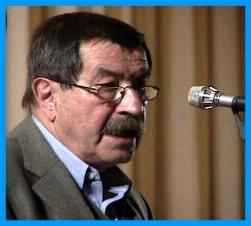
The big news story of the moment is Gunther Grass' admission that he was a member of the Waffen SS during the Second World War. Grass, one of my own favourite writers and certainly the most esteemed German writer of the late twentieth century, has confessed in a forthcoming memoir that he was a member of the Nazi Secret Service military wing and not a Wehrmacht conscript as he had previously claimed. Naturally people, particularly members of the Christian Democrats, whom he mercilessly pilloried for years over their incorporation of ex-Nazis into their party, are on the offensive, and with reason: Grass' principled stands and accusations in the past now appear hypocritical and self-serving to say the least. Those that claim he should return the Nobel Prize for Literature that he won in 1999 do have a point (though I am not sure if Knut Hamsun, the 1912 laureate and later Nazi supporter was urged to do the same thing before his death in 1950). Grass' reputation is certainly tarnished and he would have been better advised to have come out with this a lot earlier in his life. But at the same time I do not find the revelation terribly surprising, and though Grass was certainly wrong in his choice of career, no matter how young he was, there is no proof that he was an enthusiastic Nazi, nor that he committed any atrocities. If his literary and political career since then has been motivated by expiation, then I think it has been successful, though an earlier disclosure would have been more honourable.
There is a tendency among us these days to view former Nazi associations as the ultimate in evil. This is not entirely objectionable but if one persists in this idea, it is far too easy to caricature the Nazis as abominable villains, which in turn obscures a true understanding of how they rose to power. In Spike Lee's film of this year Inside Man, the central plot motive is exposition of the Nazi past of a prominent New York banker, a device that was so banal as well as predictable that the film lost steam well before its midway point. When people as varied as the current Pope and Gunther Grass reveal their past in Nazi organisations, and others such as Ingmar Bergman and IKEA founder Ingmar Kamprad reveal their past support for the Nazis, it is instructive for us to question what it is that makes ordinary people, of certain decent values do such things. I myself had a great-uncle, whom I never met, who flirted, at a great distance with Nazism in the 1930s, going so far as to have received official party literature. He was motivated more by Anglophobia and muddled thinking than by genuine conviction but it is not something that I am proud of. It is best that Gunther Grass disclosed this information now rather than after his death, when his reputation would have been irremiadebly marred. He should have done all this a long time ago, but in my opinion neither his work nor his analysis of the German Twentieth Century is devalued by this news. Don't be put off reading Gunther Grass because of dubious decisions he took in his youth.
0-4
Distressing stuff from Lansdowne Road last night, where Ireland went down to their heaviest defeat in twenty-one years, 4-0 against Holland, a team we are usually quite comfortable playing. The last defeat this bad was against the great Danish team of Elkjaer, Michael Laudrup, Morten Olsen and Sivebaek in 1985. I did not get to see any of the action last night but I believe that it could have been even more, but there is a strong case for seeing this as an abberrant result. Ireland were severely depleted, missing practically all their key players, including Shay Given, who possibly might have reduced the score by two or three. It does however highlight two worrying problems, one being a general lack of organisation in the Staunton set-up, and secondly the fact that Ireland are only five or six injuries away from being a very weak side. But then again one can say the same thing about England, who beat the European Champions Greece (yes they're still the European Champions) 4-0 in Steve McLaren's first game in charge. Not a bad start and this should provide the Brits with nourishment for their regular biannual delusion, the fact that they are going to win a major tournament. Betting website, bet365 has already got the ball rolling, naming England, naturally, as favourites for Euro 2008. The World Cup is already a distant memory.
As for Ireland, I still think that with a strengthened side, a draw in Germany is not impossible, but our backs will be to the wall for most of that game.
As for Ireland, I still think that with a strengthened side, a draw in Germany is not impossible, but our backs will be to the wall for most of that game.
Wednesday, August 16, 2006
Star Trac

Vikash Dhorasoo, one of the more enigmatic members of the French World Cup sqaud, announced last week that he was not going to play for les Bleus anymore, while pointing out that he was not going to actually announce his retirement, as "that would be pretentious, I'm not an important enough player to say that sort of thing." Admirably modest. But more interesting is the news that he plans to make a behind-the-scenes documentary using footage he shot during the World Cup. Batty, astrology-obsessed manager Raymond Domenech has indicated that he wants to be cut from the film, which will be unlikely to happen I think. Domenech has long been seen in France as being overly fond of Dhorasoo, having coached him since the player was a schoolboy. But will their relationship survive the film, which Dhorasoo hopes will get a cinema release?
Condi Clare
My contacts in the troublesome Anti-War campaign in Ireland tell me that Condoleeza Rice made an unpublicised stopover in Shannon this morning. Was it on a rendition flight I wonder?
Difficult From Here
As I remarked in the last post, Trieste's second train station, the Campo San Marzio, has been closed for a long time so there is now no direct connection to nearby Ljubljana, save for a nightly train to Budapest that goes via Zagreb, quite a detour. I asked a the man at the enquiries desk at Centrale station if there were any other connections, and he said that in good English, that "it is difficult from here." He told me to take a train to Monfalcone but gave me the impression that there was only one per day, thereby necessitating another afternoon in Trieste.
I decided to get a second opinion at the ticket office, and while waiting for a French-speaking teller to come free, another teller, speaking nothing but Italian succeeded in getting me to buy a ticket for the Slovenian capital via Monfalcone the following morning, as I required. Sometimes not speaking a language at all is more useful than speaking half a language.
I decided to get a second opinion at the ticket office, and while waiting for a French-speaking teller to come free, another teller, speaking nothing but Italian succeeded in getting me to buy a ticket for the Slovenian capital via Monfalcone the following morning, as I required. Sometimes not speaking a language at all is more useful than speaking half a language.
A Quiet City
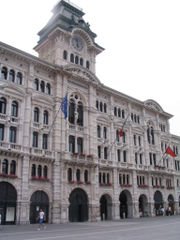
Trieste is a city that willingly chose the quiet life. A vibrant port, the main sea-portal of the Austro-Hungarian Empire until it joined the Kingdom of Italy in 1919, today it is a sleepy, if pleasant city that is not quite dead, but certainly has none of the bustle that it would have had when James Joyce lived there a century ago. In the hands of the Austrians since the fifteenth century, the city remained culturally Italian (though it is also on the border with Slovenia and there is a significant Slovene-speaking minority living in the city's hinterland) and the city's wealthy merchants, made rich by trade with the Hapsburg Empire, were for the most part irredendist, and upon the collapse of that Empire after the First World War, Trieste and the peninsula of Istria to the south rejoined Italy. (It is strange how the word 'irredentist' is not as common in usage in Ireland as it is in Italy, considering how appropriate it is to the Irish situation.) Istria later reverted to Yugoslavia after the next war and now forms part of both Slovenia and Croatia, but Trieste is still Italian.
As the train swung south from Monfalcone, the most familiar Triestine characteristic, the rain, made an appearance and did not stop for another 24 hours. The city is not too eager to attract tourists; there is no tourist office and the only map I could find was so old that Slovenia was referred to as Yugoslavia. It also included the disused Campo San Marzio railway station, detailing its connections to Klagenfurt and Ljubljana. When I finally found the hotel I was staying in, right beside the first of Joyce's many addresses in the city, I found that it was practically empty.
Trieste has a dramatic setting, the hills of the Karst rising to the north and the east and the city itself is quite hilly, with the old Venetian-build castle and the charming Romanesque Cathedral of San Giusto sitting on a height that towers over the seafront streets below. The harbour is practically unused these days, Italy had less urgent use for a new port than the inland Austrians did, a few fishing trawlers and some pleasure boats being the only vessels to be seen. Only in the marina to the south of the Old Port was there a sign of any activity. But the city, apart from the derelict dockyard buildings, does not look like it is suffering too badly. The city has a range of impressive Belle Époque architecture bequeathed it by the Austrians - stout, ornate Central European buildings, and the main square, Piazza de la Unità d'Italia, with the City Hall and a number of old merchant's mansions is beautiful. There is a lot of interesting Fascist-era modern architecture too; it is as if Mussolini was spoiling the lost child that had just returned to the family.
Joyce left Trieste when war broke out in 1914, even though Italy did not enter it until the following year, and when he returned in 1919 he found that the old glory of the city had vanished and he went off again to Paris. He is the writer most closely associated with the city, though the locals, apart from one statue and a small museum in the Municipal Library do not seem too bothered by the connection. Much more revered are the Triestine writers, such as Italo Svevo, who was taught English by the young Joyce and eventually championed in France by the Dubliner, and even more so the poet Umberto Bava. I had a bit of bad luck with the city as many of the museums were closed for the month of August, as was the famous Caffè San Marco, which was frequented by both Joyce and Svevo, and which gets a chapter to itself in the Triestine writer Claudio Magris' superb Microcosms. So instead I took a look at the city's synagogue, built in 1914 and which survived the Nazi occupation. It is reputedly one of the biggest in Europe and I would well believe it, it is a huge edifice, modelled on ancient Syrian temples, that dominates the small street on which it is located. The closest thing I have seen like it is the Portuguese Synagogue in Amsterdam, though this is a neater, more clinical work, though every bit as impressive.
The best museum I saw on my trip was a small one housed in the city's enormous Post Office. It was the Postal Museum of Mitteleuropa, and was a fascinating documentation of the history of Post in the Austro-Hungarian Empire. Even better than the permanent collection, which includes postmen's uniforms from the 19th century and old telegraph machines, was the collection of stamps and first-day issues from around the world that told the story, comic-strip style of the Friulian earthquake of 1976. Also included are postcards to and from the stricken region shortly after the quake, all of them stamped with the haunting 'Zona Torrematta'.
The beer is better in Trieste than elsewhere in Italy because of the historical connections with Central Europe, but the problem is trying to get a place that stays open after 10pm. As I said, they like the quiet life here. Two days was enough. I can't imagine I will be going back, but a pleasant city, one that has stepped into the slow lane of History.
Tuesday, August 15, 2006
Difficult Second Album
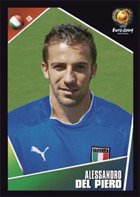
While in a bookshop in Trieste last week my attention was caught by a peculiar book, a compilation of Panini World Cup sticker albums from 1970 to 2002. Most male European adults of my generation (and more) will have spent their childhood years desperately trying to fill at least one of these things (the North American equivalent, and no doubt, the original model, is the baseball card). I managed to complete a couple of the Football League (as it was known back then) albums and also the World Cup ones of 1986 and 1990, though to be honest, at the age of 14 in 1990, I already knew I was a bit old for it, and I kept the operation secret. All the more impressive that I finished the thing without having a single person of my own age to swop doubles with.
Though I am as prone as anyone else to making purchases that I afterwards find hard to justify, I did not buy this one, a bit pricey at €18. But I did spend quite a while flicking through it, triggering off memories from my formative years. The sticker albums are presented with the stickers as mere pictures, which I could not help thinking as a form of cheating, having put so much effort and expense into filling those albums years back. Some posterior amendments have been made such as naming the birthplace of a Soviet player from the '82 World Cup as St. Petersburg - it was still Leningrad at the time - and Andreas Escobar has been removed from the Colombian team of USA 94, presumably out of respect for the fact that he was murdered by gangsters a week after his team's exit. It was strange to see that of the old Soviet teams, so few were Russian, the bulk of the teams were Ukrainian, Georgian or Belorussian. It was also poignant to see the Yugoslav teams of the 1980s, where the Bosnian Muslims Haris Skoro and Faruk Hadzibegic lined up beside the Bosnian Serb Vujovic twins, shortly before their respective nations would be at one anothers' throats. I also noticed something that I am surprised I failed to see at the time, that Argentina included in its squad for USA 94 one Carlos Javier MacAllister, and he had a similar face (and widow's peak) to his old country namesake Gary.
This Boy's Still Green
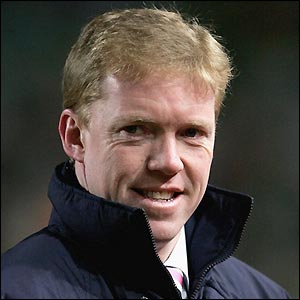
Seanachie's heart is beating a bit faster than usual this morning, as tomorrow sees the return of the Irish football team to action (why, instead of the insipid 'Boys in Green' can we not call them 'an foireann', something cool, like the Italian Squadra, the German Mannschaft, the Portuguese Seleçao, even the damn Swiss have one: the Nati). It is a friendly game at home against the Dutch, preparation for the Euro qualifying opener against Germany in 2 weeks time. I can't say that I was terribly enthusiastic upon hearing of Steve Staunton's appointment a few months back; the last thing the Irish team needs is another residuum of the Charlton era. But now that he's there, we may as well put up with it. The win against Sweden in March was convincing but then we surrendered meekly to Chile in May; little should be read into either result. Ireland have ahead of them a tough but not impossible qualification group, facing the formidable-but-predictable Germans, the Czechs, who are on the slide, the rising stars of Slovakia and the tricky Welsh. With two to advance from that group, we should be aiming to qualify. Let's hope that Staunton tackles the task honestly without resorting to the excuses that marred the end of the Brian Kerr era; Bobby Robson's stroke has deprived Staunton of his mentor (however little he likes Robson to be called that) and the latest news reports say that, in a thoroughly bizarre incident, a man has been arrested for threatening Staunton outside the team hotel in Portmarnock with an imitation Uzi. It is like an incident out of an obscure Central European novel, or something. The BBC report says that Staunton is 'unharmed' after the incident. I should hope so.
Saturday, August 12, 2006
Breaking the Law
Ljubljana is an admirable little city, of which I will speak more in later posts. I did have my first brush with the local law last night when I absent-mindedly jaywalked an empty thoroughfare, only to see two patrolling officers in front of me. I feared the worst, which was really only a fine, I know enough about Slovenia to know that it is not ridden with institutional corruption, like Russia or Belarus. They took a high hand though, asking me in roughly-Slavic English, if I knew what a pedestrian crossing was, and then if I knew what the penalty for not using one was? Ten thousand tolars they said, alternating the above comments like the Knights that Say 'Ni' in Monty Python. The fine in reality is not so fearsome, €40.60 to be precise, and the good officers let me off, telling me that I should carry an original of my passport, which was held as security in my hotel, though they did compliment me on my foresight to carry a photocopy. Slovenia is more like Austria or Switzerland than the Balkans, or Sweden even, as a young Swedish couple I met today approvingly remarked. I'm on my last chance now though and I am standing stock still with all those Slovenians until I see that little green man...
In Absentia
Sporadic posts because of logistical problems. In Italy of late one is required to hand in one's passport when one uses an Internet cafe and the proprietor is then required to periodically hand in log on records to the police. In the name of fighting terrorism of course. A lot of other countries manage to get by well enough without that measure, and the foiled bomb attack at Heathrow the other day notwithstanding, I think that former Premier Silvio Berlusconi's fondness for censorship might be more relevant to this law. Italy last year slipped to 53 in the world league table for press freedom. Keeping tabs on troublesome journalists that log on in cyber cafes might be a temptation too much.
Well at least Silvio is gone and a sensible Venetian proprietor facilitated me even though I did have ID on me at the time, hence the last post. Since then I have not been on because of not being able to find access inTrieste (a strange town indeed, and I mean that in a good way), while here in Ljubljana, where I am now, most commercial enterprises close at 1pm on a Saturday. Added to that I have to labour with both a Slavic keyboard (it is however more logical than a French one) and Internet Explorer (when will people ever learn). Back in Paris on Monday. Will post more then.
Well at least Silvio is gone and a sensible Venetian proprietor facilitated me even though I did have ID on me at the time, hence the last post. Since then I have not been on because of not being able to find access inTrieste (a strange town indeed, and I mean that in a good way), while here in Ljubljana, where I am now, most commercial enterprises close at 1pm on a Saturday. Added to that I have to labour with both a Slavic keyboard (it is however more logical than a French one) and Internet Explorer (when will people ever learn). Back in Paris on Monday. Will post more then.
Wednesday, August 09, 2006
High Campanile
Venice was the unwanted child on this trip; I only spent a day here due to the fact that a flight to Treviso was the cheapest way of getting to Trieste and Ljubljana. Not that I don't find the city charming, but in August, overrun as it by tourists it is not near as pleasant as it might otherwise be. I want to save it for another time, like not wanting to know the score before watching the edited highlights of a football game. It will probably be a windy November afternoon when I will be up to my ankles in floodwater from the swollen canals (St. Mark's Square is invaded by water a staggering 250 days per year). But in some way I would find that more enjoyable than standing in the interminable queues for St. Mark's Basilica and the Doge's Palace. The latter being the only thing I wanted to see, because of its marked influence on Ragnar Östberg's Stockholm City Hall, I was a bit dismayed. The queue for the Campanile was much shorter and so I took the lift up. Once up there the meridonal aspect of the city explodes in a mass of terracotta roofs and countless other campaniles that make you really feel that you have been conned into paying 6 euros just to get to the top of this one, until you realise then that the campanile, which has always had architectural cachet in English, means merely 'belltower' in Italian. More fool we.
On the ground I took a more unorthodox approach to exploring the city, by just getting lost. Except that you never really get lost in Venice. There is no point in using a map for anything more than the most basic of landmarks; the streetnames are only to be used as a last resort and in fact do not figure in postal addresses at all, each of the siesti or districts function in that way with the houses individually numbered in a fashion that is indiscernible to the untrained eye. But even so, you are never too far from emerging in a place that you will recognise (for all its labyrithine character the city is very small). And just as one is said to be never more than ten feet away from a rat in London, so you are never more than a street away from a tourist in Venice, no matter how isolated you think the street you are wandering on is. On some of the less glamorous squares in San Polo, where the price of everything suddenly plummets, could be seen people, mainly foreigners sketching. The squares look like a quietly morose di Chirico tableau, with the shadow cast by a crumbling building drawing the campo into its stern geometry. The town is messy, like much of the rest of Italy but it is never ugly. It wears the urban nuisances of fly-posting and grafitti well; they suit it even.
But the expense of Venice is the most frustrating, if hardly surprising thing. Though it is no more costly than most Western European capitals, the fact remains that it is a small provincial city, albeit a unique one. It is hard to filter out the rubbish from the genuine, particularly foodwise (OK, I could have bought a guidebook but I didn't really feel the need for one day, least of all spoiling my unwanted child like that) and the food in the main was mediocre. Passing by one trattoria I saw the blackboard advertising the day's fish special, in English: 'Today. Flounder, Venetian style.' Quite. Hit and miss I suppose, but the Venetians built their city on commerce and, even if the trade these days is less vaunted and less exotic than in the past, they are unlikely to change soon. And why, you can ask yourself, would they? It's not a bad pay-off for having your town overrun by strangers for most the year.
On the ground I took a more unorthodox approach to exploring the city, by just getting lost. Except that you never really get lost in Venice. There is no point in using a map for anything more than the most basic of landmarks; the streetnames are only to be used as a last resort and in fact do not figure in postal addresses at all, each of the siesti or districts function in that way with the houses individually numbered in a fashion that is indiscernible to the untrained eye. But even so, you are never too far from emerging in a place that you will recognise (for all its labyrithine character the city is very small). And just as one is said to be never more than ten feet away from a rat in London, so you are never more than a street away from a tourist in Venice, no matter how isolated you think the street you are wandering on is. On some of the less glamorous squares in San Polo, where the price of everything suddenly plummets, could be seen people, mainly foreigners sketching. The squares look like a quietly morose di Chirico tableau, with the shadow cast by a crumbling building drawing the campo into its stern geometry. The town is messy, like much of the rest of Italy but it is never ugly. It wears the urban nuisances of fly-posting and grafitti well; they suit it even.
But the expense of Venice is the most frustrating, if hardly surprising thing. Though it is no more costly than most Western European capitals, the fact remains that it is a small provincial city, albeit a unique one. It is hard to filter out the rubbish from the genuine, particularly foodwise (OK, I could have bought a guidebook but I didn't really feel the need for one day, least of all spoiling my unwanted child like that) and the food in the main was mediocre. Passing by one trattoria I saw the blackboard advertising the day's fish special, in English: 'Today. Flounder, Venetian style.' Quite. Hit and miss I suppose, but the Venetians built their city on commerce and, even if the trade these days is less vaunted and less exotic than in the past, they are unlikely to change soon. And why, you can ask yourself, would they? It's not a bad pay-off for having your town overrun by strangers for most the year.
Monday, August 07, 2006
Jocks Strapped

The Scottish Premier League - the original "Premier" league, established twelve years before the Premiership - is into its second week and the surprise leaders are St. Mirren, little of whom has been seen at this level since the late eighties, when Fun Boy Frank McAvennie and current assistant to José Mourinho, Steve Clarke were helping them win the Scottish Cup. The Paisley club are a prime example of the wonderful names that dot this sadly-retrograded championship: some of them conceived as clubs: Hamilton Academical, Queen of the South (possibly the only football club to draw their name from the Bible), Airdrieonians (now known as the boring old Airdrie United), St. Johnstone, others named after famous cultural references: Heart of Midlothian and others simply benefiting from the richness of Lowland Scots placenames: Cowdenbeath, Stenhousemuir.
My own team Celtic are of course the big yins these days though they did suffer a second-day reverse yesterday away to last years' runners-up Hearts. The Jambos are making a fair effort at re-introducing a third horse into the race. Gone are the days of the 1980s when the 'New Firm' of Aberdeen and Dundee United won the league as often as the Glasgow giants, and the Dons, managed by Alex Ferguson, beat Real Madrid in the Cup-Winners' Cup final. United also reached the 1987 UEFA Cup final and were robbed of a rightful Champions' Cup final place in 1984 by some appalling refereeing decisions that allowed Roma to overturn a 2-0 first-leg deficit. It has since been proven that the referee was bribed. Nowadays the Pittodrie club struggle to make any impression on the Premier League and were even knocked out of Europe by Bohemians a couple of years back, as for Dundee United and their famous tangerine shirts, simply remaining the number one club on Tayside is tough enough.
The Bosman ruling put paid to clubs from countries like Scotland (and Sweden, whose IFK beat Dundee United in 1987) ever having the same prospects again. The bigger European clubs are too strong and their perpetual success, and the relative smallness of Scotland, means that they generate far more money. A few years ago Celtic were knocked out of the Champions' League by Lyon and the French champions pocketed five times as much in TV rights money as Celtic would have had they progressed. Because the French market is that much bigger. Celtic and Rangers have for a number of years been trying to enter the English championship, logically as they would face tougher opposition on a weekly basis, thereby increasing their chances at European level, which is really the only important thing once the basics of winning in Scotland are taken care of. They have been obstructed by smaller Premiership clubs, for good reason: they would not only be taking two certain top-flight places but also biting into the pooled finances, a share of which is far in excess of what either club currently make in a year. English people I know sneer at the Scottish Premier League but Celtic dispatched Blackburn and Liverpool comfortably enough on their way to the UEFA Cup final three years ago. Celtic would be regular top-six finishers in the Premiership, on their current form alone. If they were to have the financial resources currently denied them, they would win quite a few titles. They are, with the exception of Man U, the biggest and best-supported club in Britain.
The sad thing though is that such a move would have a catastrophic effect on Scottish football. But at this point there is little that can be done about that.
Subscribe to:
Posts (Atom)

 Posts
Posts


