I am mostly agnostic on Quentin Tarantino these days and I didn't expect to much like Inglourious Basterds but I was shocked to discover on watching it on Sunday night that it was actually very good, in a way that any plot synopsis would hardly suggest. It may be effect of a bottle or so of wine consumed before watching it, so maybe I should watch it again before repeating the word 'masterpiece' which I bandied about a bit in the fuzzy aftermath of watching it. Anglophone media have been largely negative in their assessment of the film while in France the critical reception has been almost unanimously enthusiastic. The French are sometimes right in their praising of some American cinéma maudit (such as Heaven's Gate) and also sometimes very wrong (the entire career of Brian de Palma). In this case, I think they might be right, as a lot of the references in this most multilingual of Hollywood films would go over the heads of some Anglophones. A rich irony, and one you don't really expect from QT. Here's the trailer for the film, though you'd never imagine from watching it that the thing could be any good. More on this matter later (after I've watched the film again).
AquariumDrinker asks if cassette tapes were the perfect music technology. Not a fashionable opinion by any means and, despite having a pretty hefty collection of cassettes gathering dust in an attic back in Sligo, each one of them was a poor substitute for a vinyl copy, which back home in the late 80s and early 90s, weren't always available. But I do agree with him that cassettes were an underrated technology and the charm of the blank tape/compilation is undeniable. And he also has a pertinent point about the development of CDs being a technological dead end.
Let’s face it, CDs are a regressive technology. They have all the problems of a record — they scratch, break, and warp in the heat — with none of the advantages of holding a big piece of LP art in your hands and experiencing the music in the way the artist intended. What’s more, before the advent of iTunes and read/write discs, CDs were a locked and essentially inflexible technology.
My guess is that this combination of factors — fragility and the inability to copy and mix — probably made early CD technology the holy grail for the big record companies. In short, we were duped by the record companies into spending millions (billions?) of dollars on what was essentially a flawed technology that would be rapidly replaced by digital downloads.
I agree especially with the latter point; the record industry never liked the flexibility and recordability of cassettes and emblazoned early cassettes with the legend 'Home Taping is Killing Music' (as seen in the picture above). It never did though and filesharing will not kill music either (though it may kill off some incompetent inefficient peddlers of it).
If I'm going to praise Jon Stewart, I should also proffer plaudits to The Nation's Jeremy Scahill, whose ongoing reporting investigates Blackwater and the CIA's collusion in the alleged murder and torture of Afghans and Iraqis. The other night on 'Real Time With Bill Maher', he took aim at fellow journos, such as fellow panelist Chuck Todd, for their lack of due diligence in reporting the affair. Todd had previously dismissed the matter as 'political catnip' and that reporting it more vigorously would turn it into 'a political foodfight' that would ultimately allow Blackwater off the hook. Todd's point might, in other circumstances appear commendably clear-headed and pragmatic but Scahill's reply trumps him, saying that 'the only way you prevent future torture is to prosecute past crimes.' The fact that Todd allegedly complained to him off-air about sullying his reputation on TV shows where his priorities lie.
After having a go at the US media yesterday, I have to salute one of the truly great American newsmen, who presents a show on the Comedy Channel. Yes, I'm talking about Jon Stewart. People have said that it's a poor reflection on the US media that one of the most probing mainstream journalists is ostensibly a comedian/entertainer when many of the supposedly more serious journalists churn out stuff that is, well, comical in its worth. But that is unfair to Stewart. For all his charm and inflected irony he is a proper, responsible journalist who doesn't make a song and dance about the fact. While it's true that Stewart has a team of researchers and writers that most journalists don't have, his sense of probity and his skill at calmly outlining an argument marks him out from the rest of the field. He was one of the few in the mainstream US media to question Israel's murderous pummelling of Gaza and last week he demolished 'death panel' guru Betsy McCaughey, who, for all her mendacity and hyperbole, is a formidable adversary. It's a long debate but worth a watch. The US needs more journalists like Stewart and more networks and media outlets willing to air dissent. And I have to lift my cap to Comedy Central for its sensible and generous policy of allowing others to embed its videos.
Well done to Ireland's athletes who performed well in the World Championships in Berlin, only one year after being tarred as failures at the Beijing Olympics by the media. A silver medal for Olive Loughnane in the 20km race walk, and superb performances in sprints by Derval O'Rourke (4th and a new Irish record in the 100m hurdles) and David Gillick (6th in the 400m). These performances are phenomenal from athletes that often labour alone with little official support and are forever dependent on the benevolence of sponsors willing to invest money in unfashionable non-stars. They deserve better than the pillorying they've been getting in recent years by armchair critics and deserve better than the outrageous snubbing delivered them by RTÉ in its decision not to cover the Championships.
Abdelbaset al-Megrahi walked free yesterday, having been freed on compassionate grounds by the Scottish executive. The US is outraged, as, understandably are many families of victims of the Lockerbie terrorist attack, and everyone, including Scottish First Minister Alex Salmond, questioned the taste of the hero's welcome afforded Megrahi in Tripoli. The Libyans have pointed out that the welcome was not an official one but that's hardly going to convince the critics. But what few people have mentioned is the fact that those that welcomed Megrahi were not necessarily gloating over the murder of 270 people but because they believe that Megrahi is innocent. And they're not the only ones.
There are accusations flying about, most notably that Megrahi's release was part of a deal the UK struck with Libya to further open the country up to British oil companies. And Seif al-Islam Gaddafi, who holidayed with deputy PM (and former EU trade commissioner) Peter Mandelson on Corfu last month, says that's exactly what happened. Whitehall firmly denies this, leaving us in the invidious position of deciding whether we should believe the son of Muammar Gadaffi or a New Labour government. There are those who rightly point out the shabby behaviour of the British government in all this, who have been able to maintain their good relations with Libya while letting the SNP-run Scottish executive take the flak. Then there are others who suspect that the compassionate release was timed to avoid uncomfortable truths emerging in Megrahi's second appeal.
I'm not sure if I completely agree with the matter of compassionate release in cases of such gravity, but, as victim's father Dr Jim Swire says, that's neither here nor there because, like him, I am convinced that Megrahi had nothing to do with the bomb that brought down Pan Am flight 103. His conviction rests on the flimsiest of circumstantial evidence and on the word of one man, the Maltese shopkeeper Tony Gauci, who claims to have sold Megrahi the clothing that was wrapped round the bomb. Gauci was interviewed by police 17 times and gave conflicting evidence on a number of occasions. It is also alleged he was offered a $2m rewardin return for giving evidence, and that he was coached by police, and wined and dined by them in advance of giving his testimony.
Megrahi's defence also argues that the forensic tests on the circuit board of the timer were incomplete, relying on visual evidence rather than on gaseous swabs. The credibility of the three forensic scientists employed by the prosecution is also in doubt, not least because of them Dr Thomas Hayes was involved in the framing of the Maguire Seven in 1976. The defence also says it has a secret document that disputes prosecution claims that Megrahi bought a digital timer from a Swiss company, Mebo and then planted the bomb on a flight from Malta to Germany. In 2007 the Scottish Criminal Cases Review Commission announced there was 'no reasonable basis' to place Megrahi in Malta at the time in question. It has admitted new evidence to allow a second appeal to go ahead, which Megrahi withdrew - needlessly - last week. Its 800-page report has never been published.
The US and British prosecutors originally targeted Mohammed Abu Talb, an associate of the Popular Front for the Liberation of Palestine, who was allegedly contracted by the Iranian government to blow up the plane in retaliation for the downing of Iran Air Flight 655 by the US navy cruiser Vincennes five months previously. But it seems realpolitik intervened during the 1991 Gulf War when the US declined to antagonise Tehran so as to be able to use its airspace during the attack on Saddam Hussein's Iraq. The focus then turned to Libya, none too implausibly, given Muammar Gaddafi's deep enmity towards the US and his previous sponsorship of terrorism, including the LaBella nightclub bombing in Berlin in 1986.
Gaddafi kept Magrahi and fellow suspect Lamin Khalifah Fahima under house arrest for several years until, after protracted negotiations with the US and the UK - and UN sanction - he handed them over to Scottish prosecutors in the Netherlands, where they stood trial, and Magrahi was convicted, in 2000. Since then Libya has gradually eased itself out of its pariah-state status, agreed to scrap its weapons of mass destruction, signed successions of trade deals with Western investors and become Italy's de facto immigration policeman in return for 'reparations' for Italy's colonial past in the country. The fact that Libya accepted responsibility for the bombing in 2003 is uncritically accepted as the cornerstone for the soundness of the case against them, as if the word of a dictator who brutally suppresses dissent at home and who sponsors terrorism abroad would ever be worth anything. The Gaddafi regime has done well out of its co-operation with the Lockerbie prosecution but it now seems to be having second-thoughts with Prime Minister Shukri Ghanem telling the BBC in 2004 that the admission was made - and $2.15billion dollars of compensation to victims' families paid - as the 'price for peace'. Abdelbaset al-Megrahi was the convenient patsy that took the fall for all this.
The case for Megrahi's innocence is not some obscure 9/11 'truther'-style conspiracy theory. UN observer Hans Köchler questioned the conduction of the trial, detecting political motives. Former Scottish Labour MP Tam Dalyell has long proclaimed Megrahi's evidence as have two British parents of victims, Dr Jim Swire and Martin Cadman, both of whom described Megrahi's trial as a farce. The Scottish Criminal Cases Review Commission saw sufficient irregularities in the trial to allow a second appeal while a retied Scottish police chief has testified that evidence was fabricated by the CIA. All of this points to a strong suspicion that the compassionate release was designed to sidestep uncomfortable disclosures in the appeal. The evidence to hand is almost overwhelmingly in favour of describing the conviction of Abdelbashet al-Megrahi as a miscarriage of justice of such a scale that it makes the framing of the Guildford Four, the Birmingham Six and the Maguire Seven seem minor indeed.
But all of the above either falls on deaf ears in the US or is never reported. Washington's protestations have been matched by victims' families, with Susan Cohen, who lost her daughter Theodora calling Megrahi's release a 'disgrace' and 'vile'. There has been further outcry from newspaper editorialists and from commenters on blogs. But references to questions over the soundness of the conviction are few and far between. One can forgive victims' families their bitterness - and Megrahi, while maintaining his innocence, has done that - and one can also forgive the average American their ignorance, considering the other side of the case is so poorly reported in the media over there. One might cynically point out that a substantial number of Americans still believe Saddam Hussein had a hand in September 11th and that there were weapons of mass destruction in Iraq in March 2003, but my intention is not facile Yank-bashing. The US media are however culpable of a shocking irresponsibility in their coverage of the affair from start to finish. One might expect nothing less from the likes of Fox News and the Wall Street Journal, whose stock in trade is lies and libel. But the behaviour of other media outlets, both old (The New York Times, Washington Post and the Chicago Tribune) and new (Huffington Post) has been exceptionally remiss with all the self-righteous editorialising completely ignoring the strong evidence there is for a miscarriage of justice. Instead Steve Chapman at the Chicago Tribune says 'Libyans celebrate mass murder', a pundit on CNN wonders if the Libyans who cheered Megrahi's return home were terrorists. The Philadelphia Inquirer says Megrahi showed no compassion to his victims. The paper of record says questions arise after Megrahi's release but, of course, these questions pertain only to a possible deal done between London and Tripoli. Megan McArdle at the Atlantic is similarly coy (or ignorant) about the dubiousness of the conviction, while her colleague Eric Tarloff breaktakingly says 'Assuming Megrahi received a fair trial -- and I have read nothing to indicate otherwise -- a life sentence seems the minimal appropriate punishment for a crime of such enormity.' If Tarloff has failed to read anything that casts doubt on whether Megrahi received a fair trial, you have to question his fitness to hold a press card. The Boston Globe similarly omits to mention the flimsiness of the evidence against Megrahi. Even left-wing media are reticent on the matter, with no mention even of Megrahi's release to be found in The Nation, Mother Jones or In These Times. Only the New York Times' Lede blog gives any airing to questions raised in the media the other side of the Atlantic while the Daily Kos wonders, tentatively if there might be something wrong with the conviction.
So why is the US media reporting the story - and opinionating on it - with an almost unanimous disregard for the facts and with moral cowardice, as if questioning Megrahi's guilt would in some ways be an insult to the victims and their families? Why is the US media so uncritical and supine in its acceptance of what is clearly a flawed judgement? Why is it abdicating its responsibility to investigate a story that is crying out for media attention? It proves that David Simon's fears of a compliant, unquestioning media that doesn't do its job properly is already with us. My suspicion is that the US media and those outraged by Megrahi's release are willfully deluding themselves, repressing unwelcome truths in order to facilitate a narrative, to bring 'closure' to the bereaved, who are, understandably never going to recover from what was a terrible loss. An article in the Chicago Tribune says that Megrahi's release 'erases some of the victims' closure'. Larry Wild, whose stepdaughter Miriam Woolf died in the bombing says 'we thought we had judicial closure'. It's natural that grieving relatives should feel this way but the fact that this 'closure' was provided by Megrahi's dubious conviction does not make it right. Some of the US families accept that Megrahi was probably not ultimately responsible but they are still happy to accept his conviction, for want of a bigger fish in the net. In this psychodrama, Megrahi functions, both literally and metaphorically, as a scapegoat, and his role as the villain of the piece has symbolic value even for those who suspect he might not actually be the right guy. And the US media feeds all this. The role of responsible news-reporting is not to provide comfort and succour, not even to those who, like the families who lost loved ones in the Lockerbie bombing; its role is to investigate and query when there are reasonable grounds for doubt. The case against Megrahi is thin, the evidence so circumstantial that it would probably fail to meet probable cause for prosecution in a US court.
Relatives of British victims have been much more objective and clear-eyed in their reaction to Megrahi's conviction. This is understandable, as unlike American families, they have more immediate access to the investigation and have been able to follow it more closely. The fact that it was a Scottish court that produced the miscarriage of justice also gives them an extra vested interest in seeing something more than summary justice done. But the intransigence of some American families, while understandable, is harmful. Jim Swire says he has been unable to have a meaningful conversation with the US families since the 2000 trial and he also says the families were groomed, prepped and isolated by US authorities throughout the trial. Martin Cadman said last week that American families convinced of Megrahi's guilt need to 'get real' - a harsh comment but Cadman, like Swire and Rev John Mosey, knows that the show trial has deepened rather than assuaged the pain and hurt caused by the attack. Swire has been said to be suffering from Stockholm Syndrome by Lord Fraser, the Lord Advocate who oversaw the Camp Zeist trial, an outrageous smear on someone who rightly questions the conviction, and who is supported by many top Scottish legal minds, including Robert Black, who first proposed holding the trial in the Netherlands.
Lost in the diplomatic outrage, the headlines and the motives of Libya - which, again, are not implausible - is a simple matter of legal rectitude. Libya may or may not have been responsible for the attack - its previous admissions of responsibility are not to be taken at face value - and Megrahi is probably no angel either, as few people working for the Libyan secret service (or any secret for that matter) are. The problem is one of due process and the irregularities are so glaring that Scotland's own legal review board has called the conviction into question. Convictions can only be secured on available evidence and testimony, which, in this case, are flimsy to threadbare. We mightn't like it (or like Gaddafi's squalid, brutal regime) but it is highly unlikely that Abdelbaset al-Megrahi planted the bomb on Pan Am Flight 103. That the US media is failing to report this side of the story is a dereliction of journalistic duty.
The open-air cinema at Parc de la Villette wound up for another year the other night. It went out on a fittingly high note, with Werner Herzog's Fitzcarraldo, the B-movie par excellence, a film whose garish wash of second-hand accents and cutprice larger-than-life figures ought to have made it the quintessential Europudding. But it's a surprisingly sophisticated parable on the folly of industrial filmmaking and the maddening need for compromise and tolerance in order to mount the damn thing. Herzog, like his contemporary and countryman Fassbinder had - and still has - an instinctive feel for welding themes to robust, physical drama. Lars Von Trier (along with, perhaps, Tsai Ming-Liang) is one of the few filmmakers like that left though Von Trier is a great deal more calculating than the humanist cynics Herzog or Fassbinder.
The film also reminded me of a passage in a recent lengthy review of Peter Ackroyd's Thames: Sacred River by Iain Sinclair (that pairing strikes me as akin to the Beatles reviewing the Stones).
The corpse-fishers of Our Mutual Friend were recast as heritage television, while planning regulations for the Isle of Dogs, that unlucky swamp, were shredded for the construction of a shelf of towers. Michael Heseltine, a wild-haired, mad-eyed visionary (Klaus Kinski to Margaret Thatcher’s Werner Herzog), pushed Docklands across the Thames to the East Greenwich Peninsula, Bugsby’s Marshes. The obsessive, neurotic and delusional Millennium Dome concept was a remake of Fitzcarraldo, a film in which suborned natives (expendable extras) drag a paddle-steamer over a steep hill in order to get around an inconvenient bend in the river, the point being to bring Caruso, one of the gods of opera, to an upstream trading post. An insane achievement mirrored in the rebranding of the Dome, after its long and expensive limbo, as the O2 Arena: a popular showcase for cryogenic rock acts, artists presumed dead or missing in action, for Norma Desmond divas and the real Michael Jackson, a trembling skin-graft mask cursed with eternal youth. Parrot-scream arias and the cough of angry engines, as punters try to exit the gridlocked car park, carry across a broad expanse of oily water. Thames, Amazon, Congo: crumbling regimes like nothing better than a rumble in the jungle. A world-class photo-opportunity summit in some hangar on the edge of a dock, between old railway lines and a new airport. A major exclusion zone around a place nobody has any good reason to visit. A geography that only makes sense when viewed from a helicopter.
And there was a challenge to Herzog's own established modus operandi with his f(r)iend and regular collaborator Klaus Kinski. The Indians who played extras in the film offered to rid him of the troublesome leading man. But, no, that would be for another film. At least Herzog managed to channel the animosity towards Kinski to good effect.
Keith Ridgway has an amusing anecdote on his blog about an encounter years ago with someone who answered his ad in Hot Press looking for a guitarist. The guitarist, a young lad named Kev, turned out to be intimidatingly better than Keith and his maladroit band-partner. The encounter ended there. Kev went on to form My Bloody Valentine, one of the half-dozen great rock bands Ireland has produced.
MBV have been in the news a lot lately, having reformed last year; one imagines Kev et al have cottoned on to the fact that there's money to be made being My Bloody Valentine. A friend of mine went to see them at the Route du Rock festival in Brittany at the weekend. Apparently it was the loudest gig he's ever been at but great nonetheless. Libération carried a brief review of the concert, which it said could be heard some ten kilometres away in Saint-Malo. There was a curious interview with one Christophe Brault, musicologist and friend of the band who has seen the Valentines live twenty times. Brault bemoans the fact that he couldn't hear the voices on the tracks. 'It's a real waste. I couldn't even make out some of the songs. It something they should look at.' To which one can only respond that, having seen the band twenty times, it's a bit late in the day to be finding that out. Maybe he was listening more to the -ology than to the music.
I have to say I'm finding MBV's newfound popularity a bit of overkill. I should be delighted that they're touring again (and about to record a third LP) but I'm feeling a bit nostalgic for the days when the couple of dozen songs and memories of teenage days were enough to sustain oneself, along with the opportunity to see Kevin Shields line up with Primal Scream on tour. Now I find it all a bit too much. Not that I find the music intolerable though:
My Bloody Valentine - When You SleepTechnorati Tags: music, ireland
Those of us who read the Washington Post on a regular basis will know that the rather kind portrayal of the paper in All the President's Men is at odds with the slightly shabbier reality. Things have come to a pretty pass though when they're outsourcing their reports to what one can only imagine are idiot cub interns at Reuters. A piece on xenophobia in Northern Ireland (a phenomenon that, of course brings shame on the island of Ireland) by one Andras Gergely comes up with this interesting piece of historical information:
Historically, it was economic migrants from the largely Catholic Republic of Ireland who stirred up sectarian trouble in Protestant commmunities. The south, a "Celtic Tiger" until the credit crunch kicked in, is now the euro zone's weakest link.
One doesn't need to subscribe to the parity of victimisation so popular in the Six Counties to take one look at those words and just say WTF? I was wondering where all those economic migrants from the Republic were going all those years from 1922 on. Looks like it was one long border raid. The fact that the Post publishes a piece on racism and xenophobia under the rubric 'On Faith' says it all really.
I don't follow English football as closely as most, mainly because I have no emotional attachment. A brief childhood passion for Manchester United fizzled out in the early days of Alex Ferguson's stewardship. Now though I follow the results and highlights as much as I can, it's rare I go out of my way to watch a match. That said, I'm happy to accept the claims of it being the best league in the world, though I think La Liga, after a few years on the blink, is back on the ascendancy. And, in my own dispassionate way, I can observe and wish well or ill, as I like. I wouldn't mind seeing Liverpool regain the title, which is ironic as I beheld the end of their glory days in the early 90s with the same vague pleasure. Arsenal are also a side I admire, in spite of everything. A truly repulsive outfit in the George Graham era the club now has an admirable core of fine players, and a manager committed to intelligent, beautiful football. But they remain Arsenal nonetheless, a long-standing underachieving club, with colourless supporters, and a stadium so bereft of atmosphere and beholden to the new corporate order of football, that Tottenham fans rightly - if hypocritically - call it the 'library'. A friend of mine who is a longtime Spurs supporter says the fact that Arsenal play nice football these days really sticks in the craw - things were a great deal simpler in the days of 'Boring Boring Arsenal'.
The Arse' got the season off to a good start at the weekend, hammering a wretched Everton side 6-1 at Goodison. For us Celtic fans facing them tonight at Parkhead, this might be alarming, but you would also expect them not to be able to reproduce such freak form immediately afterwards. Arsenal are certainly the favourites for the tie but it's not unwinnable for the Bhoys either. Unfortunately the only way Celtic are likely to progress is via a titanic struggle, like when we beat Barcelona in the UEFA Cup six seasons ago. A slim 1-0 home win followed by a draw at the Camp Nou did the job. If we progress this time it will take a similar effort, and I can't see us taking a two-goal lead to the Emirates. Of course, Celtic have a good home record against English sides and English hubris often tends to backfire when teams travel north of the border. But Arsenal, with their dearth of English personnel and the presence of former Celtic manager Liam Brady on the backroom staff, probably won't be afflicted by this. And the Gunners have a strong record of over-performing when written off - think of their away victory against Real Madrid in 2006, and their hammerings of Fenerbahçe and Inter away from home.
Celtic have themselves got off to a decent start, the jitters in the home game against Dynamo Moscow aside. The performance in Russia was robust and professional as well as containing some attractive football. Nobody's going to read too much into the easy 3-1 win at Pittodrie last Saturday but the break with the pragmatism of the O'Neill and Strachan years is noticeable. Celtic fans are often derided for wanting to see football played the 'Celtic way' but the track record of teams that played that way in the past 20 years hasn't been great (one need only think of the fine football and lack of trophies of the Brady and Tommy Burns years). You might even say that Celtic playing an open game will favour the visitors tonight. On paper it should be a fine game but I think it might be too early in the season to expect that.
Update
A comfortable enough 2-0 win for Arsenal, who deserved the victory even if they were gifted with two lucky deflected goals, and rarely otherwise troubled Artur Boruc. Celtic played some nice football (it's refreshing to see that some of the players who couldn't execute a ten-yard pass under Strachan now don't seem to have any problems) but they were largely ineffective, producing very few openings for their 60% second-half possession, giving rise to the worries I expressed above about attractive football yielding poor dividends. Turning the tie around looks an impossibility at this point and we should humbly accept the Europa League is more our measure for this season at least. A long run there wouldn't be out of the question.
He could be covering Hamas v Al Qaeda but Robert Fisk takes time out to pen a paean to the humble cuppa, one of the few things capable of unifying the Far East, the Middle East and the old metropole of the British Empire. Of course, Fisk surely knows that tea brewed south of Nottingham or east of the Irish Sea is a watery affair scarcely worthy of the name. But the most revealing information comes from his adopted region of the Middle East:
A secret, now, from the Arab world. Western soldiers in the Middle East are always encouraged to drink 12 litres of water every day. Long ago, in the deserts of Syria, Jordan and Saudi Arabia, I learned differently. The Arabs will drink tea at dawn to warm them up – often poured from a great height, at arm's length – and then they will drink tea in the burning heat of midday to cool them down. Then they will drink tea at dusk to warm them up again. I do just the same on my balcony in Beirut. It works. "Water makes you perspire," an old Syrian friend once told me. "Then you have to drink more water to make up for lost water. They you perspire again..." (So is there a military conspiracy going on here, I wonder, by the bottled water companies?)
That said, I suspect the Irish UN peacekeepers used to bring their own with them:
And now for those who do have Spotify, a bit of music. It's mostly acoustic guitars and stuff and not terribly well thought out, but hey, it's free.
I had wanted to include the late, great John Hartford's 'In Tall Buildings' but it's not on Spotify (a decent cover by The Jones Street Boys will have to do). And, thanks to the copyright-infringement joys of YouTube, here's Hartford himself giving it a go:
Like most people in those countries fortunate to be able to use Spotify, I'm enthusiastic about the Swedish-streaming music service and it looks like it might be a much-needed reaction to illegal downloading from an industry painfully short on ideas. According to an article over at the Guardian, though, the artists are getting shafted. 18% of shares are going to big music companies (for a start-up it's not too unusual, and the majors are at least, for once, showing interest in something that does not guarantee the risk-free return that they see as their birthright) but artists are seeing little of the small profits accruing from it at the moment. Bob Dylan has already withdrawn much of his back catalogue and Swedish veteran Magnus Uggla has followed suit.
On his blog he said that, after six months on the site he'd earned "what a mediocre busker could earn in a day". Regarding his record label, Sony Music, he says "after suing the shit out of Pirate Bay, they're acting just like them by not paying the artists". When he found out that Sony had 5.8% equity in Spotify he wrote: "I would rather be raped by Pirate Bay than fucked up the ass by (Sony boss) Hasse Breitholtz and Sony Music and will remove all of my songs from Spotify pending an honest service."
Now, it may be that things might improve as advertising revenues increase, which will surely happen as the currently limited service is expanded (particularly to the US). Spotify, after all, is still only nine months old. But after all the bleating by the recording industry regarding artists being swindled by downloading, the situation on Spotify doesn't seem to be that much different.
Radiohead are a band I've always admired more than loved. And it's likely to remain that way. But their stealing a march on entire swathes of a superannuated record industry is something I have to take my hat off to. They're far from the only group or musician to have a sanguine towards attitude filesharing by people who love their music but they are probably the most high-profile and the most consistent. They famously put their 'In Rainbows' album up online to be downloaded on a pay-what-you-want basis, using the rationale that they were reaching more than 175 countries at a distribution cost of a few pence per copy. The band ended up making £8 profit per copy; of course there are not many groups in the position of being able to command such a reach and Radiohead made their name using those old-industry distribution and publicity mechanisms that are now in such disarray. They were also fortunate to crack the US market in 1992 when British breakthroughs were as rare as hen's teeth (they also broke America before they had made much of a dent in Britain).
Now Radiohead have gone and, it seems, stabbed the poor old music industry in the back by making a new track available on the torrent-sharing site, Mininova. The band haven't admitted doing so but on their blog, Johnny Greenwood does offer Mininova as a download link. It's hardly big news nor is it really that surprising but having just read in The Times that Peter Mandelson intends to implement 'Hadopi'-style laws to keep the music industry happy, it's interesting to see the biggest band in Britain going in a direction diametrically opposed to both their former bosses and a government that seems as out of touch as the Macmillan one was when rock 'n' roll first reared its head fifty years ago.
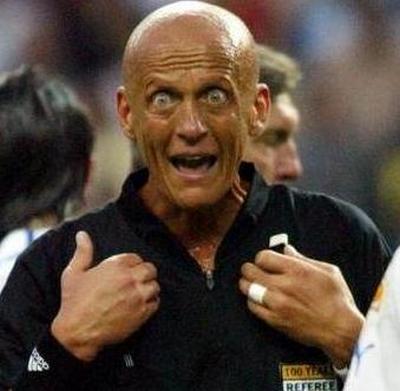
A film about referees. Now I have to say I find this very interesting indeed and I'm also surprised that nobody has ever thought of using a referee (or indeed an umpire in any other sport) as a vehicle for fiction. Surely referees are every bit as capable of being existential heroes as Peter Handke (and Albert Camus) imagined goalkeepers to be. Simon Kuper and Stefan Szymanski, in Why England Lose... (of which more later) also left referees out from their broad-ranging economic survey of the game. I've always been interested by the sort of men (and, these days, women) who voluntarily step into a position that brings glory to few and vicious invective to most. And many of them do it at a very young age; becoming a whistler is to assume an older, middle-aged persona it can only be comparable to being a Young Tory, or, these days, joining the priesthood. The referee must surely be the ultimate masochistic archetype.
I took a gander up to Parc de la Villette to watch, for the first time in years, a film at the annual open-air cinema. Past years have been marred by a timid, unadventurous range of films but this year the middle-brow (Little Miss Sunshine) and the inexplicably remembered (Amistad) are leavened by some genuinely interesting films. Monte Hellman's Two-Lane Blacktop and Herzog's Fitzcarraldo are both on this week. Another interesting film was showing Tuesday night, Dino Risi's Il Sorpasso, known in English as The Easy Life, or rather not known in English, as the film, like Risi (who died a year ago, aged 92) is shamefully neglected in the English-speaking world.
Not so in France, where he is revered as an equal of Billy Wilder. The French title Le fanfaron (meaning, roughly, the braggart or the loudmouth) has given its name to a bar not too far from where I live and the film is rightly considered a comedy classic. The tale of a chance encounter between a shy young law student (Jean-Louis Trintignant) and an ebullient older charmer (Vittorio Gassman), the film reminded me partly of Ferris Bueller's Day Off (I wouldn't be surprised if John Hughes was a fan) and partly Alberto Moravia's contemporary grim meditations on postwar Italy (Trintignant's Roberto has more than a hint of his role at the obedient young fascist in Bertollucci's adaptation of The Conformist).
While the trajectory of the film is predictable enough, it never strains credibility and Gassman's 40-something chancer masks a poignant loneliness and frustration at being just a bit too old for the recent opening-up of Italian society and relaxing of traditional mores. The film is unusual in that it has an almost equal spread of one-liners and visual humour. Risi is best known for his film Scent of a Woman, which was remade as the Oscar-winning Al Pacino shoutathon, but strangely his work is unknown to all but the most seasoned anglophone cinéphiles. Co-writer Ettore Scola went on to become an acclaimed director of social comedies in his own right. And Alfio Contini's evenly-lit monochrome photography recalls Aldo Scavardi's sunkissed lighting on Antonioni's L'avventura. And Risi even gets a dig in at the maestro of alienation too...
Hmm. Not a good night out down in Thomond Park and Ireland didn't even have the excuse of fielding an understrength side. That said, there's probably little to glean from a 3-0 defeat to a decent Australian side, which both Trap and visiting manager Pim Verbeek agreed flattered the Socceroos a bit. Ireland were far less solid at the back than they've been in recent matches and in the final third of the field there was precious little enterprise.
Trap might be right in saying that after a few more league games certain players will show a bit more pep. Ireland might have improved a bit in the second half but the rhythm of the game was still that all-too-familiar drudgery of Ireland games of the past (the Roy Keane-fuelled 4-2 victory over Iceland in Reykjavik in 1997 is the exemple par excellence). Switching over to the Holland-England game was a sobering glimpse of the gulf in, not quite class, but certainly urgency.
Trap's two defeats thus far have come at home in friendlies against teams (Poland and Australia) of similar stature to ourselves. Not too much to get panicked about. The fact that in each of those games we shipped three goals though is slightly worrying. For the moment though, I'm happy enough to keep winning (or drawing, if need be) those matches that count. Cyprus can hardly be too happy with their 6-1 defeat in Albania either...
Another year at the movies and another good one. Too often we hear jeremiads about the decline of cinema and the lack of good films out there (of course, such gripes are usually based on a diet of English-language cinema, which is far from being the world’s most interesting at the best of times). But this year, like last, showed that there are talented filmmakers from the whole world over forging visions that go beyond mere careerism or empty derivativeness. Another heartening thing is many of them are young and can expect to have long careers ahead of them.
Of course I have to admit that, living in Paris, I am more privileged than most when it comes to the choice of cinema on offer but with the internet the possibility of films accessing wider markets is considerable and the films I have listed all deserve to be seen by people any where in the world. My list, of a top ten listed in order, and a few dozen more listed in no particular order, is naturally a subjective one and in the top ten in particular there are a number of recurring themes and subjects, such as crime, war, urbanism, immigration and class politics. And many of the better films of the year seem to be pitched precariously between fiction and documentary reality, something I personally think gives cinema the frisson that no other art form can really provide. There are also films there for pure enjoyment, such as The Dark Knight, the best of the Batmans so far, the hilarious Tropic Thunder and Jean-Christophe Richet’s exhilarating two-film biopic of legendary French bank robber Jacques Mesrine.
The fact I live in Paris means that some of you will be surprised by some inclusions; there will be films that will have played elsewhere before this year and there will be many others that will have yet to come to a cinema near you. The basic rule for inclusion is a cinema release, no matter how small, in France in 2008 though I have bent the rule on one occasion, of which more later.
There were no new revelations of national cinemas though Brillante Mendoza’s two fine films Foster Child and Serbis seem to herald an emergence of Philippine cinema, while Eric Khoo once again put Singapore on the map with My Magic. France had an annus mirabilis, with a Palme d’Or win, two Oscars for La Môme (or La vie en rose as you might know it by), a domestic box-office record for the slight but likeable Bienvenue chez les Ch’tis and a range of fine films, of a variety unseen since the 1960s. Germany continues to make brilliant social dramas, as does Argentina, while Israel and Portugal are still producing strong films. Italy, that titan of post-war cinema, has been stuck in an impasse of mediocre, middle-brow films for a few decades now but there are promising signs. Two Cannes favourites, Matteo Garrone’s Gomorrah and the forthcoming Il Divo by Paolo Sorrentino have a vitality that has been missing from the Peninsula’s once great cinema for a long time. American cinema had a better than usual year too with a couple of decent films in for the Oscars, Oliver Stone’s biopic of Bush, his best film in over a decade, and James Gray’s stunning Two Lovers. While the rot in Hollywood is probably too deep set for it to ever become a consistent producer of great cinema again there should remain pockets of excellence.
As the financial crisis grips the world, one might be forgiven for thinking that a big casualty will be cinema, particularly films that don’t give a very great return on their investment. It’s hardly the world’s most pressing problem but a downturn in production at a time of such great inventiveness would be a shame. In any case there’s a backlog of plenty of good films if you find yourself having nothing left to watch. Enjoy whatever you choose off the list and apologies in advance for the lack of subtitles on some of the trailers and clips, and have a Merry Christmas and a Happy New Year.
1. La Graine et le mulet (Adbelketif Kechiche - France) Released just before Christmas in France last year, Adbelketif Kechiche's La graine et le mulet was an important breakthrough for French and European cinema. Kechiche hasn't exactly come from nowhere - his previous film L'Esquive won best picture at the Césars three years ago - but the jolt felt by this marvellously ambitious and inventive feature was such that you had a sense of seeing cinema entirely anew.
Frank O'Connor once said in an essay on the short story that a good story was comparable to the effect of seeing a circus strongman bend a barbell; you don't see how it happens, you don't understand how it happens but you accept that it does. The effect of La graine et le mulet is similar. Kechiche started off as an actor in the films of André Techiné and he has inherited his mentor's astutely deft handling of ensembles and his clear-eyed humanism. The film tells the tale of Sliman, a Maghrebin sexagenarian living in Sète in the south of France, who after being laid off his job renovating boats in the town's harbour, decides to do one up himself and open a couscous restaurant on it. So far so banal, this hoary old tale is given extra pertinence for the fact that its protagonist is so firmly outside the French system that simple scenes such as visiting the bank and the local authorities are invested with unbearable tension and discomfort. Sliman is assisted by Rym the daughter of his common-law partner, a resourceful young woman, who works the system, herself half in the dark as to its labyrinthine intricacies.
There is also Sliman's family, from whom he is not estranged, despite having left his wife, and who each have their own marital problems, and Sliman suffers from high-blood pressure, which his fondness for chocking four sugars into his coffee doesn't help. Sliman's efforts to open the restaurant hinge on a gamble; he plans a one-off gourmet night, which he hopes will be a success and convince investors and bureaucrats of the soundness of his business capabilities.
Everything about the film ought to work against it; Kechiche uses non-professional actors and improvises heavily, he shoots long takes and lingers on small dramatic details. And the simplicity of the plot would be hard to get past most producers in this day and age. But Kechiche pulls it all off, mainly because he understands so well how cinema works, how much it is a fusion of the kinetics of human drama and the strange fabric of familiar everyday life. The film's magic is a fine balancing act between sociological observation of an immigrant community and dramatic exploration of a group that fleshes the characters out as the film develops.
The film's resounding success in France, where it did very well at the box office for a low-budget film without any stars, and also won Kechiche another brace of Césars, was even more remarkable. It also introduced Hafsia Herzi, a 22-year-old law student from Marseille, in the role of Rym. She herself won a César for best female newcomer and is likely to become a star, having stolen the show with a belly dance (which she put on 6 kilos to perform) that marks the film's dizzying climax. Internationally its success was not so great, hampered by a lack of big names and the awful title 'Couscous' but it will be a film that will last. Kechiche, along with Rabah Ameur-Zaïche and Karim Dridi, is part of a fine generation of French-Arab filmmakers who tell the stories of an oft-ignored and maligned community. But what marks these films out is their lucidity, their universalism and their clear lack of bitterness. If French society might be a long way from its Obama moment, its cinema is getting there.
Trailer for La graine et le mulet:
2.Waltz with Bashir (Ari Folman – Israel) Folman’s dazzlingly innovatively animated documentary was most people’s favourite to win the Palme d’Or at Cannes this year and though the eventual winner, Laurent Cantet’s Entre les murs, was a fine film, Waltz with Bashir was probably the best in competition. Folman builds on his own experiences of serving as a conscript in the Israeli Defence Force in the invasion of Lebanon in 1982. Unlike some of his former comrades he cannot remember anything from the time so he interviews others, fellow soldiers, military commanders and journalists to piece the personal history together.
The film is a harrowing, yet matter-of-fact exploration of the war that veers from hallucinogenic phantasmagoria to moments of keen psychological observation. Folman’s blocking out of his memories is undoubtedly linked to the guilt of the Israelis guiding the Christian Phalangist militias to the refugee camp of Sabra and Chatila, where they massacred thousands of Palestinian civilians. The film closes with real footage of the slain bodies, which provides an uncomfortable jolt after the stylised animation of the previous hour and a half. As Israeli cinema continues through a period of unprecedented creativity, Folman’s film will serve as a great introduction to the country’s films. It also stands, along with the majestic documentary work of Avi Mograbi, as testimony to the troubled conscience of a country that is both infused with an extreme self-righteousness and so often is subject to a similar righteousness on the part of its critics.
Trailer for Waltz with Bashir:
3.Two Lovers (James Gray – USA) After being underwhelmed by Gray’s first two features, Little Odessa and The Yards, despite signs of promise in both, I never expected much from the New York filmmaker. But last year’s cop family drama We Own the Night was one of the best films of the year and a refreshingly intelligent and unpretentious answer to Scorsese’s preposterously overrated The Departed. Gray is, you could say, the true heir to the great Scorsese of old that we have seen so little of over the past twenty years. All his films have been set in Brighton Beach in Brooklyn and are steeped in the atmosphere of the down-at-heel neighbourhood. Gray also reminds you of many of the finer forensic observers in the history of cinema, the Bergmans, the Rossellinis, the Ozus.
Two Lovers is a departure from the crime films of Gray’s previous work, being a simple yet psychologically sophisticated love story involving a young man with a troubled past. Joaquin Phoenix is superb as Leonard Kraditor, jilted for his medical history and who struggles to rehabilitate himself having moved back into his parents. His parents encourage him to start a relationship with Sandra, the daughter of another Jewish businessman, and she is all game. But the irrational call of love incites him to look elsewhere, towards Michelle, the glamorous blonde who has moved in upstairs. She finds him charming, indulges him but is ultimately uninterested. It’s a banal tale of unrequited infatuation that will be familiar to everyone, but Gray films it with the same tautness as he did his tales of hoodlums and hard-nosed cops. It is one of the most psychologically plausible love stories ever to have been put to film and Phoenix’s performance is such that you hope his current retirement from acting will be only temporary.
Trailer for Two Lovers:
4.Gomorrah (Matteo Garrone – Italy) The young Italian writer Roberto Saviano was already in hiding before the release of this film version of his best-selling non-fiction book but the film’s success can hardly have helped his security situation. The film examines the Comorra, the Neapolitan mafia, and its tentacular reach into all sectors of Italian business and society. The film departs from the book by dispensing with the narrative voice, which was Saviano himself, who occupied a recklessly central role in his tale. What we are left with are six distinct tales told in a sober, dispassionate manner, similar to Alan Clarke’s Elephant or Gus Van Sant’s of the same name. Tim Parks has complained that the film lacks an oppositional force, a crusader that might represent resistance to the thuggery of the Naples mob. But this misses the point of the film, which is to resurrect the mob film from the relativistic morass and the dubious glamour it has been mired in for near on thirty years now. It is significant that the two young numskulls that try to muscle their way onto the turf of much more formidable men should be beholden to Brian de Palma’s Scarface. But Gomorrah has little truck with the mythologizing of that film – its gangsters are brutal thugs that bully their way around any situation, fascists in shellsuits.
The film is bleak in that it declines to offer a way out for anyone, the only characters that manage to opt out do so at the expense of their career. But it’s a timely film for its frankness in tackling the canker of organised crime from a left-wing point of view without making facile, shopworn observations about how it’s simply another extension of mainstream capitalism. The Comorra is deeply embedded in mainstream capital but the film makes no attempt to exonerate the organisation because of its unorthodox status.
Trailer for Gomorrah:
5.Night and Day (Hong Sang-Soo – South Korea/France) I’ve been a fan of Hong’s unassuming intimiste dramas for a few years but Night and Day took me by surprise. Going to Paris to make a film has by now become almost an obligation for Asia’s top directors and Hong follows the lead of Tsai Ming-Liang, Nobuhiro Suwa and Hou Hsiao-Hsien with this tale of a Korean artist, Kim Sung-nam, who flees to France having been ratted out to the police by an American backpacker for sharing a joint. That starting point is representative of the film as a whole, which is a succession of brilliantly filmed episodes, most of which could themselves pass as self-contained stories. Kim loafs about Paris in the cocoon of its tiny Korean immigrant community, meets a former girlfriend by accident, has a falling-out with a North Korean over an unguarded comment about Kim Jong-Il, develops an ill-advised infatuation for a young, narcissistic art student and pines for his wife back home. The film’s tagline is ‘everything is as it seems’, which puts it fairly well. Not only a fine film in its own right but also one of the few that offers a foreign perspective on Paris without falling into clichéd and banal observations.
Trailer for Night and Day:
6.En construcción/Dans la ville de Sylvia (José Luis Guerín – Spain/France) My own big discovery of the year, and I can’t believe I hadn’t heard of Guerín before now. I have to admit I’m cheating a bit by putting En construcción here as it was made in 2001, but as it was released simultaneously with the only slightly less brilliant Dans la ville de Sylvia, I feel entitled to bend the rules. The earlier film is half-documentary, half-film essay about the demolition of a building in the Barrio Chino, Barcelona’s old red-light district that was built in 1900 and is to meet its end in the dying months of the century. The film observes unobtrusively the inhabitants of the old quarter now being moved out as the area faces gentrification, the North African workers building the replacement apartment block and Guerín even had the boon of the workers discovering Roman remains during the excavation. Dans la ville de Sylvia is an oblique film about a young man looking for a lost love while visiting Strasbourg. While very different from the earlier film, it does however share its warmth and its feeling for the lived urban environment. There are few directors that film people and buildings with equal care. There’s a fine essay by Guerín on En construcción here and it’s interesting to note that one of his early films, Innisfree was filmed in Ireland and is apparently a tribute to John Ford.
Trailer for Dans la ville de Sylvia:
8.Hunger (Steve McQueen - UK/Ireland) When I first heard about Hunger, I couldn’t have been less interested. Did we really need another film about the hunger strikes? And, Steve McQueen’s reputation as a visual artist notwithstanding, I was worried that the result might be an over-aestheticization with most of the politics sucked out of it. So I’m glad I was proved wrong. Hunger is a fascinating, unflinching look at the strength of a principle and people’s determinations to stand by them. Previous H-Block films such as Some Mother’s Son and H3 were typically void of either a visual sense or ideas like many British or Irish films but McQueen dissects the historical incident with economy and aplomb. Michael Fassbender is great as Bobby Sands, with the 20-minute-long colloquy with Liam Cunningham that lies at the centre of the film a masterclass in dramatic writing. More remarkably, though McQueen’s sympathies are clearly with the hunger strikers, there is no facile endorsement of the IRA forthcoming. The Republicans are shown to be every bit as brutal as their captors and you don’t need to be a supporter of the men of violence to be affected by this film.
Trailer for Hunger:
9. Je veux voir (Joana Hadjithomas and Khalil Joreige – Lebanon/France) The Lebanese video artist pairing of Hadjithomas and Joreige came to international attention a couple of years back with the Antonioni-esque Perfect Day, the tale of a narcoleptic young Lebanese haunted by the disappearance of his father who was kidnapped during the Civil War and now about to be declared officially dead. It was a film I should have liked but I found it stultifyingly languid and ironically, for a film about a narcoleptic, put me to sleep.
Perfect Day came out before the 2006 Israeli bombing, the results of which form the basis for their second oblique film. Catherine Deneuve, attending a film festival in Beirut, announces she wants to see the damage done to the country. Hadjithomas and Joreige go with her and film her. It’s a strange film, where Deneuve plays herself in what appears to be a documentary but of course is a scripted film. Ill at ease, she slowly develops a rapport with her driver Rabieh Mroue; they chat about the effect of decades of war on Lebanon and view the rubble in the Lebanese capital and the southern towns, shattered by the bombings. Very little happens in this short, 75-minute film, but few other films have managed to make a country come to life on screen so well with such modest means. Just sit back and watch.
Trailer for Je veux voir:
Other films worth a look (in no particular order)
Wonderful Town (Aditya Assarat – Thailand) Teeth (Mitchell Lichtenstein – USA) Le Silence de Lorna (Jean-Pierre and Luc Dardenne – Belgium) Happy-Go-Lucky (Mike Leigh – UK) Woman on the Beach (Hong Sang-Soo – South Korea) Un conte de noël (Arnaud Desplechin – France) Changeling (Clint Eastwood – USA) Home (Ursula Meier – Switzerland/Belgium/France) W. (Oliver Stone – USA) La vie moderne (Raymond Depardon – France) Christopher Columbus, the Enigma (Manoel de Oliveira – Portugal) Tropic Thunder (Ben Stiller – USA) Jar City (Balthasar Kormákur – Iceland) El Otro (Ariel Rotter – Argentina) Frownland (Ronald Bronstein – USA) Lake Tahoe (Fernando Eimbcke – Mexico) Mesrine: L’Instinct de mort/Mesrine: Ennemi publique Nº1 (Jean-Christophe Richet – France/Canada) Dernier maquis (Rabah Ameur Zaïmeche – France) The Dark Knight (Christopher Nolan – USA) The Tears of Mrs Wang (Liu Bingjian – China) It’s a Free World… (Ken Loach – UK) There Will Be Blood (Paul Thomas Anderson – USA) La Influencía (Pedro Aguilar – Spain/Mexico) Cloud Nine (Andreas Dreiser – Germany) Counterparts (Jan Bonny – Germany) No Country for Old Men (Joel and Ethan Coen – USA) Funny Games US (Michael Haneke – USA) Yurmurta (Semih Kaplanoglu – Turkey/Greece) Four Nights with Anna (Jerzy Skolimowski – Poland) The Banishment (Andrei Zvygavintsev – Russia) Leonera (Pablo Trapero – Argentina) Body Rice (Hugo Vieira da Silva – Portugal/Germany) Garage (Lenny Abrahamson – Ireland) XXY (Lucía Puenzo –Argentina) Agnus Dei (Lucía Cedrón – Argentina) My Magic (Eric Khoo – Singapore) Foster Child/Serbis (Brillante Mendoza – Philippines) The Visitor (Tom MacCarthy – USA) The Orphanage (Juan Antonio Bayona – Spain) The Pope’s Toilet (César Charlone and Enrique Fernández – Uruguay) California Dreamin’ (Endless) (Cristian Nemescu – Romania)




 Posts
Posts


