Monday, August 07, 2006

Hicksville


I spent the latter part of last night (a euphemism for being out drinking) listening to some early Bill Hicks. I was familiar only with his later stuff, recorded in 1991 or 92, shortly before his death. This other material, from about three years before that if one is to judge by the references to Tiffany and Debbie Gibson, is even more abrasive than the later stuff. One gets the impression that even Hicks felt the need to tone down the more potentially defamatory comments once he got a big following. In this recording he outed George Michael ten years before the LAPD did; perhaps not the most ground-breaking observation but few did so on the record.

My friend Tony, who played me the Hicks tapes, pointed out something that I never noticed before: Hicks' similarity to an evangelist. It is true: his rhetorical flourishes and his periodic raising of the voice suggest that he should be winning people over to the Good Book. You can take the man out of Georgia but you can't take Georgia out of the man. Of course, Hicks was as much formed by being one of a generation of angry, cynical, post-baby-boom kids that suddenly saw the liberties and culture that the previous generation took for granted begin to disappear as conformism crept back in under Reagan. God knows what he would make of the America of Bush, Rumsfeld, Ashcroft and Tom deLay. He'd get some good material out of it anyway.

Under A Vest


I am not the most astute observer of male fashion trends (if I were, I would make sure I made a lot of money out of it) but I can't help noticing that more men, in Paris at least, are wearing wife-beaters this summer. Is there a rise in the taste for 'lout chic'? Is it a rebellion against the metrosexualism that has gained ground in recent years? Is it a conflation of both?

The wife-beater, or tank top, or classic white singlet, as its manufacturers no doubt prefer it to be called, is distinguished in the main by its cheapness, though I am sure that there are ways of parting with a lot of cash for one if one really must. A few friends of mine stock up on them regularly (sometimes not even bothering to keep their previous vests for a second wear) and I have been impressed by the fact that the wee singlets are so small bunched up in their wrapping and they still represent half of your wardrobe for a summer's day in Paris.

The wife-beater is also style-neutral, despite the negative connotations it has assumed over the last ten years; it resolves immediately one fashion dilemma. It is, if you like, the sartorial equivalent of fast food. The French call it 'le Marcel', which, seeing as it evokes an image of a Provençal soused in mid-afternoon on Pastis, amounts to almost the same thing. I have yet to buy one.

Sunday, August 06, 2006

Padrino Padrone


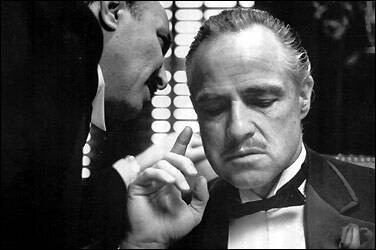
The Godfather has just been re-released here in a new print, with Part 2 at least to follow in a few weeks. I watched it tonight, for the first time in probably ten years, at the great three-tiered Max Linder Panorama cinema on Grands Boulevards. It is as hugely impressive as ever, even if thirty years of parody and 'homages' in bad Hollywood movies and even worse TV ads have rendered some of the more famous scenes and dialogue comical to say the least. When Brando first opened his mouth this evening, there was a big collective laugh from the audience.

If anything this shows that the film's iconic standing in popular culture has outstripped the film itself. Which is not unusual, the same can be said of other films such as King Kong, Psycho and Jaws. But underneath all this the film is a stunningly complete and organic work. Just as Michael Cimino's career has hardly been represented by his two early masterpieces The Deerhunter and Heaven's Gate, so Coppola has been outmanoeuvred by his early works of art, this film and its sequel and The Conversation, which was sandwiched between the two of them and won the Palme d'Or, as did his later Apocalypse Now, which is where, in my opinion, the rot began to set in. Coppola now makes films with Robin Williams and adapts John Grisham bestsellers when he does anything at all, being seemingly more interested in making wine, at which he is quite adept.

The film is seamless, so much that you find yourself wondering how it works structurally, and it is much more than the sum of its parts. Its most remarkable quality is its understatedness, and its use of unshowy elements, such as Gordon Willis' meticulously even lighting, which only begins to up the contrast in the final twenty minutes. The performances are superb, especially Brando; the famous scene where he keels over and dies while playing with his grandson is masterly, choreographed with the most throwaway gestures and tics that most actors would find it impossible to replicate never mind imitate. It is always surprising to see a non-shouting, non-swearing Al Pacino, and the youth of him and many of the other actors that have since become big stars, Robert Duvall, James Caan and Diane Keaton gives the film an extra layer of history. The film has matured since it was made, assuming different significations as the world has changed. A reading of the film that has long passed into truism is that it portrays American mafiosi as just another type of businessmen. And of course, this is, like any truism, basically correct. But in the post-Enron, post-WorldCom, neo-con driven US, The Godfather seems as prescient of a change in the mainstream business culture itself. The only relevant morality is self-interest. And the film, that wears Coppola's superb direction so lightly it looks like it might have been made by anybody, resolves any moral quandaries in the bloody final half-hour when self-preservation shifts gear into self-interest. Coldly, like in the great final shot, where Keaton's fretting wife, disappears behind a shutting door.

News Items

Fun-loving and Scrabble-obsessed Scottish revolutionary Tommy Sheridan, mentioned on this blog a couple of weeks back, won his libel case against the News of the World, and was compensated to the tune of 200,000 stg, over allegations that he visited swingers' clubs, and used prostitutes, among other depraved activities. Few expected him to win as such libel cases are difficult to resolve in Scottish courts, based as they are on Roman law, and sacking his counsel mid-way through the case was a maverick act that seems to have paid off, quite literally. While I do not think that Tommy is quite as retiring and nerdy as his wife painted him out to be in court, it is nice to see someone on the Left put one over the Murdoch press.

A cover story in Libération has claimed that the French government covered up for years the links between thyroid cancer in French Polynesia (about 500 cases) and the continuous nuclear tests on the nearby Mururoa Atoll, the last of which took place in 1995. A researcher passed information on to French Polynesian President, Oscar Temaru, who then made the story public. Temaru is a supporter of independence for the islands, which are still officially part of France, as a territoire d'outre-mer, so a separate political agenda is at play. But nobody can be too surprised at the story. Nor is it likely to cause any heads to roll.

Arthur Lee of Love, followed fellow tortured soul Syd Barrett to the great psychedelic happening in the sky, dying of leukemia at the age of 61. No lengthy eulogy from me, though I am a big fan of Love's masterpiece 'Forever Changes'. Here's one from Pitchfork, on the same page is news of the break-up of Death From Above 1979 and Johnny Marr's confirmation as a new member of Modest Mouse. Well, he has to eat just like the rest of us.

Martin O'Neill has been named new manager of Aston Villa; surely they can't fuck up that very sensible appointment? Meanwhile here in France the season got underway, Seanachie's beloved St-Etienne suffered a defeat away to the very modest Sochaux, but pleasure was to be drawn from Paris Saint-Germain's 3-2 defeat at home to newly-promoted Bretons Lorient. L'Équipe won't be happy with that.

Museum Piece


No post yesterday(s) due to a convergence of various things; my mum and dad left after their brief visit, and I had financial and administrative matters to take care of. Spent a couple of hours wandering around the Musée Carnavalet, the museum of the history of Paris. It is situated in the beautiful 16th-century townhouse, the Hôtel Carnavalet, and is huge, taking in another old town-house behind it. Having been getting up earlier than normal this week I was awfully tired and I was straining to digest in as passive a manner as possible the abundant tableaux detailing events in the city's history. There is a disorienting nature to the museum, seeing the names and images of familiar Parisian landmarks and then trying to conceive of them in their previous incarnation. One such instance was the painting of Beaumarchais' mansion, and the Bastille, painted one year before the revolution; the mansion stood on what is now boulevard Beaumarchais, but back then these outer reaches of the city were effectively fields. A view of Paris from Belleville in 1740, which is these days only up the street from me was similarly strange, not to mention the paintings of Grenelle and Passy and the Champs Élysées, when they were still actual champs. Other highlights were Proust's reconstituted bedroom and those of a couple of other lesser writers, and the preserved Art Nouveau jewellery shop, the name of which, nor its architect I cannot remember. Most of the rest of the exhibition was just a little dense for me to absorb. A good museum though and, yesterday at least, admission was free to the permanent collection.

Thursday, August 03, 2006

It Was the Dog With a Blunt Instrument in The Parlour

Contacts abroad have alerted me to a story about a guard dog who went, er, postal this week. After an apparently glittering career, he snapped and mauled about 100 rare and expensive teddy bears he was charged with guarding, including one, almost 100 years old, that used to belong to Elvis Presley. I'm sure his friends are saying that he seemed so happy, and was such a gentle dog...

Meanwhile James Blunt has been voted one of the top 10 most irritating things in Britain, in fact the top-placed specifically-named human being. Cold callers are first, caravans second (why caravans). Nice to see that David Blaine figures somewhere on the list. The question about Mr Blunt then is, if people find him so annoying, who is buying those records. It's like Thatcher, Fianna Fáil, Berlusconi; nobody claims to vote for them, but somebody clearly does.

Wednesday, August 02, 2006

Thinking (Oneself) Outside The Box

And now, a mildly-comic political cock-up that would not bear mentioning had it not happened in my home village in the west of Ireland. The local TD (a sense of embarrassed pity of the sort you get watching David Brent on The Office prevents me from naming him though the more intrepid can easily find out if bothered), a bit of a dynamo for culturally-minded PR stunts, delivered on his promise of getting a big-name New York politician to unveil a monument to local man Brigadier General Michael Corcoran, commander of the 69th Infantry Regiment in the American Civil War. The man who was eventually due to pull the curtain was Republican Mayor Michael Bloomberg, a man with no discernible links to Ireland.

What was at play was the intersection of the political interests of a small player (show one's clout in New York to win votes at home) and those of a very big one (the wish to win vital votes from New York Irish-American community, not always too disposed to do Jewish politicians a favour). As it turned out though, a 10-day power cut in Staten Island prevented Bloomberg from leaving the city, and the monument arrived in the post. Bloomberg offered to send a deputy but the Irish public representative, seeing a shrinking in prestige, declined and the monument remained in its box, obviously not in itself enough to interest the dejected lawmaker. Unfortunately a large delegation of the regiment's veterans made their way to the venue and were disappointed to find that they would not be of much use for a colour parade or some such thing. The locals were also miffed and even the usually compliant local media have put the boot into the now-laying-low TD, who claimed that Bloomberg would yet come, to local scorn. The Mayor's office chipped in by saying that he would dearly love to attend but that his future presence would be contingent on events in New York, which is a 'volatile place.' Which put the Deppity in his.

I have no great love for either of the principals in this affair. The Irishman is a harmless fellow, a colourless product of the clientelist Irish political system (and the smallness of the country too), and I could not bring myself to give him a vote even were I induced into a state of extreme rapture. Bloomberg, for all his liberal credentials has yet to permit an anti-war march in the city he governs; he is also one of the world's richest men, making most of his money from media outlets. The Irishman has come off the worst, being found to be out of his depth, without a viable back-up plan. The bizarre thing is that this little fiasco is likely to cost him more than any more politically substantial ones might have.

Des Res


The day-trip ended up being to Fontainebleau, a pleasant but sleepy town about 40 minutes south of Paris, best known historically for being home to the most important royal château after Versailles, and these days for being the location for France's football academy, through whose doors most of their stars of the past few years have passed.

Though the château is not the only thing of note in the town - there are one or two interesting-sounding museums, including France's National Prison Museum - to be honest, had King François I not decided almost 500 years ago to establish the country seat of the Bourbons there, there would be little reason to go anywhere near the place today. The town is small, about 17,000 people, and the best-known non-royal landmark seems to be the enormous vintage carousel planted in the middle of the main square. It has probably been there longer than any of the town's citizens and no doubt kept going all the way through the Nazi occupation too. The sound of that generic organ-ground carnavel music generates an eerie effect as you eat your lunch on a restaurant terrace; it reminded me a bit too much of that spooky Disney movie, Something Wicked This Way Comes, and The Lady from Shanghai too, if my memory serves me right.

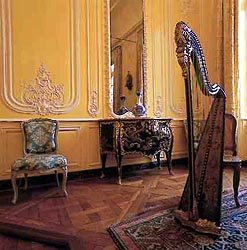
The château is less physically imposing than Versailles and its gardens are more peripheral. It is also less pristinely symbolic as, unlike Versailles, it continued to be used long after being the Revolution, being the favoured residence of all the Napoleons, from Bonaparte on. But for this reason, it is more interesting, as the building, often-extended and re-built is physical testimony to changing tastes and regimes. Though on the outside, the structure was maintained throughout its renovations as classically, even academically, baroque, the inside is like a living museum of additions and revisions, as one moves from stucco and fresco to wood-pannelled, porcelain-encrusted passages, to lush tapestries, to the splendid 80-metre long Diana Room, which was the royal, and later imperial, library. The centre-piece is Napoleon's enormous marble globe, which I think I have seen before but it may have been a similar contraption in a Vermeer tableau.

An unexpected impression I got was one of comedy. Reading the caption cards about the incessant extensions and renovations, the last major one being as recent as the 1920s, I could see a macro-version of the Irish Big House comedy, such as Castle Rackrent, in which the grand designs and the pomp of successive conceptions were forever being undermined by the bathetic changes of regime and allegience. Or maybe it was more like a novel by Günther Grass. I could hear History laughing down through the ages. Another amusing sight was Bonaparte's bed. It is usual for historical beds to be smaller and shorter than modern ones, as we have managed to outstrip our ancestors in average height. Bonaparte's bed however, at scarcely 5'6" long came as a bit of a shock. Even better was its height, cruelly elevated for such a short man, necessitating a couple of ornate steps to reach it. Perhaps that is why he might have turned out the man he did.

Tuesday, August 01, 2006

Slow News Day

Slow news day in Seanachie's designer monastic cell in a secret location on the corner of rue du Chemin Vert and avenue Parmentier. I am currently trying to engineer a day-trip out of Paris for tomorrow for my parents and me. The Normandy beaches are out of the frame because of their relative inaccessability in one day and Reims, home to the famous Gothic cathedral and the world's most famous and erroneously over-rated sparking wine, was a rip-off courtesy of SNCF (€133 return for a four-hour round trip!). Now I am trying to find the name of that charming inland port on the Seine, in Normandy that I've heard do much about. I thought it was Gonflans-Ste-Honorine but that particular town seems to not want to advertise its charms too openly on the Internet. I suppose I could ask a friend...

I found out courtesy of my father that the word 'craic' (as in what Irish people have when they're not terminally depressed) is a genuine Irish (i.e. Gaelic) word. I thought it was a made-up 1980s expression that came along about the same time that trendy young Irish people starting telling people to "póg mo thóin" (sic). But apparently it comes from old Donegal Irish, in those pre-Gaeilge caighdeánaithe days it was craich, and it meant 'plunder', which is what the O'Donnell's and co used to do on their medieval pleasure trips into Sligo and beyond. Considering that they probably helped themselves to some rape and pillage as well as harmless old cattle-rustling, the origins of this already-overused word are beginning to perturb me.

TOTP Tops Itself

The demise of Top of the Pops, which came to a head last week, was a long, slow one. The wind had so long ago been knocked out of the show that there was relatively little fanfare when it wheezed its last. Everyone had their eye on MySpace, iTunes, last.fm or some other Internet-age innovation of the sort that has rendered the show redundant. Either that or they were all on holidays.

TOTP for me, as for many people I think, was defined mainly by how it was between the ages of six and thirteen. Therefore it was the Paul Hardcastle theme, Frankie Goes to Hollywood, Cyndi Lauper, The Cure doing Lovecats, The Smiths, The Jam, Dexie's, Phil Collins, no doubt. Just after the Happy Mondays started appearing on the show and slagging it off, I, as a typically snooty teenager had begun to question the show's integrity. The fact that The Clash and The Pistols had always refused to play on it combined with the lip-syncing that was OK for the likes of Milli Vanilli but hardly for the seminal bands like Ned's Atomic Dustbin that I was listening to at the time, hardened my resolve against TOTP. I'm sure that, had Ready Steady Go, The Tube or even The Old Grey Whistle Test enjoyed the same success, I might have been equally unforgiving. The best, perhaps only way I can pay homage to the show is by going to YouTube, as ever, to dig out a band that marked their only ever appearance by taking the piss. Royally. Ladies and gentlemen...Nirvannnaaaaaaa!!!!

Monday, July 31, 2006

Evil Comedians

Somebody tried to convince me the other night that, in the autumn of his life, Bob Monkhouse, filled with self-loathing despite his hugely successful career as a demonic light entertainer, persuaded some film director to cast him as the villain, because, and I quote from hearsay: "that's the man I am". The film was apparently atrocious but Monkhouse was credible enough as the baddie. Intriguing, but I have not been able to track it down.

Brendan Grace, the comédien de référence of 1980's Ireland, was also a suitably well-cast baddie when he played the villainous Father Fintan Stack in a memorable episode of Father Ted, and I always felt it a shame that he never got the opportunity to broaden his scope into the movies. Brendan, as well as being a Fianna Fáil lickspittle all his career, also claims that Frank Sinatra was a big fan of his, and to have met him a few times. So he knew plenty of unsavoury people to shape his Method.

Bolivia 3 Vatican 2


Bolivian president Evo Morales, got his nose broken during an indoor football game at the weekend, after being fouled by an over-zealous goalkeeper as the game, poised at 2-2, drew to a keenly-fought close. Earlier in the week, Evo himself managed to put the nose of a much bigger opponent, the local Catholic Church franchise, out of joint. President Morales has stated that the Big Boys will have to accept a widening of the school religion curriculum to embrace native religions. The Church has muttered about Morales' "discourse of hate, rancour and unforgiveness" having the potential to start wars but the President's plans for reform are mild enough, and hardly qualify even as kulturkampf.

I cannot say I support the teaching of religion in schools, be it one of the Abrahamic Big-Three or a hippy-dippy marginalised Andean creed but putting an overwhelmingly powerful institution in its place in a properly democratic society is no harm, something that should be exercised everywhere on a regular basis. And that applies to institutions and organisations a good deal more secular and worldly than the Catholic Church.

Mad Mel, the Road Warrior


God's favourite filmmaker Mel Gibson was unusually contrite yesterday after a lapse in his struggle with the demon drink. A famous alcoholic, with more than one or two similarities to the current tenant of the White House, Mel ('not short for Melvin', as news sources outside Longford and Athlone have long strained to point out) was driving at 87mph in a 45mph zone in Malibu, California and was arrested, and failed a breath test, a three-quarters-full bottle of tequila found on the passenger seat beside him.

Mel then proceeded to shower his captors with anti-semitic invective, including the familiar allegation that "the Jews have started all the wars in the world"; he also asked one of the officers on duty if he was Jewish. We will come back to the Gibson family's anti-semitic heritage in a moment. But the Holy One's outburst was baffling given the low number of Jews in police forces anywhere in the world (except Israel, of course); you would be more likely to find a Jew in the NBA than in the LAPD. But of course, Malibu is not, strictly speaking LA, and I wonder if Mel was roughed up by the same local police chief as the Dude in The Big Lebowski?

One might reasonably assume that Mel's anti-semitic remarks, his first of the kind to be made public, can be put down to in vino veritas. Mel has since apologised for what he calls his 'despicable' remarks and has put it down to his 'horrific relapse'. It's a familiar excuse from an alcoholic; they are of course altered people when they are off revelling but their more colourful pronouncements are usually drawn from some well-stocked yet well-repressed pile, and mean more to them than they claim after the fact. Mel's father Hutton Gibson, an exceptionally repugnant old Catholic bigot, is on the record as being a holocaust-denier (I imagine he does not holiday in Germany too much then).

Now, as those Old Testament Jews would have it, let not the sins of the father be visited upon the son. But with his film The Passion of the Christ a couple of years back, Mel seemed to be dusting off the old Roman accusation of Deicide for a new generation. The Passion, to be fair was no more anti-semitic than its source texts, the Four Gospels (though this does not make it lightweight in this repect). It was, however, a lugubrious, dull, pedantic, quasi-pornographic work, that rammed home the message that Christ died on the cross for our sins, and had the poor old human side of him dragged through the mill along the way. It looks like the other partners in the Blessed Trinity stepped well back from the action on that particular Friday 2000 years ago. The Jews in the film don't get a very good press, and for the most part they look similar to the portrayal of their co-religionists in propaganda films made for a certain 20th-century European power. At the time Mel attempted to complicate the auteur theory by claiming that the Holy Spirit directed the film through him - a little like how the Lord talks through Bush, but being an Evangelical Protestant, Dubya cannot have the same privilege of access as devout Catholic Mel. Judging by the finished item, the Holy Spirit might have some trouble getting funding for its next project, unlike Mel, who enjoyed extraordinary success worldwide with the film, particularly in Poland, where many of the Catholic faithful have a taste for the retro pleasures of Jew-baiting.

Sunday, July 30, 2006

This Will Get You Sacked

I've been using the open-source Firefox browser since soon after its appearance in late 2003. In those days I was still labouring away with the PC albatross around my neck so Firefox was an indispensable replacement for the porous, universally decrypted defences of Internet Explorer.

Though Firefox, in recent versions, has had some issues, such as slowness and a tendency to freeze, not to mention one or two security problems, the latest update has steadied things again. There are other good browsers available free of charge, such as Opera and Safari for Mac, but there is nothing as comprehensive, nor as visually attractive as Firefox. Anyone who persists with Internet Explorer, particularly PC users, is asking for trouble. 83% of computer users still do.

The plug-ins are the big bonus on Firefox, particularly its search options that integrate various search engines (and reference sites such as Wikipedia and IMDB) in the toolbar, and another favourite is the control bar for iTunes. Possibly the greatest and simplest innovation is now available as a plug-in, something that surprisingly took so long to be thought of. It is called Stumble-Upon, a plug-in with its own toolbar, which allows you to summon random web pages, according to criteria you enter when you configure your account. All it does is introduce you to page after page of sometimes obscure, sometimes famous, sometimes amazing, sometimes dull stuff. And it gives you the option too of rating the pages, thereby banishing them forever if they are not to your liking. It's great fun, and of course, a terrible distraction. You'll never work again. As for cache history, cookies and other things, there is a concern there but I assume that the good Open Source people at MozillaDev are not doing anything remiss with one's information.

Motherless Child To A Motherless Child


I mentioned a week or so ago on this blog that I tried to go see Tsotsi, the South African Oscar-winning film but was side-tracked by technical problems of a cycling nature. Yesterday I finally got to see the film, and as far as Best Films in a Foreign Language go, it's not all that bad. Usually films that win in this category play off a winning formula that involves the initially difficult relationship between a single adult male and a cute child, text-book examples are Kolya, Cinema Paradiso, Life is Beautiful. Not all the films of this sort have been that bad, Bille August's Pelle the Conqueror and Nikita Mikhalkov's Burnt By The Sun hold up to this day to an extent that one forgets that they won the damn award in the first place. And I do still retain a certain regard for the mad Chaplinesque genius of Benigni in Life is Beautiful, though the ending was too saccharine for my taste.

Tsotsi, directed by South African stalwart Gavin Hood, adapted by himself from an English-language novel by renowned playwright Athol Fugard, varies slightly this trend in winners of the award by reducing the ages of the two principles drastically. It is rather a relationship between a teenage hood and a six-month old baby. The film is set in Soweto, and, unlike U-Carmen e-Khayelitsha, the other South African award-winning film released here this year, is not primarily Xhosa-language, but Tsotsitaal (thug-speak) a township patois composed of words from Zulu, English, Tswana, Sotho and other native languages. The shadow of AIDS, which would have been absent from the original novel, published in 1980, hangs over the film. We see on a number of occasions billboards reminding people that AIDS concerns "us all" and the hero of the title Tsotsi has lost his mother from some disease, and he is young enough for it to have been the current big killer in Africa. Tsotsi, then is a motherless child, rather than sometimes feeling like one. Having fled his abusive father, he grows up in the townships where he makes a reputation for himself as a particularly bloodthirsty thug, appalling even members of his own gang when he gratuitously knifes a commuter on the Underground. When he goes off for some time on his own, he carjacks a wealthy black suburban woman and shoots her when she resists. It is only upon abandoning the car that he realises he has inadvertently abducted her baby son.

Tsotsi's hard man image recedes momentarily and he takes the child with him, being so caring as to force a neighbouring new mother to breast-feed the baby at gunpoint. Meanwhile a hunt is on for the kidnapper, and he complicates things by returning to the scene of the crime, and robbing the baby's father of cash so as to pay the compliant breast feeder. This is where the film's problems lie; structurally things are far too episodic, and every incident is inserted into the action in order to serve the plot and move it forward. It is too crude, and having three key scenes orchestrated at the same house, moving the hero there in each instance is far too artificial.

Other than this the film is a fair stab at portraying the Johannesberg underworld, the gangsters, led by the Kwaito (South African dancehall) star Zola, are all scarily credible. Tsotsi, played by Presley Chweneyagae, is a lost soul from the moment we first see him, his eyes expressing an infinite sadness, his age uncertain, anything from 14 to 30. That said it is not terribly convincing that he makes such a sudden change from heartless killer to guardian of a lost child (whom he gives his own real name, David). The recurring flash-backs to his mother's deathbed give the film a false air, as does the cheap atmospheric music that takes over from the vibrant Kwaito in the last half hour. A film that starts off with much promise fades out into sentimentalism, beating a well-trodden path. No wonder the ultra-conservative Academy members loved it so.

The Next Last Broadcast

I have only recently discovered Last.fm, and having tried numerous other music resources of a similar type, such as Pandora and radioblogclub.com, I will say that this is the best so far. Easy to install and use, it plays you streams according to the criteria that you have entered at log-in. Unlike Pandora, which feeds off a central database and often throws the worst types of approximations of your taste at you, Last.fm is peer-supported, so you can rely upon the past choices and gradings of like-minded people to guide you serindipitously towards nuggets that you might otherwise never hear of. And even stuff that you have known well for many years sounds different when bracketed by unknown bands from North Dakota. Be careful to refine your search criteria though; I picked 'folk' and folk only and the first two tracks thrown at me were Ben Harper and Alanis Morrisette. Computers are only 0's and 1's after all.

Saturday, July 29, 2006

What I Learned This Week

1. That, in one of the five attempts on Hitler's life by members of the Nazi Party, on a flight from Smolensk to Berlin in March 1943, a bomb was secreted in a bottle of Cointreau, but failed to detonate. Clearly shabby bomb-making from an organisation that prided itself on its logistical rationalism and wherewithal. Hitler, as is well known, was not a big drinker but is it possible that he liked to sup the sturdy orange-flavoured liqueur as a night-cap or digestif? I assume that the standard 700ml bottle was used, but if they were foolhardy enough to use the 500ml, then I can see already where they began to go wrong.

2. That Dusty Springfield's real name was the unglittery Mary O'Brien. Well, why didn't you say so Mary? And the name on Jon Bon Jovi's birth cert is John Francis Bongiovi Jr., which is even better than his already fab nomme de guerre. All thanks to this fantastic resource. Prepare to be amazed!

Friday, July 28, 2006

Turnip for the Books as Derry Mash Swedes


Congratulations to Derry City (the team we love to hate so well, as they are known in Sligo), on beating twice-former-UEFA-cup-winners IFK Gothenburg in the first qualifying round of this year's tournament. A 1-o win in each leg gave the Candystripes the victory. Following Cork City's victories over the past two seasons against Malmö and Djurgården, the National League can now claim superiority to the much better-funded, much better-supported and better-publicised Allsvenskan. There is no excuse of rustiness from the Swedes either: just like the Irish, they play summer football.

Drogheda United also progressed in the UEFA Cup, beating Helsinki side HJK after extra time at Dalymount. Both Derry and Drogheda should fancy their chances of reaching the first round proper as they now face Gretna (last year's surprise Scottish Cup finalists) and Start of Norway respectively. Cork faced sterner opposition in the Champions' League in Red Star Belgrade (6-0 aggregate winners over the mighty Sligo Rovers in the 1977 tournament), and went down unluckily to a first-half own-goal. Sligo, enjoying a good season so far - six wins out of the last seven - are in with a shout for a European spot next year, and surely will be hoping for Swedish opposition, maybe Hammarby (Stockholm is beautiful at this time of year), GAIS, Gothenburg's other team or even better, Henrik Larsson's Helsingborg. We've got league leaders Shelbourne - seven wins in their last seven - to take care of tonight.

Åston Villa

Sven Göran Eriksson, recently departed coach of the English national football formation (the word "team" would be a dignity too far) is being mooted for the job of Aston Villa manager, as he predicted all those months ago in his down-time with the News of the World's fake sheikh. It all depends on whether Cleveland Browns owner Randy Lerner (what a wonderful name, how old is he, 15?) buys the club. Presumably he won't as soon as he googles the words "aston" and "villa" and finds out their true pedigree. Martin O'Neill has also been mentioned as possible successor to David O'Leary, which in the cold light of day, might seem a far more sensible appointment, but Sven should at least fit in, seeing as the England team have long been the Aston Villa of international football.

I had a bad dream last night: Ireland were comprehensively beaten 3-0 by South Korea in the last 16 of the World Cup. What World Cup I do not know, but I seem to recall in my dream that Giles and Dunphy - though not Brady - had predicted such an outcome.

Musical Interlude


Seanachie is not the world's biggest Radiohead fan; I can acknowledge their songwriting abilities and have even been 'moved' by some of their past output but overall I find their brand of home-counties misery wearisome and frighteningly dull. I don't know why but I think the Yanks do all this thing a lot better, Kurt Cobain, Elliott Smith and so on. But I have to say that 'Creep' is an excellent track that has aged well, and here it appears in an acoustic version, which though unremarkable enough, is accompanied by a beguiling animated video that is completely at odds with the song itself (one has the suspicion that it is meant to project something more in the way of humour - the full address of the site is www.lowmorale.co.uk ), and the crisp line of the drawing is a nice counterpoint to the mounting self-pity of Thom and co.

I have been listening a lot lately to 'Return to Cookie Mountain', new album by the brilliant-but-awfully-monikered Brooklyn group TV On The Radio, and like pretty much anybody that has listened to any of their music, I don't know what to do with it. It's like buying on impulse a piece of furniture that you are convinced will suit any room in the house, only to find on hauling it back home that it really has no place, but is indispensable all the same. TVOTR do music, probably best described as music to listen to sitting down; you certainly can't dance to it, and it is too slow and too laid-back to qualify as rock. It is never going to get much day-time radio airplay and is unlikely to feature as even background music in a bar, however hip the joint might be. The closest thing the album gets to a loose groove is on the excellent single "Dirty Whirl" but for the most part it chugs along at its own nonchalant pace. The band seem like those sort of earnest, strangely-dressed young men you sometimes see standing in the corner of a hipster nightclub, observing all around them with mild condescension, refusing to dance the whole night but then get up to shake out in a slow, pretentious and embarrassingly gauche fashion to The Upsetters.

Which, admittedly, is a bit unfair to the group. David Bowie appears on the track 'Province', singing just behind lead singer Tunde Adebimpe. Bowie is a big fan and given the swarm of synthesizers on this track the band are probably as big fans of post-Let's Dance Bowie as they are of Ziggy Stardust or Aladdin Sane. Hell, they might even think Tin Machine are hugely underrated. But under all the layers and sonic textures on 'Province' there is a conventional enough song, not unlike hundreds of others with the added bonus of a star guest. Unique as TV On The Radio's music is (not to mention great) I imagine that they will find it being pilfered over the years to come for many underwhelming cover versions, Paul Anka might even get his hands on it. 'There is hardly a method you know," as sometime singer Kip Malone warbles on one song. The melodic and structural core of most of the songs can be deceptive, and it may be testimony after all to TVOTR that they sound like nobody but themselves. Some hacks have called them the American answer to Radiohead, which will sound like a perplexingly inept comparison to anyone that knows either band.