Thursday, August 31, 2006
Slow, slow, quick, quick, slow
I finally figured out what was slowing my Mac down; a quick look at Activity Monitor (why did I not do this before?) revealed that a toolbar application called RSS Menu (it does exactly what it says on the tin) was using up a whopping 46% of CPU. A very handy application but it will no longer be gracing my screen. Use a free Newsreader such as Vienna instead if you need to read feeds; RSS Menu is not worth the hassle.


I'm Forever Blowing Burbujas
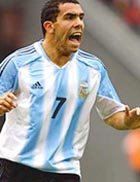
What's going on at Upton Park? West Ham United have just signed Argentinian World Cup pair Javier Mascherano and Carlos Tevez, the latter the South American Footballer of the Year for the past three years. Why would Señor Tevez, in particular, want to go to East London? As an article in today's Guardian says, the Hammers are now transformed into contenders for the UEFA Cup. It could all go wrong though - does anybody remember Alberto Tarantini's transfer to Birmingham after the 1978 World Cup?
Wednesday, August 30, 2006
More on Keef
Apparently Keith Richards is not going to be prosecuted for smoking onstage as he was within his rights, because the stage at the open-air gig was not an enclosed space. So what dolt at Glasgow City Council didn't read the law then?
Chavez Takes The Bunkers
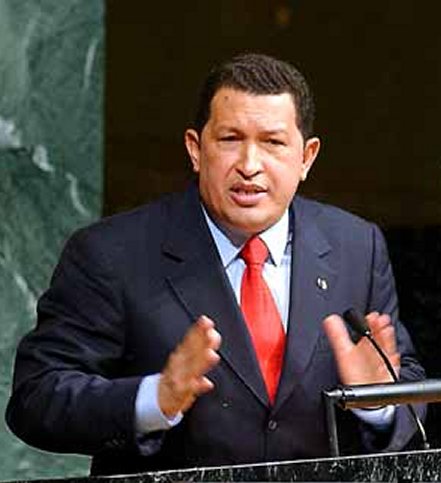
Hugo Chavez is seizing the golf courses! The increasingly zany and publicity-conscious Venezuelan president has said that he is going to appropriate two exclusive Caracas country club golf courses and use them to build houses for the city's poor. Señor Chavez and I are unlikely to be meeting for a four-ball any time soon, as I am no more a golfing enthusiast than he is. In theory of course seizing golf courses is a fantastic idea, and might well be reproduced with success the whole world round. But the reality is something more depressing, yet another example of Chavez's silly populist and politically cosmetic moves to consolidate his popularity. Chavez is hardly too bothered by alienating his enemies both at home and abroad any more, but he is in danger of losing many allies if he continues like this.
The US government is once again trying to oust Chavez, and after this incident and another highly-publicised one last week, in which Venezuelan customs busted a US diplomatic importation (with some justification), it will take some encouragement to repeat the failed cout d'état of four years ago. The US and many in the Western media have tried to paint Chavez as a dictator (and this has trickled down to many people I have met, who have travelled around Venezuela convinced that Chavez was some sort of Saddam Hussein or Pinochet), conveniently ignoring his successive electoral victories, his victory in a plebiscite on his reign floated by his political enemies (which international observers, including former US president Jimmy Carter declared to be fair) and the fact that he tolerates open criticism of him on national TV (which is almost all owned by his political enemies). Some of this criticism, such as baseball commentators letting fly at him during games, is of the sort that the likes of Tony Blair and Silvio Berlusconi would have invoked hand-picked Press Complaints Commissions to stifle. And let us not even imagine any US network tackling Bush in this way. Chavez is no angel, having himself attempted a coup d'état in 1992, while still a General, and Amnesty International have found his regime cause for concern, but by comparison with many of the tinpot dictators the US have supported in Latin America over the years he is a model democrat. The shame is that he should be engaging in such stupid and ultimately wasteful policies, which only embolden his enemies and alienate a large sector of the Venezuelan left. Venezuela is a wealthy country and redistribution of its wealth can be effected quite easily by policies that do not play into the hands of the giant to the north that would like no better excuse to re-install a compliant stooge in the Presidential Palace in Caracas.
Arabesque
Underachievement Department of Idiocy: a report from the BBC tells us that an architect of Iraqi descent was asked to remove a T-shirt with the legend "We will not be silenced" printed on it in both Arabic and English before boarding a flight from JFK to California. The flight staff of JetBlue, the airline concerned said that the T-shirt was offensive, after a number of inane passengers expressed concern over what the Arabic phrase meant.
Let us put aside for one moment the civil liberties issue here (it is but a small drop in the ocean after all compared to so much else engendered by the illegal Bush and Blair war) and ask how could anyone be so stupid as to think that somebody wearing a T-shirt with an Arabic slogan onto a commercial flight is likely to be a suicide bomber? An American is statistically more likely to be killed in a car crash or by food poisoning than in a terrorist attack, or even to be killed in a plane crash, caused by human error, as happened in Kentucky last week. The removal of the T-shirt seemed to have a talismanic effect though; once you take that scary alien language Arabic out of the equation, then the threat is gone. Whatever measures, long or short-term, might be taken to combat terrorism there is unfortunately little that can be done to legislate for idiocy. That will be with us long after Osama's assault on "Western values" has been reduced to a footnote of history.
Let us put aside for one moment the civil liberties issue here (it is but a small drop in the ocean after all compared to so much else engendered by the illegal Bush and Blair war) and ask how could anyone be so stupid as to think that somebody wearing a T-shirt with an Arabic slogan onto a commercial flight is likely to be a suicide bomber? An American is statistically more likely to be killed in a car crash or by food poisoning than in a terrorist attack, or even to be killed in a plane crash, caused by human error, as happened in Kentucky last week. The removal of the T-shirt seemed to have a talismanic effect though; once you take that scary alien language Arabic out of the equation, then the threat is gone. Whatever measures, long or short-term, might be taken to combat terrorism there is unfortunately little that can be done to legislate for idiocy. That will be with us long after Osama's assault on "Western values" has been reduced to a footnote of history.
Tuesday, August 29, 2006
…And No Funny Stuff
Gloomy, school-masterly, high-arty, lefty misanthropic (and occasionally brilliant) Austrian film director Michael Haneke is set to remake one of his worst (and most well known) films for Hollywood, claiming that he has no intention of sanitizing it for American audiences. Which is just as well, as it was barely watchable in its original incarnation. Supposed to make us question our relationship to gratuituous movie violence, the film's disurbing ultra-violence, though superbly enacted was couched in a preacherly tone that made me want to go out and watch any dumb film by his compatriot Herr Schwarzeneggar as an act of rebellion. Does Mikey seriously think that the average audience for violent Hollywood films will pay a blind bit of attention, much less get the point?
Slovenia, not Slovakia

I promised that I would post something on Ljubljana and Slovenia, and it is now over two weeks since I got back from there. The moment has passed but I will try to gather up some impressions. The most lasting one, unfortunately, was the weather. For the first two days of my stay there was almost constant rain. Apparently it is quite common in the city, especially in August. I missed the local version of the July heatwave where it was 4o˚every day. Walking around looking for a department store to buy a change of socks is not the most pleasurable way of seeing a city, and is ever less so when you are trying to find a place open after 1pm on a Saturday afternoon - the Slovenian people two years back voted in a referendum to close shops at that time. Thankfully the bars, restaurants and museums stay open. And they were of a generally high standard as long as one's feet were dry.
Slovenia has the misfortune to be often confounded with the other Slavic country further to the north, Slovakia (as it was by none other than George W. Bush during his election campaign in 2000) and the countries' two flags are also remarkably similar. Slovenia is a much more prosperous country though, the richest of the ten newest EU members, and it was historically the richest of the Yugoslav Republics. Its Mitteleuropean civic sense, as suggested by that referendum mentioned above, set it apart from the corruption and factionalism of Croatia and Serbia in the final days of the Federal Republic. According to an exhibition on Slovenian independence in the superb Museum of Modern History the Slovenians countered Milošović's plan for a Greater Serbia with a programme for the democratic reform of the Federation. When they realised that these efforts were doomed to failure, they declared independence (after a plebiscite, of course) on December 23rd, 1990. There then followed six months later a nine-day war with the Yugoslav army, which was largely bloodless and barely impinged on any of the country's cities. Since then the country has integrated itself almost seamlessly into Western Europe; apart from a few examples of Socialist-era architecture, it is almost unrecognizable as a former Communist country.
Because of the rain, I spent most of my time in the city's museums, which are not of the greatest general interest, but the Architectural Museum was fascinating for its focus on Jozé Plečnik, the man who almost single-handedly redesigned Ljubljana in the mid-twentieth century, having a hand in everything from parks and squares to churches to bridges to war memorials and arcades, and his most famous building, the National and University Library (pictured above on the left), built on the ruins of a palace destroyed in the 1895 earthquake. It is justifiably renowned worldwide as a masterpiece, and it is similar to the romanticism and sleek lines of other centres of learning of the same period, such as Gunnar Asplund's Stockholm Municipal Library and Charles Rennie Mackintosh's Glasgow College of Art. Ljubljana is probably the only city that has as an indelible a stamp of a single architect. He designed the main bridges that cross the Ljubljanica river, including the triple bridge that links Prešernova Trg with the Old Town, and the market arcades that line the river both above and under ground, (one of these houses the best bar I was in, called Makalonca, which throws up a gobsmacking riverside view, after a descent of a staircase into what at first appears to be a cellar; the barmaid there also used to live in Lucan, of all places).
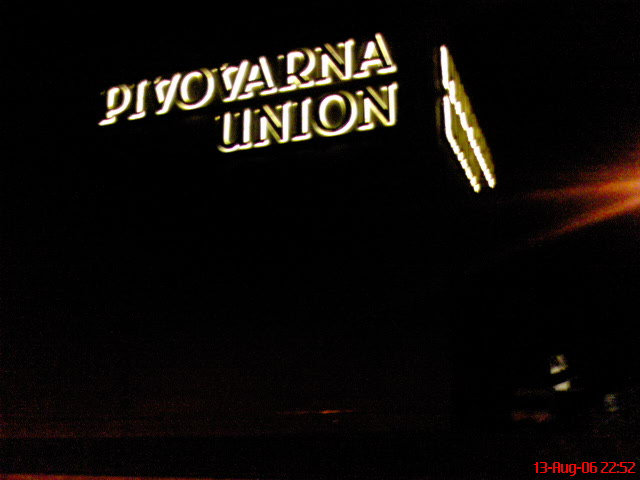
The Old Town is charming and beautiful, in a similar way to Prague or Cracow, though much smaller (the population of the city is just 330,000, with not much more than that in the greater urban area), and it is lined with bars and restaurants, whose terraces are about three times the size as their tiny indoor areas. One regrettable tendency of bar owners in the town is to pipe MTV or local radio all over their premises, including the terrace. In the age of iPods and radioblogs, you wonder is this really necessary. The beer, either Union, the local (the newly-designed brewery is pictured, at night) or Laško, from the eponymous town in the east of the country, is on a par with Czech and Slovak beer, which is the highest of praise, and is cheap, about €2 for a 50cl bottle.
Because of the rain I decided not to head off to Bled, the town and lake in the Southern Alps about an hour north of Ljubljana. It is the country's biggest tourist attraction, but I was more interested in seeing Tito's summer home, which is now a luxury hotel. Having seen the Hotel Dajtla in Tirana a couple of years back, I have developed a bit of a taste for Communist-era chic. The rain cleared up on Sunday afternoon but by then I would have been left with only an hour in Bled so I stayed in town and visited the Castle, which like the fortress in Trieste, is built on the summit of a steep hill in the centre of the town. Architecturally it is less interesting than the castle in Trieste but it was at least open. From the clock-tower there was a panoramic view of almost the whole country (it is quite small, about the size of Leinster and Munster combined). Upon descending the mount, it was time for a burek (a sort of Albanian deep-fried pizza and one of the world's great junk foods) and a beer. Some of the locals eat this stuff for breakfast and like the Italians, the Slovenes are not shy of having a beer before 11am, which took a bit of adjusting to, as none of the people I saw tippling looked either dishevelled or as if they had been out all night.
Of the few Slovene writers I am familiar with, Slavoj Žižek is the most famous, mainly because of his fame on US campuses and because he writes in English (as well as French, German and his native language). A Lacanian Marxist, known to lazy journalists as the 'wild man of critical theory' (presumably because he has a full beard), he has long resisted attempts by US universities to capitalise on his fame and get him to accept tenure. He prefers instead to work as a researcher at the National Centre for Social Research at the University of Ljubljana, located in the Faculty of Philosophy building, just around the corner from Plečnik's library. It is a dull, functional building similar to hundreds other campus buildings worldwide but it is strikingly big for a Philosophy faculty. A piece of graffito on the side proclaimed, in English: 'Fuck Marx, I love Slovenia'. Žižek has no doubt seen it and was probably amused.
I hope to go back to Ljubljana, as it is a good spot for a weekend break (to such an extent that it now unfortunately becoming a destination of choice for English stag parties) but the weather is hard to divine. A bit like back home, only more so.
Not Being Evil?
More on Google; for the first time it is going into direct competition with Microsoft, launching its own range of office software, going so far as to host it itself. And the company, in contrast to AOL, as mentioned yesterday, has been holding onto search information for its MySpace equivalent, Orkut (which is the market leader only in Brazil) resisting pressure from the Brazilian government, which says the website is being used by child pornography rings.
Monday, August 28, 2006
Smoke and Mirrors

Keith Richards is facing his latest bust, for smoking on stage at a Stones gig in Hampden Park in contravention of Scotland's new anti-smoking laws. Though I am an enthusiastic supporter of such laws, surely this is the sort of move that only alienates people further in an over-zealous application of the law. Perhaps Keef should not be above the law anymore than anybody else but he is hardly going to be as put out by the fifty pound fine as your average Glaswegian might be. It is disproportionate and silly and only contributes to the impression that such laws are the conception of humourless killjoys. The fact that Richards is being rapped for smoking at an outdoor concert calls into question the wisdom of the law banning smoking in outdoor work environments. Under Ireland's much more sensible laws he would be allowed to smoke as much as he liked, provided the work-area in which he was smoking had fifty percent of its surface area exposed. Workplace smoking bans are laudable on a purely pragmatic basis; in Ireland the majority of people - including a majority of smokers - support the laws and they will gradually eliminate smoking in society over ten to fifteen years, as well as protecting the health of those previously exposed to noxious smoke. Glasgow City Council's move to prosecute Keith Richards does not fall in with this pragmatism.
Meanwhile, French health minister Xavier Bertrand has announced that a ban on smoking in public places will be implented in January of next year, with bar-tabacs, some restaurants and other places exempt for the first year. A sensible enough compromise. His own government and his own ministry however have distanced themselves from his comments, fearful of implementing a possibly unpopular law before next year's Presidential and Legislative elections. The French will not go for the ban as enthusiastically as the Scandanavians and the Irish before them, but they are not as heavy smokers as is popularly imagined. Certainly those that drink in France smoke a lot but if you go to any small town in the French provinces, the non-smoking section is generally the larger one. If the Italians could do the ban before them, and they smoke a lot more than the French, then there should not be too much trouble here.
Don't Be Evil
An interesting, and alarming, piece in today's Guardian concerning Google's use of search information. Somebody at AOL, which uses Google as its search engine, thought it would be a good idea to gather detailed search information and post it on an online database. It was taken down within a week and the person responsible sacked (just like in Monty Python). The worrying thing is that people, both on the side of the watching and that of the watched, do not seem to see the problem with such expansive access to information. Google likes to set itself up as a benign, philanthropic counter-culture company, but it is also the fastest growing company in history, and is likely to overtake Microsoft within the next ten years. There is not any great reason to trust Larry Page and Sergei Brin any more than any other, less sophisticated or culturally inclined capitalist. Page and Brin have an ambition to catalogue and map every form of information and knowledge, hence the prolific cross-pollination of information contained in their services. Of course the real secret of Google's success lies in their selling small ads, and I find it disturbing that, when I use Gmail, the ads in the sidebar are all specifically linked to keywords in my mail text. Maybe it might be time for government intervention to rein the company in before they get too strong.
Not that the present US government is terribly worried about people's right to privacy, what with its fondness for illegal phone-tapping. I have been wondering for quite some time about those ubiquitous ads for the Green Card lottery that flash every time I use a Yahoo account. They are genuine US government placements as far as I know, and a journalist friend of mine claims that they are there for the purpose of information gathering (presumably, to 'help fight against terrorism'). It sounds a bit paranoid but they have started to appear in Metro cars here in Paris and one poster claimed, quite improbably, that 70% of successful applicants have been either born in France or have lived there. There is a story to be written on this.
Not that the present US government is terribly worried about people's right to privacy, what with its fondness for illegal phone-tapping. I have been wondering for quite some time about those ubiquitous ads for the Green Card lottery that flash every time I use a Yahoo account. They are genuine US government placements as far as I know, and a journalist friend of mine claims that they are there for the purpose of information gathering (presumably, to 'help fight against terrorism'). It sounds a bit paranoid but they have started to appear in Metro cars here in Paris and one poster claimed, quite improbably, that 70% of successful applicants have been either born in France or have lived there. There is a story to be written on this.
Dans tes rêves, Michel
The film last night was La Science des rêves, the new film by Michel Gondry. It is a truly awful piece of shite, and I am not going to waste my time appraising it in detail. Two of its more fundamental errors are imagining that other people's dreams are interesting and the erratic casting, Gael García Bernal is the lead, despite the fact that he speaks practically no French are scarcely any more English. The film only perks up when French is spoken. Gondry is working for the first time without the devilishly clever Charlie Kaufman, who scripted his last two films. He should get on the blower straight away to Charlie if he wants to make another decent film.
Final Score

The weekend's football threw up narrow victories for all three of Seanachie's sides, Sligo Rovers advanced to the quarter-finals of the FAI Cup beating Bray Wanderers for the third time this season, by two goals to one. Celtic came from behind at home to Hibs to win by the same scoreline, their new signing, the man with the longest name in football, Jan van Hennegoor of Hessilink scoring the winner. The early season still looks dicey for the Bhoys, and improvement will be needed before they face Man U and Benfica in the Champions' League. Meanwhile over here in France, St-Etienne won their third match on the trot tonight, beating Lens 3-2, though they made things difficult for themselves after leading 3-0 after 55 minutes.
In the other code, as sporting people in the West of Ireland would say, Mayo defeated Dublin in the All-Ireland football semi-final, in what was apparently a thriller, and according to my Dad, the best Gaelic football game in 20 years. Mayo will now face Kerry in a final for the third time in ten years (and their fourth final in all in that time). It seems strange as Mayo never seem to be a formidable team, and they have still not won an All-Ireland since 1952. I don't expect them to win this year but I wish them the best of luck.
Sunday, August 27, 2006
High Living on Fatty Liver
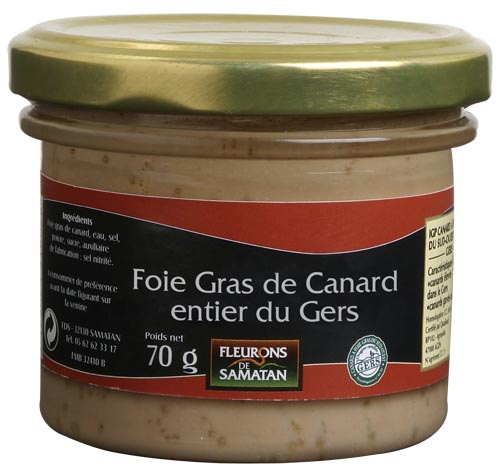
As of last week it has been illegal to sell, and therefore serve foie gras in Chicago, as a result of a a by-law passed by the City Council. Predictably enough it has been passed because of the alleged cruelty of force-feeding the geese and ducks involved in the production of the greasy liver pâté. All very well but I wonder if Chicago City Council passed a motion condemning the Israeli bombing of Lebanese civilians? I think it is highly unlikely, and the sad truth is that fowl in the south of France can muster more compassion in the West than Arabs in southern Lebanon.
Another news story on the cruelty-to-animals front is a campaign to make it illegal to slaughter horses in the US for consumption abroad. Willie Nelson and Bo Derek (remember her?) are among the, er, celebrities, that have lent their support to the campaign. I assume that many of these good people are meat eaters; as Dennis Leary used to say, you only spare the cute animals. Eating horse-flesh is one of those horrendous things that Johny Foreigner gets up to and I can understand the indignation of patriotic animal lovers seeing American horses being packed off to end up on a European dinner plate. I had foal, roasted and served in a red-wine sauce in Slovenia a few weeks ago, and I have to say I was disappointed - tough and flavourless the meat was but I would give it a go again, whatever the provenance of the equine beast.
I was a vegetarian for eight years and for much of that time I defended my rationale behind my choice not to eat meat. Now five years on from going back to meat I can no longer do that. I turned vegetarian when I was 18 and before that time I had probably never eaten in a half-decent restaurant. Nor had I left Ireland. When I started working in the catering trade, and living in France, I soon realised what a dull, philistine choice vegetarianism is. While I know that not all vegetarians are self-righteous and puritanical about not eating meat, many are. There is something infinitely smug about vegetarianism and it also bespeaks a depressing lack of curiosity about the world, about culture and about food itself. It is no coincidence that many vegetarians do not care very much for vegetables or pulses. And other than the obvious (and very different) case of Hindu vegetarianism, abstention from meat is something that exists almost exclusively in English-speaking and Nordic countries. There is a clear link with religious self-righteousness there. The thing that annoys me the most about those that abstain from meat is the way that they moan about not being catered for in countries where vegetarians are non-existent (i.e. most of mainland Europe, Latin America and Africa, and a good stretch of Asia); why in God's name should a French brasserie owner or the proprietor of a Spanish tapas bar go out of their way to provide an elaborate meat-free dish for some Anglophone with a bizarre dietary penchant, and who in most cases, makes no effort to order in the local language in the first place?
Another feature of vegetarianism, and associated strains of anthropomorphism is the consumerist easy political choice it offers; one can have a conscience without having to think about any of the nasty things going on in the world, without even having to vote. I wonder if it sits easy on the conscience of a mobile-phone-owning vegetarian the knowledge that the current war in south-east Congo is being fuelled by the tungsten trade, which is vital to the mobile telecommunications industry? It may or may not, and many people would not be too bothered. And perhaps they shouldn't be. Other than feeling mild guilt, there is not an awful lot that any of us can do about it. I have yet to meet anybody that has given up using a mobile for this reason. For my part it does not really bother me that a duck or a goose suffers during the production of foie gras. I would like to say it does, but I really do not care, even if I can hardly call myself a big fan of the stuff. I just find it depressing that people in the US or elsewhere would interest themselves in foie gras only because of its association with avian cruelty. One thing that always annoyed me when I was vegetarian was somebody pointing out for the umpteenth time that Adolf Hitler was a vegetarian too, as if there were any correlation between compassion for animals and being a psychopath. I don't do that when discussing vegetarianism but vegetarians do share a certain belief that they are absolutely right married with a lack of adventure of anything beyond what they know.
Another news story on the cruelty-to-animals front is a campaign to make it illegal to slaughter horses in the US for consumption abroad. Willie Nelson and Bo Derek (remember her?) are among the, er, celebrities, that have lent their support to the campaign. I assume that many of these good people are meat eaters; as Dennis Leary used to say, you only spare the cute animals. Eating horse-flesh is one of those horrendous things that Johny Foreigner gets up to and I can understand the indignation of patriotic animal lovers seeing American horses being packed off to end up on a European dinner plate. I had foal, roasted and served in a red-wine sauce in Slovenia a few weeks ago, and I have to say I was disappointed - tough and flavourless the meat was but I would give it a go again, whatever the provenance of the equine beast.
I was a vegetarian for eight years and for much of that time I defended my rationale behind my choice not to eat meat. Now five years on from going back to meat I can no longer do that. I turned vegetarian when I was 18 and before that time I had probably never eaten in a half-decent restaurant. Nor had I left Ireland. When I started working in the catering trade, and living in France, I soon realised what a dull, philistine choice vegetarianism is. While I know that not all vegetarians are self-righteous and puritanical about not eating meat, many are. There is something infinitely smug about vegetarianism and it also bespeaks a depressing lack of curiosity about the world, about culture and about food itself. It is no coincidence that many vegetarians do not care very much for vegetables or pulses. And other than the obvious (and very different) case of Hindu vegetarianism, abstention from meat is something that exists almost exclusively in English-speaking and Nordic countries. There is a clear link with religious self-righteousness there. The thing that annoys me the most about those that abstain from meat is the way that they moan about not being catered for in countries where vegetarians are non-existent (i.e. most of mainland Europe, Latin America and Africa, and a good stretch of Asia); why in God's name should a French brasserie owner or the proprietor of a Spanish tapas bar go out of their way to provide an elaborate meat-free dish for some Anglophone with a bizarre dietary penchant, and who in most cases, makes no effort to order in the local language in the first place?
Another feature of vegetarianism, and associated strains of anthropomorphism is the consumerist easy political choice it offers; one can have a conscience without having to think about any of the nasty things going on in the world, without even having to vote. I wonder if it sits easy on the conscience of a mobile-phone-owning vegetarian the knowledge that the current war in south-east Congo is being fuelled by the tungsten trade, which is vital to the mobile telecommunications industry? It may or may not, and many people would not be too bothered. And perhaps they shouldn't be. Other than feeling mild guilt, there is not an awful lot that any of us can do about it. I have yet to meet anybody that has given up using a mobile for this reason. For my part it does not really bother me that a duck or a goose suffers during the production of foie gras. I would like to say it does, but I really do not care, even if I can hardly call myself a big fan of the stuff. I just find it depressing that people in the US or elsewhere would interest themselves in foie gras only because of its association with avian cruelty. One thing that always annoyed me when I was vegetarian was somebody pointing out for the umpteenth time that Adolf Hitler was a vegetarian too, as if there were any correlation between compassion for animals and being a psychopath. I don't do that when discussing vegetarianism but vegetarians do share a certain belief that they are absolutely right married with a lack of adventure of anything beyond what they know.
Friday, August 25, 2006
Barley Water

Winner of this year's Cannes Palme d'Or, Ken Loach's The Wind That Shakes The Barley arrives in France, fresh from its good box-office showing in Ireland and its predictable success in getting the wind up the right-wing tabloids in Britain, an achievement, however facile, that is much to its credit. I cannot say however that I find the film itself hugely satisfying, even if I find myself in agreement with many of its political stands.
This is often the case with Loach's work, in which I usually find more to admire than to love. He is at his best when he focuses on a single character, usually a 'little man', who is caught up in minor events beyond his comprehension or ability to surmount, which are woven into the socio-political actuality. There is rarely a triumph in his films, and when there is, it is usually modest enough, or heavily mitigated. Among his best films of this sort are Kes, Raining Stones, and My Name is Joe. The new film falls in with his previous historical work, such as the 1975 TV-mini-series Days of Hope and his Spanish Civil War drama Land and Freedom. The brushstrokes are broader and the political pronouncements more explicit. Which does not necessarily make for a good film.
The film concerns the political awakening of a young medical student from West Cork, played by Cillian Murphy, who after a serious of suitably dastardly raids by the Black and Tans on his village at the start of the film, abandons the hospital job he has just taken on in England to devote himself to the cause of Irish Independence, in which, conveniently enough, his older brother is already a local commander. Loach and his regular screenwriter Paul Laverty were probably right to use Cork as a backdrop as the south-western corner of the country was the main theatre - and the most vicious one - of both the War of Independence and the subsequent Civil War. It does however present the Irish viewer at least with a difficult obstacle to overcome: sympathising with a shower of Cork people. But disbelief can be suspended, even within oneself, and given that it is the Black and Tans and the slightly more benign British Army pitted against them, they don't look so bad after all. The opening fifteen minutes are shamelessly manipulative however, on Loach's part. We have barely got to know any of the characters before we know them as victims, and victims only. The Tans break up a hurling match (inserted into the opening credits for its maximal visual value), citing it as a prohibited gathering. They then beat and hang a local teenager, who refuses to give his name in English (as ever in Irish films, the Gaelic pronunciation hangs very uneasily, and unconvincingly, on gallgeoir lips). Then a Dublin train driver, a former Citizen Army POW played by Liam Cunningham, is beaten by the Tans after refusing to transport British Army personnel or material, as ordered by his union, the ITGWU, in front of the medical student, O'Donovan, who promptly turns back to sign up for the Cause.
Anyone who is familiar with the history of the two wars, and indeed anyone with a close knowledge of any liberation struggle throughout history, will find the plot the least interesting thing about the film. The film ends predictably enough, though credibly so. Not surprisingly, the famous brother-versus-brother character of the Civil War is played out within the hero's family. Loach, unlike Neil Jordan in Michael Collins (who tried to convince us that Collins, armed to the teeth by the British 'died trying to take the gun out of Irish politics) is firmly on the side of the Republicans, and the film does enumerate in its various creakily mounted debates (a reprise of Land and Freedom) some of the sound historical arguments for rejecting the Treaty: the unacceptable threat of violence by the British in the event of its rejection (not unlike the behaviour of the US and Israel in this day), which in any case was most likely a bluff, as the UK would probably have courted too much disfavour both in the US and Europe by doing so; the disputing of the narrow election victory for the Free Staters in June 1923 as the Free State Constitution was made available only the morning of the ballot, something that would have had modern-day election observers seriously doubting the validity of such an election.
Loach views the Republican cause through the prism of the Republican left, which, by 1922 had the wind knocked out of it both by the decimation of the ICA in the 1916 Rising and the abstention of the Labour Party in the 1918 elections to accomodate Sinn Féin. Loach and Laverty are not fanciful enough to believe that the left was any stronger than it actually was, though at times their political matrix is thrust upon the characters in an ungainly way. Much of the political dialogue heaves in the mouths of the young actors, particularly Murphy's speechifying. I have never been convinced by Murphy's acting abilities; he is much too devoid of energy and life to carry a film but I can understand him being cast because of his bankability and his Cork origins. While the accents elsewhere in the film are better than average in an Irish film, there are one or two that bear the imprint of late twentieth century exposure to foreign media (and did anyone in Cork in 1920 ever speak of the King's "ass"?) and Orla Fitzgerald, as the token woman revolutionary, has both an accent a bit too plummy for a West Cork peasant girl and a very contemporary frizzy perm (to be lost to the villainous Tans in a spectacularly badly-directed scene that is supposed to be harrowing). When Murphy says at one point in the film that he hopes that the Republic he is fighting for will be worth the effort, he is showing a prescience far beyond anything that he demonstrates elsewhere in the film. His relationship with Cunningham's socialist train driver is cursorily treated and Murphy's social conscience never seems to be rooted in anything deeper than outrage at the Black and Tan attacks he witnesses. That a soot-faced Jackeen like the train driver, no matter how egalitarianist and internationalist, would have had that much time for the Corkonians in this film is itself questionable.
There are some remarkable sequences in the film however, such as the training drill early on in the film, where the more experienced IRB men laconically inform the new recruits how many of them would have been dead had they exposed their positions in combat. The violence is also treated in a brutal, unromanticised way. Loach also gives us a great stock character, in the local Unionist landlord Sir John Hamilton, played by Roger Allam, who recently played Steve Coogan's agent in A Cock and Bull Story. Allam has a wonderfully patrician contempt for all and sundry and he looks and sounds just like Christopher Hitchens, which makes him all the more imposing, and maddening. The final scene where Murphy's character refuses to cross over to the Free Staters, despite his brother's pleas, is also great, and thankfully Loach refuses to cast O'Donovan in a messianic way, as many a lesser director would have done.
The British tabloids of course did not like the film for its uncomplimentary portrayal of British security forces. I am not one of those Irish nationalists that views the British occupation of Ireland as one long simple narrative of brutality and repression, there were many nuances to it, and the Irish were quite often willing collaborators in the colonial project. But it is impossible to traduce the memory of the Black and Tans and the Auxiliary Police; they were filth and no amount of socio-historical reasoning, be it their status as lumpen proletariat, their exploitation by a cynical ruling class, or trauma suffered during the Great War can mitigate this. They should be viewed as the US military personnel who tortured prisoners at Abu Ghraib and elsewhere and judged on their own personal refusal to allow the dignity of their victims. Anti-republicans in Ireland are wont to say that films such as this give 'succour' to the present-day IRA but the gulf between the idealists of the War of Independance and the base gangsters of the Provos is too wide to give this view credence. Not that the Old IRA were saints, and they were given to atrocities that will remain unpardonable in the eyes of anyone. But they were also up against a formidable and unfettered brutal adversary. Loach never glorifies the violence committed by the Irish in the film, even if he does emphasise that of the British a bit more than necessary.
At Cannes Loach and Laverty compared the situation during the Civil War with the Occupation of Iraq; there is certainly the parallel of a subjugated people not necessarily thankful for the intervention of a foreign force, but the Insurrection in Iraq is a far more heterogenous grouping than the IRA of the time, and in some parts a hell of a lot more vicious. But Loach's message that viciousness on the part of the state will only beget more is well put. As a film overall though it is one of Loach's weaker ones. The drama is sloppily presented and, as I mentioned before, the film's dialectics are over-demonstrative and the dialogue hangs uneasily on the action. Loach seems too hamstrung by hammering his message home to allow the film an organic life. That said, a Loach film even when it is very bad, like the film about the LA janitors' struggle for labour rights Bread and Roses, is always stirring stuff, and the emotional impact of The Wind That Shakes The Barley is considerable. But, even in a poor year at Cannes, it is not a worthy Palme d'Or winner. Hopefully Loach will step back from World History for his next film and get back to the little man.
Back Home In Derry
Well done to Derry City, who have advanced to the First Round proper of the UEFA Cup, having seen off Gretna 7-3 on aggregate following an impressive first-leg drubbing away in Scotland. Commiserations to Drogheda United, who, in the same competition and after finishing level on aggregate to the Norwegians Start - managed by former Liverpool player Stig Inge Byornebye - went down 11-10 in a marathon penalty shoot-out. The unfortunate Graham Gartland missed both the first and the last kicks, possibly the first player ever to have missed two kicks in the same penalty shoot-out. Derry's reward is a tie with Paris St-Germain, and as I am an anyone-but-PSG-man, I hope to shoot down to the Parc des Princes to cheer the Candystripes on. Meanwhile, next year's European contenders-in-waiting Sligo Rovers, face Bray Wanderers, who they have already beaten twice this season, including last weekend, in the third round of the FAI Cup. C'mon the Bit o'Red!
Thursday, August 24, 2006
The Heat Is On
Further to my post yesterday on my iBook's underperformance, it appears that Apple are recalling 1.8 million laptop batteries issued between 2003 and 2006, which includes mine, due to over-heating. Not that I have ever noticed my computer overheating. What should I do? Is it connected to my problem?
Underachievement - Special Hello! Edition
Malaysian popstar Siti Nurhaliza yesterday married the presumably very wealthy businessman Datuk Khalid Mohamad Jiwa at a highly-publicised ceremony in Kuala Lumpur yesterday. Apparently it caused a bit of a stir in Malaysia, as Nurhalzia has been accused of wrecking the previous marriage of Khalid, 20 years her elder, and has lost a bit of the goodwill of the Malaysian public. Ms Nurhalzia's music is unknown to me, though she is hugely popular in South-East Asia and my guess is that I would hardly find her warblings any more listenable than those of her Western counterparts. What this episode (which was broadcast in both Malaysia and Indonesia live from a real mosque) demonstrates is the possibility of Islam co-existing with the modern West. They really are, as the Onion would say, into the same dumb shit as us. Not the good people of South-East Asia to hate our freedom. Hell, if it's packaged by MTV, bring it on!
Kiss Me, Hardly
Washington has made another 'overture' to Cuba, renewing a four-year-old offer to lift the economic embargo if Cuba 'embraces' democracy. Of course, the democracy on offer is rather something that will facilitate the return of Cuban-Miami fascists to the island and for US capital to make inroads once again in the Cuban market. A sensible foreign policy would have spurned the Helms-Burton act a long time ago, which only shored up support for Castro among his own people and won sympathy for the regime abroad; the Clinton adminstration protested to the Canadian government ten years back for doing business with Cuba and Ottawa duly told Washington where to go.
Unlike a lot of the left in the Northern Hemisphere I am no cheerleader for Castro; his time has long passed and the much-repeated mantra of 'the best literacy rates and health service in the world' are not enough to justify a continuation of his decrepit regime. Which is not to say that his intervention in 1959 was a negative thing in itself, nor that the only regime change that the Cuban people want is a neo-liberal stooge for the Bush administration. It may well be that the clichéd use of the word 'embrace' in that news report is the BBC's own but it is strange how it has come to be used in conjunction with 'democracy' so much. It conjures up a vampiric image, hardly worthy of a lofty ideal such as democracy. In fact it reminds me of the embrace and the kiss on the lips that Michael Corleone gives his brother Fredo in The Godfather Part II at the New Year's Eve party in Havana shortly before Fidel and Che run Batista and his Fortune 500 backers out of town. And we all know what happens to Fredo in that film.
Unlike a lot of the left in the Northern Hemisphere I am no cheerleader for Castro; his time has long passed and the much-repeated mantra of 'the best literacy rates and health service in the world' are not enough to justify a continuation of his decrepit regime. Which is not to say that his intervention in 1959 was a negative thing in itself, nor that the only regime change that the Cuban people want is a neo-liberal stooge for the Bush administration. It may well be that the clichéd use of the word 'embrace' in that news report is the BBC's own but it is strange how it has come to be used in conjunction with 'democracy' so much. It conjures up a vampiric image, hardly worthy of a lofty ideal such as democracy. In fact it reminds me of the embrace and the kiss on the lips that Michael Corleone gives his brother Fredo in The Godfather Part II at the New Year's Eve party in Havana shortly before Fidel and Che run Batista and his Fortune 500 backers out of town. And we all know what happens to Fredo in that film.
Nothing About Nothing
In the search for extra modes of income, I came across ads on writing websites looking for people to write copy for commercial websites. The pay is pretty awful ($7 per 400-word article, and some others pay as little as $2 for the same) but there is a large workload per week so I decided if I could master the format I could start knocking them out in less than half an hour, and make decent supplementary cash. Perhaps it would be good writing practice, writing huge amount of copy to set criteria; I even had some conception of myself becoming a macho Stakhanovite hack, unflappable in the face of fearsome labour, like Gary Cooper's architect working in a quarry in the film version of The Fountainhead.
When I attempted the first of the trial assignments that were sent me though, I soon wilted. I was asked to write 400 words on www.elitebodykits.com, mentioning key words five times throughout the passage. There were various other strictures, all of which are designed to provide a final text that is bland and barely informative in a sale-pitch way. A big disadvantage for me was the fact that I know nothing about 'body kits' and even if I decided to ad-lib the copy would be shot down for inaccuracy. After brooding over 80 words, completely lost, for over an hour, I gave up. Writing something about nothing has never held any fear for me; in fact, it's probably what I'm best at, that old school-detention assignment,"write ten pages on the inside of a golf ball" is grist to my mill. Writing nothing about nothing however is beyond me. I imagine there are people that do hundreds of these sorts of things, at an equally incredible rate, every week and earn a decent living off them. I dop my hat to them, in some way they are better men (and women) than me. I started the week envying (and admiring) the great Grigory Perelman, for his genius and his nonchalance in declining the Field's Medal (as featured in the film Good Will Hunting). I am now in awe of people much more ordinary than him.
When I attempted the first of the trial assignments that were sent me though, I soon wilted. I was asked to write 400 words on www.elitebodykits.com, mentioning key words five times throughout the passage. There were various other strictures, all of which are designed to provide a final text that is bland and barely informative in a sale-pitch way. A big disadvantage for me was the fact that I know nothing about 'body kits' and even if I decided to ad-lib the copy would be shot down for inaccuracy. After brooding over 80 words, completely lost, for over an hour, I gave up. Writing something about nothing has never held any fear for me; in fact, it's probably what I'm best at, that old school-detention assignment,"write ten pages on the inside of a golf ball" is grist to my mill. Writing nothing about nothing however is beyond me. I imagine there are people that do hundreds of these sorts of things, at an equally incredible rate, every week and earn a decent living off them. I dop my hat to them, in some way they are better men (and women) than me. I started the week envying (and admiring) the great Grigory Perelman, for his genius and his nonchalance in declining the Field's Medal (as featured in the film Good Will Hunting). I am now in awe of people much more ordinary than him.
Black Cat Back In The Fold

Niall Quinn is finding the going a bit tough as Sunderland chair-manager after the Black Cat's calamitous start to the season, so he has drafted in his old friend Roy Keane as manager. Niall, in the press conference to announce the appointment, described Roy as a 'world-class' manager, which is startling progress for a novice. Apparently Niall and Roy are getting on better these days; it must be all that Gift Grub therapy they've been undergoing together. But I wonder if Roy the Gaffer will tolerate any backchat?
Subscribe to:
Posts (Atom)

 Posts
Posts


