

I promised that I would post something on Ljubljana and Slovenia, and it is now over two weeks since I got back from there. The moment has passed but I will try to gather up some impressions. The most lasting one, unfortunately, was the weather. For the first two days of my stay there was almost constant rain. Apparently it is quite common in the city, especially in August. I missed the local version of the July heatwave where it was 4o˚every day. Walking around looking for a department store to buy a change of socks is not the most pleasurable way of seeing a city, and is ever less so when you are trying to find a place open after 1pm on a Saturday afternoon - the Slovenian people two years back voted in a referendum to close shops at that time. Thankfully the bars, restaurants and museums stay open. And they were of a generally high standard as long as one's feet were dry.
Slovenia has the misfortune to be often confounded with the other Slavic country further to the north, Slovakia (as it was by none other than George W. Bush during his election campaign in 2000) and the countries' two flags are also remarkably similar. Slovenia is a much more prosperous country though, the richest of the ten newest EU members, and it was historically the richest of the Yugoslav Republics. Its Mitteleuropean civic sense, as suggested by that referendum mentioned above, set it apart from the corruption and factionalism of Croatia and Serbia in the final days of the Federal Republic. According to an exhibition on Slovenian independence in the superb Museum of Modern History the Slovenians countered Milošović's plan for a Greater Serbia with a programme for the democratic reform of the Federation. When they realised that these efforts were doomed to failure, they declared independence (after a plebiscite, of course) on December 23rd, 1990. There then followed six months later a nine-day war with the Yugoslav army, which was largely bloodless and barely impinged on any of the country's cities. Since then the country has integrated itself almost seamlessly into Western Europe; apart from a few examples of Socialist-era architecture, it is almost unrecognizable as a former Communist country.
Because of the rain, I spent most of my time in the city's museums, which are not of the greatest general interest, but the Architectural Museum was fascinating for its focus on
Jozé Plečnik, the man who almost single-handedly redesigned Ljubljana in the mid-twentieth century, having a hand in everything from parks and squares to churches to bridges to war memorials and arcades, and his most famous building, the National and University Library (pictured above on the left), built on the ruins of a palace destroyed in the 1895 earthquake. It is justifiably renowned worldwide as a masterpiece, and it is similar to the romanticism and sleek lines of other centres of learning of the same period, such as Gunnar Asplund's Stockholm Municipal Library and Charles Rennie Mackintosh's Glasgow College of Art. Ljubljana is probably the only city that has as an indelible a stamp of a single architect. He designed the main bridges that cross the Ljubljanica river, including the triple bridge that links Prešernova Trg with the Old Town, and the market arcades that line the river both above and under ground, (one of these houses the best bar I was in, called Makalonca, which throws up a gobsmacking riverside view, after a descent of a staircase into what at first appears to be a cellar; the barmaid there also used to live in Lucan, of all places).
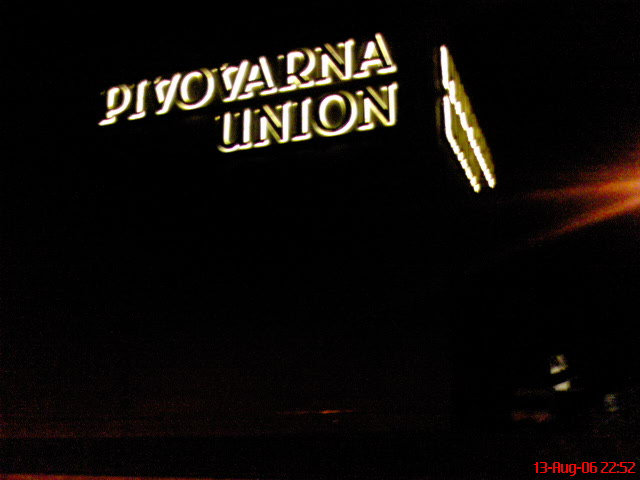
The Old Town is charming and beautiful, in a similar way to Prague or Cracow, though much smaller (the population of the city is just 330,000, with not much more than that in the greater urban area), and it is lined with bars and restaurants, whose terraces are about three times the size as their tiny indoor areas. One regrettable tendency of bar owners in the town is to pipe MTV or local radio all over their premises, including the terrace. In the age of iPods and radioblogs, you wonder is this really necessary. The beer, either Union, the local (the newly-designed brewery is pictured, at night) or Laško, from the eponymous town in the east of the country, is on a par with Czech and Slovak beer, which is the highest of praise, and is cheap, about €2 for a 50cl bottle.
Because of the rain I decided not to head off to Bled, the town and lake in the Southern Alps about an hour north of Ljubljana. It is the country's biggest tourist attraction, but I was more interested in seeing Tito's summer home, which is now a luxury hotel. Having seen the Hotel Dajtla in Tirana a couple of years back, I have developed a bit of a taste for Communist-era chic. The rain cleared up on Sunday afternoon but by then I would have been left with only an hour in Bled so I stayed in town and visited the Castle, which like the fortress in Trieste, is built on the summit of a steep hill in the centre of the town. Architecturally it is less interesting than the castle in Trieste but it was at least open. From the clock-tower there was a panoramic view of almost the whole country (it is quite small, about the size of Leinster and Munster combined). Upon descending the mount, it was time for a
burek (a sort of Albanian deep-fried pizza and one of the world's great junk foods) and a beer. Some of the locals eat this stuff for breakfast and like the Italians, the Slovenes are not shy of having a beer before 11am, which took a bit of adjusting to, as none of the people I saw tippling looked either dishevelled or as if they had been out all night.
Of the few Slovene writers I am familiar with,
Slavoj Žižek is the most famous, mainly because of his fame on US campuses and because he writes in English (as well as French, German and his native language). A Lacanian Marxist, known to lazy journalists as the 'wild man of critical theory' (presumably because he has a full beard), he has long resisted attempts by US universities to capitalise on his fame and get him to accept tenure. He prefers instead to work as a researcher at the National Centre for Social Research at the University of Ljubljana, located in the Faculty of Philosophy building, just around the corner from Plečnik's library. It is a dull, functional building similar to hundreds other campus buildings worldwide but it is strikingly big for a Philosophy faculty. A piece of graffito on the side proclaimed, in English: 'Fuck Marx, I love Slovenia'. Žižek has no doubt seen it and was probably amused.
I hope to go back to Ljubljana, as it is a good spot for a weekend break (to such an extent that it now unfortunately becoming a destination of choice for English stag parties) but the weather is hard to divine. A bit like back home, only more so.




 Posts
Posts





