Shokuzai (Kiyoshi Kurosawa – Japan) Part 1: 119 minutes Part 2: 148 minutes
Kiyoshi Kurosawa’s last film Tokyo Sonata (2008) featured a salaryman who doesn’t tell his family he has been made redundant and continues to go to work as normal, hanging around a public park, dressed in his suit, with other jobless corporate workers. The film met with reasonable international success but was a flop in Japan and Kurosawa has since struggled to get funding for subsequent films. Like the hero of Tokyo Sonata, he continued going into work anyway and eventually got a television series off the ground. Based on Kanae Minato’s best-selling novel, Shokuzai (‘Penance’) was a five-part mini-series, released outside of Japan as a two-part film, running to four and a half hours in total. Its made-for-TV origins are rarely evident and it's a fine addition to Kurosawa’s oeuvre, which has long straddled horror and social realism.
The film focuses upon the rape and murder of a seven-year-old girl, Emili, the daughter of an industrialist recently arrived in a small Japanese town. Four of her friends are with her as she is taken away by her killer, who poses as a technician doing repairs in their school; the four girls discover her body but, traumatised, they are unable to help the police and the hunt for the murderer goes cold. None of this convinces Emili’s mother Asako (Japanese pop star Kyôko Koizumi, previously seen as the wife in Tokyo Sonata) who takes the four aside and tells them she demands information from them or else she will exact unspecified compensation.
After the initial prologue we fast-forward fifteen years, where the girls are now young women leading separate lives. A different episode focuses on each, with the only common thread the presence of Asako, who flits in and out, looking increasingly deathly, as if she is an avenging angel. Each of the four women has internalised her trauma in a way that ‘de-feminises’ them – Sae (Yû Aoi) has never menstruated once in her life, convinced it is punishment for her failure to remember the killer’s face. She meets and marries a former school friend, now a wealthy businessman, who is seemingly unfazed by her barrenness but who incorporates her into a weird fetish whereby she adopts the role of a passive rag doll. Maki (Eiko Koike) is a primary school teacher, in a school very similar to the one the killing took place in; she practices the martial art Hiro Koda and has an overbearing possessiveness regarding the children in her care, which is one day put to the test when a knife-wielding maniac attacks them.
Akiko (Sakura Ando) has turned into a tomboyish hikikomori, living with her parents, playing video games in her room and whose only social relationship is with the neglected seven-year-old daughter of her brother’s girlfriend. Finally, Yuka (Chizuru Ikewaki) follows her sister to Tokyo and promptly seduces her husband behind her back.
Shokuzai is an unusual horror movie in that the fateful killing is kept largely offscreen and happens at the beginning, letting the story, and the characters, unwind from thereon out. Like Kurosawa’s previous films, the tone is one of heightened realism, where just the slightest modification of the everyday is sufficient to induce uneasiness in the viewer. Though the plot lurches from time to time into the incredible, the film’s portrayal of disturbed characters is masterly and complex.
The only flaw lies in the final episode, which offers a framing narrative, focused on Asako herself, and which delivers the answer as to who killed Emili. All this is a bit unnecessary as Shokuzai has not been a whodunnit up until that point and it delivers a very weak punch indeed. One presumes that Kurosawa inherited it from the source novel and television executives would have been none-too-keen to change the ending. It does seem at odds though with the rest of the film and Kurosawa’s previous work. Still, the damage is not fatal and Shokuzai is a remarkably rich work that has made Kurosawa bankable once again. He has another film, Real, on the way but more troubles have arrived, with his biggest production to date, the historical drama 1905, largely in Chinese, starring Tony Leung, falling foul to budgetary problems and the Shenkaku Islands dispute between Japan and China. The poor man must feel as cursed as the characters in his films.
Showing posts with label Japan. Show all posts
Showing posts with label Japan. Show all posts
Thursday, July 11, 2013


Wednesday, August 01, 2007
Underachievement's Annual Sumo Wrestling Post
The Guardian's always-entertaining Fiver mailshot is the source for today's scandalous news. Mongolia's sumo-wrestling pride and joy Asashoryu Akinori (apparently considered one of the greatest wrestlers in the long history of Sumo) has been banned from the next two grand tournaments after being caught playing football back home in Ulaan Baator, despite telling the sumo authorities he was injured. The chat forums (including this thread started in Dublin) are hopping and here is the newsflash from Japan just in case you don't believe us:
Sunday, April 29, 2007
A Curious Coincidence

I read on the front page of the International Herald Tribune yesterday of the death of the Russian cellist and Soviet-era dissident Mstislav Rostropovich, and later, having just begun reading Kenzaburo Oë's 1983 novel Rouse Up O Young Men of the New Age!, I came across this passage on page 20:
Before it had become plain that he was fuming, Mr H had removed his International Herald Tribune from its paper cover and shown me an article whose contents I can convey vividly: it was about the cellist Mstislav Rostropovich's attack on the suppression of freedom of speech in the Soviet Union. Still in Russia at the time, Rostropovich was dedicating himself to defending his comrade Solzhenitsyn, and I had copied his remarks in the flyleaf of the book I was reading that day: "Every human being must have the right to express without fear his own thoughts and his opinions about what he knows and has experienced. I am not talking about simply regurgitating with minor modifications opinions that have been fed to us..."
A strange coincidence, a ghost from the past, almost. That serendipitous passage apart, the novel seems to be - to judge from the first forty pages at least - one of Oë's finest, beautifully written and translated. Like most of his fiction since the amazing A Personal Matter, published the year after the birth of his brain-damaged son Hikari, it is autobiographical and the brain-damaged son features once again, this time a teenager and grappling with the frustrations and fears brought on by puberty. What is most remarkable about Oë's work is that he writes novels about writers and intellectuals without ever sounding dull; when he tells of his experiences travelling around Europe while reading Malcolm Lowry or William Blake in the original, he provides revealing glosses and reflections of his own experiences (the novel also takes its title from Blake). At one point he describes his reading as a young student of French: "I continued to feel that I was reading to forget", something that will be familiar to anybody who has waded through masses of text for academic research. Oë could give John Banville a few lessons
Monday, March 12, 2007
A Better Eastwood

Late last year I reviewed Clint Eastwood's Flags of our Fathers, the first of his diptych about the Battle for Iwo Jima, which I found well-intentioned but worthy and dull, and ultimately devoid of sufficient tension to make it a memorable war movie. The companion piece, Letters from Iwo Jima, which was surprisingly nominated for a number of Oscars and which treats of the Japanese soldiers who died defending the island, is curiously a more interesting film. The film, based mainly on the letters of Imperial General Tadamichi Kuribayashi, who is played by Ken Watanabe, is an old-fashioned Renoiresque slice of humanism, that, even if it does not quite realise the ambitions either of its subject matter or its lenght, is for the most part engaging.
As well as Gen. Kuribayashi, an equestrian champion at the 1932 Los Angeles Olympics, the film focusses on the lives of a young conscripted baker Saigo, played by Japanese boyband singer Kazunari Ninomiya and the cynical but good-hearted Shimizu, played by Ryô Kase, who has been seen in such excellent Japanese films of the past few years such as Katsuhito Ishii's The Taste of Tea and Kore-Edu Hirokazu's Nobody Knows. Shimizu is a former Tokyo policeman mobilised as punishment for insubordination when he fails to kill a family pet on his beat. What makes the film most interesting is its gradual pull towards the ineluctable military humiliation seen through the eyes of men who by the end of the film have been thorougly sickened by both the ravages of the battle and the Imperial propaganda fed them. Iris Yamashita's screenplay is a bit creakily schematic in its exposition of the change in heart among the men but the performances alone are persuasive and it is good to see a film that shows the losing side of war, especially that fought by ordinary people whose cause was abominable.
Eastwood's diptych is a refreshing redressal of the simplistic hagiography of US soldiers that followed Saving Private Ryan and Band of Brothers, something that has since fed into bullying of any American that dared to criticise the US' involvement in Iraq. One senses that Spielberg, as co-producer on these two films, has a tinge of regret at the way his own laudable message has been used. While the film has been a huge hit in Japan, possibly the first American film about the war to be so, it is also unmistakably an Eastwood film, bearing the unfussy but well-crafted stamp of his entire oeuvre, which, even when the films are not that good, always delivers a few qualities. My opinion might be tinted by having recently seen the second half of the series, but I even think that the earlier, inferior film might be enriched by proximity to Letters from Iwo Jima. Well worth seeing.
Wednesday, January 10, 2007
First Two Films of the Year

A short post on two not-unpleasing films I saw in the past few days. First there was Kiyoshi Kurosawa's Loft, the latest in a line of maddeningly oblique and opaque psychological thrillers by the Japanese director, who is no relation to his much better-known namesake. The tale of a female writer suffering from, yes, you've guessed it, writer's block, who holes up in the country, only to discover that the man next door is hoarding an 800-year old mummy, who was preserved in the same mud that the writer appears to be puking up every day. A film that can yield either no interpretation or dozens, depending on your disposition. Half the audience walked out (in my opinion not always a bad sign). If nothing else, I was interested to the end and the photography, low-lit, ethereal and misty like that of the great Kazuo Miyagawa, is stunning.
Allen Coulter's Hollywoodland suffers from the same problem as many other filmic tales of the history of American popular culture such as Quiz Show, The Aviator, and Gods and Monsters: it is really hard to care about the injustice that lies at the heart of it all, the distance in years being by now too great. But the film is enjoyable nonetheless with Ben Affleck worryingly convincing as the washed-up Saturday-morning-serial actor (and former Superman) George Reeves, and Adrien Brody as the gumshoe who tries to unravel the facts behind his suspicious suicide. The film plays on every hoary cliché known to viewers of films from Hollywood's golden era, down to the smug straightening of his suit by a beefy doorman as he is caught in the flash of a surreptitious lens, but I found myself strangely forgiving of this, even of Brody's character who is much too James Dean for a World War II veteran in 1959. But Allen Coulter's direction is assured and the film is entertaining enough to forget that it was based on a true story in the first place.
Tuesday, August 22, 2006
Watching An Old Classic Again
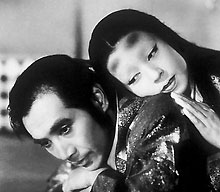
Another film I watched for the second time last weekend was Kenji Mizoguchi's Ugetsu Monogatari, a canonical work from 1953. The experience was unfortunately a disappointment; I had just been caught in a downpour before I went into the cinema so I watched the film sitting in sodden clothes. This may or may not have had any bearing on the film not being quite as good as when I saw it last about eight years ago. The tale of two brothers, one a successful potter and the other a simpleton with delusions about being a Samurai, and their two wives caught up in the Japanese civil wars of the 16th century. One brother goes off and finagles his way into a Samurai position by killing a genuine soldier and claiming his booty as his own. Meanwhile his wife, at home and unprotected is raped by marauding soldiers and eventually sells herself into prostitution. The other brother is duped into a bigamous marriage with an admiring aristocrat, who it turns out is a ghost. When he returns home he discovers that his wife has been killed by more soldiers.
The film is a caution against pride and hubris, and while it might seem conservative in the synopsis above, there is a strongly transgressive nature to it, as in all Mizoguchi's work. The portrayal of a Samurai as a cowardly impostor would have been unthinkable ten years before under the Empire, and as is common with Mizoguchi, the women are far more admirable characters. I remember thinking the film was one of the best thirty or so I had ever seen but on second viewing it appeared lugubrious (the friend I saw it with, someone not adverse to such films, claimed that he was bored). The shimmering monochrome photography of the great Kazuo Miyagawa, who also worked with Kurosawa, Ozu and Ichikawa among others, is still fantastic, as is the portrayal of the mad brother by Eitarô Ozawa, which is disturbing in direct proportion to how annoying it is. And the famous (or at least to hardcore cinéphiles) scene towards the end where Genjurô the potter returns to his family, not knowing that the wife he sees is but a ghost, is as moving as it was last time I saw it.
Perhaps the film needs another watch; I have seen about ten films by Mizoguchi since I last saw Ugetsu and they are of varying quality. Some are boring and too stately, others such as Sansho Dayu and Streets of Shame are exhilarating. The interest in many of them is the way they reflect the time in which they were made, as Mizoguchi worked from the early silent era, through the Imperial era and into the post-war democratic age, making over 100 films, about half of which have been lost. There is still enough in Ugetsu Monagatari (which, incidentally, means 'Tale of the Pale and Silvery Moon after the Rain') for it to remain indisputably a great film, but the nature of such slow and old-fashioned work is fragile and something can go amiss on second viewing.
Friday, July 14, 2006
Two Passengers
I happened to see two films of the same title yesterday, by pure coincidence. The first one was a Franco-Québécois-Japanese production from which I have three degrees or so of separation. A friend of mine edited a short film directed by one of the associate producers on this one. The short, which will remain unnamed, was awful, but this was a lot better. The tale is of a dodgy Japanese businessman, who is apparently robbed of money he owes a mob syndicate by a dodgy Québécois businessman. His teenage daughter then persuades her part-time mobster, part-time rent boy boyfriend to go to Canada and get it all back, thereby saving her father's skin. The plot is the least interesting part of the whole thing and even the twist in the final five minutes of the film is a bit pointless. But the film succeeds in its immaculate framing, particularly of long shots, and the editing is superb, chugging along at a nice slow pace, yielding its secrets only every so often. Not bad for a film with a shooting budget of 95,000 euros.
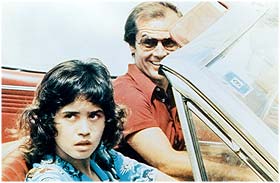
The second is Michelangelo Antonioni's much better known 1975 film, starring Jack Nicholson as a disillusioned reporter, who swaps identity with a casual acquaintance who dies on a trip to an unnamed Saharan country (most likely Niger or Chad), thereby faking his own death in the process. It turns out that the other chap was a shady arms dealer and it is up to Jack to seize the day and ride his luck and travel all around Europe in an existential haze, or it seems, just for the heck of it, while his widow gets suspicious and tracks him down to Almeria. I saw it first about six or seven years ago on video and I was surprised, upon watching it again how funny it is, which is not usually the most striking quality of an Antonioni film. There is an unusually dizzying sense of release and abandon in the way that Nicholson runs away from everything (one great scene has the Maria Schneider character asking him what he is running from and he tells her to turn around in the car and look at the road behind) and I imagine that the film's trans-European trajectory would have had an even greater romance in the days before cheap flights. The famous penultimate shot, a five-minute zoom-and-pan that appears to pass through the grills of a window is not, on second viewing quite as virtuostic as I originally thought - if you look closely you can see the joins - but it is an amazing shot in terms of composition and the way it draws the action to a close, reprising the grammatical elements of so many earlier shots in the film. One I would like to see again.
And if that weren't bad enough, there have been three other films named The Passenger released in the past year.
Subscribe to:
Posts (Atom)

 Posts
Posts





