Je suis supporter du Standard (Riton Liebman – France/Belgium) 90 minutes
Standard Liege (or, to give the club its full title, FC Royal Standard de Liège) is not Belgian football’s most successful club, its ten titles paling in comparison to Anderlecht’s 32, Club Brugge’s 13 or even now-lowly Saint-Gilloise’s 11. Standard are, however, a sentimental favourite among Belgians, with their appeal, like few other things in the country, straddling its linguistic divide. Riton Liebman, who first came to attention as a teenager in Bertrand Blier’s 1978 comedy Préparez vos mouchoirs, directs his first features and stars as Milou, who, like Liebman, is a Bruxellois who fell in love with Standard as a child (no doubt because the 1960s and 1970s were the club’s glory years). Je suis supporter du Standard is a Belgian Fever Pitch of sorts though it bears better comparison with David Evans’ so-so 1997 film than Nick Hornby’s fine book, published five years earlier.
Milou is a forty-year-old n’er-do-well, a man-child living alone among his Standard memorabilia and his Panini stickers, who never leaves the house without one of his dozens of replica shirts and owes his job as a driving instructor to the fact his uncle owns the driving school; he reminds you of those football fans who pop up from time to time in the side columns of tabloid newspapers having named their first-born after the entire squad. This ought to make him prime material for a good comedy, all the more given his mother is a psychoanalyst and he, like Liebman, is Jewish. The script makes some play with the psychoanalysis and the humour of Jewish neuroticism but it is soon cast aside in favour of rather less lofty laughs. Milou, when he messes up on a promising date (Léa Drucker), belatedly realises he has an addiction and tries to get it under control – the title refers to the standard Alcoholics Anonymous introduction, and Milou unsuccessfully tries to get AA to let him in as a ‘footballic’.
The jokes in the film are predictable and lame, mainly because they are mined from situations that just don’t happen in real life. Among these are when a friend of Milou, on an away trip to Gent, leaves a ticket for the late-arriving Milou, on the gate with a match steward who doesn’t speak French. Milou subsequently watches the match in a Gent supporters bar in the shadow of the stadium (surely these fans would all be at the match?) and gets found out when he celebrates a Standard goal and is tossed in the nearby canal. Such creaky mechanics are an all-too-common feature of the plot and the football-supporting-as-addiction trope is not terribly convincing, especially given Liebman, in real life, battled heroin addiction for a long time. Neither is Liebman much of a director – his visual palette hardly stretches beyond the functionality of television. A film whose appeal to football fans (its obvious target) will be dented by a rather facile critique of their passion, its hard to see who will be interested by Je suis supporter du Standard.
Showing posts with label Belgium. Show all posts
Showing posts with label Belgium. Show all posts
Sunday, June 02, 2013


Monday, February 26, 2007
Bugs, Belgians and Germans

Short of time so a quick resumé of a number of films I saw in the past week. There was William Friedkin's Bug, a film I went to see only because of a number of glowing reviews it received in the French media (Friedkin is one of those faded Brat Packers who the French still revere). Based on a play by Tracy Letts (and boy do its stage origins show) it is a diverting if not exactly memorable paranoia thriller about an AWOL marine who is convinced that he has had a colony of ravenous bugs implanted in his body by the CIA on behalf of a wider global conspiracy. Sounds like great fun already and joining Michael Shannon, who plays the paranoid marine, are nineties next-big-thing Ashley Judd and former Sinatra seatwarmer Harry Connick Jr., who is very good indeed, if largely superfluous. And there is also Irish actor Brian F. O'Byrne as a, well, shifty CIA doctor. It has one of the nastiest tooth extraction scenes in cinema history and should do a far trade on the DVD rental market.
There was also Steven Soderberg's The Good German, an anaemic and uninvolving espionage drama set in post-WWII Berlin. Soderberg makes films with such regularity that there are some that slip through the net; personally I think he is at his best with his less serious efforts, such as Schizopolis, Out of Sight and Ocean's 11. This is one to file alongside dull pedantic efforts such as The Limey and Solaris. I posted on Carol Reed and Graham Greene's The Third Man recently and it is striking how much fresher it is than this clunking beast that is let down as badly by Soderberg's own hamfisted monochrome photography as it is by the earnestness of the performances (Cate Blanchett Lili von Stupp-like Jewish whore is particularly culpable).
Better than these two is the Belgian film Nue Propriété, directed by Joachim Lafosse and which stars as Isabelle Huppert as a forty-something divorced mother of two spoiled brothers, played by real-life brothers Yannick and Jérémie Regnier - the latter of whom was in both the Dardenne brothers' La Promesse and L'Enfant. The film is a quiet, well-observed drama detailing the falling-out of the family as Huppert attempts to sell the family home, which the boys, and their estranged father, see as theirs, in an effort to open up a restaurant with her new beau. Nothing of note happens until the final twenty minutes but Lafosse has an impressive eye for detail and when the drama does arrive it is abrupt and unexpected. Huppert is excellent as the beleagured mother and even better is Patrick Descamps as her ex-husband, a great actor who has been a regular in the films of Lucas Belvaux. A worthy addition to the canon of bleak Belgian cinema.
Monday, July 24, 2006
One Night Flingue
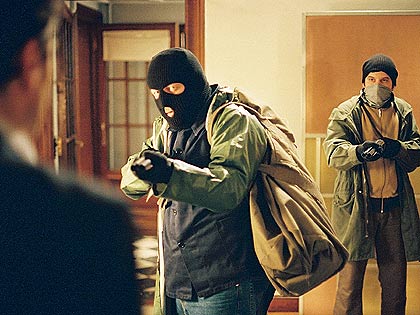
Lucas Belvaux (best known for his trilogy of three years ago, released in English as Trilogy:One, Two, Three etc.) is back with a film set in his native Belgium, entitled La Raison du plus faible (it translates, ungainily, as 'The Reason (or reasoning) of the Weakest'). It's a thriller set in the depressed industrial city of Liège. Two laid-off steel workers plot to steal the safe of their old workplace which is filled with the proceeds from the new owners' asset-stripping. To help them they engage an ex-con, Marc (played by Belvaux himself), recently out of prison, having served time for armed robbery and still reporting to the cops every day, but he soon withdraws as he knows he's dealing with a bunch of amateurs. He ends up getting replaced in the scheme by the mild-mannered unemployed college graduate Patrick, for whom Marc initially got involved so that he could afford to buy his wife a new moped. If this does not sound silly enough, well even worse is the speed with which the three bunglers adopt a criminal élan. It all ends predictably badly, with the lads reverting to type in the last ten minutes like a plucky non-league team caving in in the ninetieth minute of a cup-tie. And then the focus switches, inexplicably to Belvaux's character, and we see him as a romantic criminal hero, of the type you would get in a Popular Front-era film by the likes of Jean Renoir, Marcel Carné or Julien Duvivier. Which is all very well, but it's a change of gear a bit too late in the film, and like the rest of the film, not terribly convincing.
Belvaux does however conjure up some fantastic images of the industrial decay of southern Belgium, particularly in the scenes set in the disused steelworks and the haunting shots of the high-rises where one of the gang lives. The fact that Marc works in the local Jupiler bottling-plant (Jupiler being the biggest-selling beer in Belgium), one of the few staples of the manufacturing base that has not been out-sourced, provides a poignant metaphor for the prospects of the local working class. Like nearby Seraing, which features in all the films by the Dardenne brothers, Liège does not look like a place you would want to live. This film, however, isn't up to the standard of the Dardennes.
I also saw Michael Winterbottom's The Road to Guantanamo, which somehow won him the Best Director award at Berlin this year. Politically it is laudable, if predictable, though it does indulge the Tipton Three a bit by not questioning the nature of the 'help' they had planned to give in Afghanistan. From a dramatic point of view it is slapdash and not always convincing. The film straddles fiction and documentary uncomfortably and I found that too many of the scenes involving US soldiers jarred. I worked on a documentary on the Iraq war, and all US soldiers, even the likeable ones, were meaner and tougher than the actors deployed on this. That said, if it convinces anybody of the blight on the planet that is Camp X-Ray (and Camp Delta) it will have done its work. Anyone doubting that Guantanamo violates the Geneva Conventions might want to read this brief summary.
Subscribe to:
Posts (Atom)

 Posts
Posts





