Showing posts with label Comics. Show all posts

Friday, November 01, 2013

Snowpiercer – Bong Joon-ho


Snowpiercer (Bong Joon-ho – South Korea/USA/France) 126 minutes

Bong Joon-ho, director of the excellent Memories of Murder, The Host and Mother, makes his first foray into English-language film for what is the most expensive South Korean production in history. Unfortunately, the whole thing is a sorry mess. Snowpiercer is based on a mostly forgotten French comic book Le Transperceneige, which started running in 1984, and the production design, which is admirable, borrows heavily from the source material. The opening sequences inform us that in 2014, world governments, in a desperate attempt to offset global warming, smothered the planet in a chemical called CW7, which accelerated the onset of a new Ice Age. All life on Earth has died, with the only survivors having boarded, Noah’s Ark-like, a massive train, powered by a perpetual-motion engine. Now, seventeen years in the future, it travels continuously across the Asian, European and African landmasses on a circuit that had been built by its megalomaniac industrialist owner, one Mr Wilford.

The train is divided according to a binary class system, with those at the head ruthlessly suppressing the proles in the tail. There doesn’t seem to be any rhyme or reason to this division, other than arbitrary pauperisation in the interest of Wilford’s holistic belief of constant order – the underclass does not appear to be retained to do any work, be it slave or indentured. The tail-dwellers, living in squalid, cramped misery, mount a new revolt – all previous ones have been savagely put down – masterminded by Gilliam (John Hurt), a crippled Gandalf-type figure, and led by Curtis (Chris Evans) in which they hope to get to the head of the train and take the ‘sacred’ engine. On the way they enlist the help of train engineer Namgoong (Bong regular Song Kang-go) and his daughter Yona (Ko Ah-sung), both of whom are addicted to Kromul, a drug made from industrial waste that is hugely popular in the front of the train.

Blocking their way is a fearsome army of security guards, led by Franco Elder (Vlad Ivanov – the abortionist from 4 Months, 3 Weeks, 2 Days) and overseen by Mason (Tilda Swinton as a weird cross of Margaret Thatcher with Nora Batty). The first disappointment of Snowpiercer is it doesn’t have anything to elevate itself above your run-of-the-mill apocalyptic drama, even though it clearly fancies that it does. The backstory remains as flat as it does on the page – comics can get away with short-hand like this, films need to flesh things out a bit more. The information that is divulged about the train’s history comes far too late in the film, by which time its possible dramatic impact is vitiated. It is also, for all the grisly scenes of axe murder, and talk of horrific living conditions, not a very disturbing film. Rarely do we get a real sense of menace, and even then, it mostly comes by way of the wordless killer played by Ivanov, whose character is pretty cliched anyway.

The dialogue, despite being worked on by New Yorker Kelly Masterson, is seriously hokey and embarrassing, with Swinton in particular being given some of the most cringe-worthy: ‘Water comes in the mouth, not through the bum’, when she explains how the engine absorbs snow for the train’s water supply. Chris Evans, who played Captain America in The Avengers, is far too lightweight a presence, and too wooden an actor, to carry a film as heroic leader. There are a few efforts at satire, such as a scene where kids are indoctrinated by a cheery schoolteacher (Alison Pill), but these are flat and one-dimensional. Snowpiercer has to recommend it some good production design and well-choreographed action sequences but it is for the most part catastrophically inept. Here’s hoping the talented Bong Joon-ho soon gets back to something smaller in scale and avoid the bombast on display here.


Friday, August 02, 2013

Man of Steel & Pacific Rim

Man of Steel (Zach Snyder – USA/Canada/UK) 143 minutes

Pacific Rim (Guillermo del Toro – USA) 130 minutes

Christopher Nolan, at the end of his career, will be able to say one thing: he single-handedly made comic-book adaptations very serious indeed. Many comic fans date the start of the super-hero seriousness to Frank Miller’s refitting of Batman in The Dark Knight but it was Nolan that brought that extra gravitas to the summer blockbuster. Batman Begins started it all off, a post-9/11 muscular liberal fantasy for tough-but-fair Americans paralysed by the Bush presidency.  After a decent enough sequel in 2008’s The Dark Knight, Nolan went full-Samuel Huntingdon with the thinly-veiled millenarianism of The Dark Knight Rises.

Nolan now has got his mitts on Superman for the latest renewal of the franchise, Man of Steel. Comic aficionados have long considered Superman a slighter creation than its DC Comics stablemate from Gotham. All film adaptations thus far have been duly hokey and comical, including the most recent – Brian Singer’s mishit Superman Returns, which made the error of building the film around Kevin Spacey’s Lex Luthor. Man of Steel, produced and written by Nolan, is not in the business of such frivolity. The traditional Superman villain Luthor is jettisoned, in favour of General Zod, who last appeared in Richard Lester’s splendidly enjoyable 1981 Superman II. This affords more capacity for Nolan’s civilisational concerns. Zod, played by the gnarled, doesn’t-suffer-fools-gladly Michael Shannon, is a Coriolanus figure, who has been exiled from the doomed planet of Krypton after a failed coup, around about the same time the infant Kal El is sent into space to maintain the planet’s lifeblood. Zod and his cronies, in Superman II, were dispatched trapped in an oversized make-up mirror; this time they are rather humanely placed in giant dildos, in one of the rare unwitting moments of humour in an undertaking of otherwise great import.

If I have spent more time so far talking of Zod than Superman, that is because he is a far more interesting character than the buff cipher at the centre of the piece, played by Henry Cavill, who is all alpha pecs and beta countenance and is as unlikely to linger in the popular consciousness any longer than the last Clark Kent, Brandon Routh. Shannon as Zod is a steely military realist, one you find yourself nodding along in agreement with, even as he openly advocates genocide to clear Earth for Krypton colonisation. Superman, on the other hand, is despairingly wispy, saddled with even more backstory than ever. Two father figures loom heavily, played by Kevin Costner, in folksy Mid-Western mode, and Russell Crowe, as Jor-El, increasingly ludicrous as he yaws about in the Sunday best of his faux-RADA accent. Lois Lane is, of course, in the mix too, this time played by a suitably girl-next-door Amy Adams, who even passes muster somewhat as a Pultizer-prize winning journalist.

All this though is to accord more significance to Man of Steel than is really warranted; there is little more than your average mega-budget action movie on display. Zach Snyder (he of Watchmen and 300) films in the Nolan manner but directs with far less verve; the movie strains for the epic but its dun tempera palette reminds you too often of a heavy metal album cover. The music couldn’t get any more intrusive – Hans Zimmer’s score practically shits Valkyries; if I never hear a bassoon again in my life, it won't be too soon.

But if the film’s execution is questionable, it is the tone that ultimately sinks it. Dredging up underlying themes and subtexts in popular comic books is a legitimate endeavour (Mark Millar’s Superman: Red Son is a fantastically inventive variation on the original Superman) but need it all be done with such overweening urgency? The original Superman films starring the late Christopher Reeve (OK, with the exception of the fourth) were well-packaged entertainments with just enough intelligence to anchor them in a recognisable narrative discourse. They were also packed with wit and had a winning sense of their own playfulness (who can forget Terence Stamp’s Zod in Superman II remarking of the US president kneeling before him: "this man cannot be your leader if he kneels so easily"?) A light touch is no guarantee of success in a comic book adaptation – Singer’s Superman Returns and Joel Schumacher’s two Batman films are both immeasurably worse than Man of Steel – but the more I see these Nolan-produced works the more I think erring on the side of levity is the way to go. Besides, if a film like Man of Steel is so determined to be taken seriously, why give it a title that evokes none other than one of the biggest mass murderers of the 20th century?


Guillermo del Toro’s Pacific Rim, despite grappling with similar issues such as the possible eradication of human life from Earth to benefit a more advanced species, is an altogether less serious film than Man of Steel. It also feels like a throwback to blockbusters of the 1990s, resembling at times Independence Day, Men in Black, Armageddon and, naturally, Godzilla. That is hardly the greatest of pedigrees but del Toro’s film, while it is nothing special, is still better than all but the Tommy Lee Jones/Will Smith vehicle. Like Man of Steel, it struggles to bring some freshness to a very limited genre in a similar way to how designers must re-work an iconic football shirt every year or two. Pacific Rim does manage though to occasionally step outside the blockbuster’s traditional comfort zone.

The film, despite being a little overlong, is also admirably economical with its story-telling. A brisk voiceover sets the scene in the opening few minutes: alien life-forms have begun to attack Earth from a portal called ‘The Breach’ that reaches deep under the Pacific Ocean. These huge monsters, called Kaiju, look like they share some DNA with Godzilla, and carry out relentless raids on the agglomerations on each side of the ocean. An international coalition develops the Jaeger, a massive human-like machine that is powered by melding the consciences of its two pilots with technological interface. In the prologue, we see two pilot brothers, Raleigh and Yancy Becket, bested by a Kaiju, costing Yancy his life. Raleigh (Charlie Hunnam, of Queer as Folk by way of Sons of Anarchy) then drifts into casual labour as governments decide to withdraw support for the Jaeger project. Commander of the project Stacker Pentecost (Idriss Elba) decides to go rogue and summons the remaining pilot teams to his base in Hong Kong, including Raleigh, whom he feels still has something to give.

Raleigh is paired with Mako Mori (Rinko Kikuchi, of Babel and the brilliant Japanese comedy A Taste of Tea), orphaned in a Kaiju attack on Tokyo, the trauma of which causes Pentecost to doubt she is temperamentally capable of graduating to being a pilot. The film from hereon out is predictable enough. Even so, there are a few pleasing innovations – the technological process that allows the pilots to merge with their machines is intriguing and even has an elegant name: the ‘neural handshake’. The film, while it has American heroes (though, interestingly, both played by Brits), is de-centred for a summer blockbuster. You get the real sense that a large tranche of humanity is in danger from the Kaiju, not simply those that happen to live between the Rio Grande and the 49th Parallel. No doubt this is partially to do with marketing but it is surely no accident either that a Mexican filmmaker might have a wider scope than your average studio hack. If, as Ambrose Bierce said, war is God's way of teaching Americans geography, maybe action movies can fulfill a similar function in the future. The villain is even a cocky loud-mouthed Australian (played by EastEnders alumnus Robert Kasinsky) – you wonder why nobody has ever thought of that before.

Del Toro has flitted between arty horror films (Cronos, The Devil’s Backbone and Pan’s Labyrinth) and second-rank Hollywood action movies (Blade 2 and Hellboy). They have almost all been more interesting in their details than in their entirety but he brings enough to Pacific Rim to lift it above your run-of-the-mill blockbuster. It’s by no means a great film – the plot is clichéd, the script deliberately corny, and many of its characters hug the touchline of grating annoyance – but there is a refreshing honesty about Pacific Rim, a sense that it has no intention of short-changing you nor does it ever have ideas above its station. Christopher Nolan ought to take some notes.


Saturday, June 30, 2007

Persepolis: Sometimes Things Are Black and White


I have written quite a bit on this blog about Marjane Satrapi's Persepolis, both the four-volume comic book that has been a huge international success, chalking up over one-and-a-half-million sales, and the animated film version which she has herself directed, together with fellow comics artists Vincent Paronnaud. The film has just been released and I was pleased to see that it is more than a simple slavish adaptation of the book.

For those unfamiliar with the book, Persepolis is the autobiographical tale of Satrapi growing up at the time of the Iranian revolution, in a communist family that also had royal heritage. As for many liberal, left-wing Iranians, the Satrapis saw their initial joy at the overthrow of the Shah quickly evaporate with the rise to power of the Mullahs, who foisted a viciously demented totalitarianism culled from the Dark Ages on a country that already had one foot in the modern age. Satrapi's uncle, an activist with Tudeh, the Iranian Communist Party, who had already been imprisoned and tortured under the Shah saw his complaisance at the coming to power of the Islamists rewarded with first imprisonment and then execution.

There then follows the Iran-Iraq war, waged by two squalidly despotic regimes, in which one million people needlessly perished. The war is refracted through tales of Marjane's childhood friends coming from back from the front forever altered and the deaths of neighbours in Iraqi airstrikes. When the feisty teenage Marjane begins to question her teachers' indoctrination too loudly, her parents send her off to the French Lycée in Vienna for her own safety, a wise move considering how the Islamists had few qualms about executing dissident schoolchildren, taking the trouble to rape them so as to circumvent the Koranic prohibition on subjecting virgins to capital punishment.

In Vienna, in the 1980s she encounters Europeans with dismayingly one-dimensional views of her country and following a number of fallings-out with people she ends up sleeping rough and almost dying, something which her own parents never found out until the publication of volume three of he comic. She returns to Iran to brave a country where ordinary people are forever at the mercy of the dour, viciously puritanical Moral Police. After a failed marriage she decides to move to France, where she still lives, her international success having made a return to Tehran impossible while the current regime remains in power.

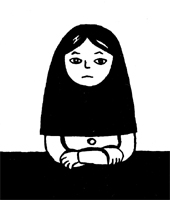
Part of the success of Satrapi's work is the simple, almost child-like line of her two-tone drawings, which feature clunky, cartoonish people, which she herself claims is a result of being forced to draw life studies in art school in Tehran of models absurdly draped in full-length chadors (something which is alluded to in one scene in the film). The film elaborates on this style, introducing more shade for the sequences depicting the revolution and the subsequent war. The model Satrapi and Paronnaud followed was German expression, which is suitable on a poltical as well as aesthetic level, considering how many of the UFA filmmakers had to flee on the Nazis' assumption of power. They also based the family sequences on Italian neo-realism, which carry a recognisable stamp of Rosselini, de Sica and early Visconti, and offer an equally brilliant condensing of the political climate of the time. Both Satrapi's parents (voiced by Simon Abkarian and Catherine Deneuve) are admirable characters but the real scene-stealer is the outspoken, opium-smoking grandmother with the voice of veteran French actress Danielle Daressieu.

Marjane herself is played by Deneuve's real-life daughter Chiara Mastroianni, and she is the same ballsy, likeable and occasionally infuriating woman and girl that appears in the comic. The film is often funny, rarely passing up an opportunity to ridicule the lethal God-fearing nonsense of the Mullahs but many of the scenes are also devastating, from the very beginning, when the adult Marjane puts on her chador at Orly airport (instantly attracting derision from a French bystander) in order to board a flight home. Satrapi never allows us to lose sight of the tragedy of the revolution that was betrayed and crushed by a crowd of fundamentalist madmen, yet there is also a complete lack of the sentimentalism that often mars such accounts of exile. Persepolis the film, like the comic that preceeded it, is a moving, indispensable portrait of a country with a formidable civilisation that has lived a nightmarish existence for the past fifty years, and it is a fitting companion piece to the courageous work of Jafar Panahi, among others, in offering a view of Iran that will challenge the preconceptions of many in the West.

It looks like being huge too, if the queues that prevented me from seeing it on its opening day are anything to go by. It is due to released later in the year in an English-language version (it is produced by Kathleen Kennedy and Frank Marshall - Spielberg's regular producers) and should be guaranteed large audiences. Not to be missed.

Tuesday, May 22, 2007

Marjane Satrapi and the Cartoon Characters That Run Iran


I'll write more on the Cannes Film Festival later in the week (though as I am not down there, there won't be a great deal to write about) but here's a brief note about the Iranian government protesting at the presence of Marjane Satrapi and Vincent Paronnaud's Persepolis in competition: the Mullahs bleat that the film gives 'an unreal presentation of the consequences and successes of the Islamic Revolution'. Those leftists and nationalists that perished in the Islamist reign of terror in the years following the Revolution that they themselves helped bring about would beg to differ.

Tehran also claims that the festival is committing an 'anti-cultural' and politically-motivated act in showing the film, which is laughable given the Iranian Islamists' blanket censorship of thousands of films, including many of those by Iran's finest filmmakers. Thankfully Iran is not as influential as China and able to bully distributors and festivals abroad into deselecting dissident films, and what Tehran really fears is the more positive attitude towards ordinary Iranians and Iranian culture that the film will foster, thereby removing the country's bogeyman status, in turn depriving them of their own raison d'être. That Satrapi, being a good Persian leftist, has no time for Bush and the Washington neocons' plans to bomb her homeland is, of course, irrelevant to them.

Friday, May 18, 2007

Just Like in Real Life

I'm not a fan of the International Herald Tribune but occasionally it does provide a bumper issue within its very thin pages and today's is one of those. We learn of the first rail crossing between North and South Korea since the end of the Korean war fifty-four years ago and the campaign of harrassment and vilification conducted by Hindu fundamentalists against an Indian Muslim artist (it is strange how the Western media, so given to the word 'Islamofascism', has yet to start using 'Hindufascism' even though fanatics allied to the former ruling BJP have been long engaged in undemocratic activities against everyone from Muslims in Gujurat to filmmaker Deepa Mehta to Richard Gere and Shilpa Shetty, but I suppose the Western conception of all Hindus as peaceful cow-loving Gandhi-followers precludes such a stance). Best of all is the story from a correspondent in the Czech Republic about Cimrman, a fictitious Czech character born in the 1960s as a satirical prop against the Stalinist dictatorship, and who has since inspired fourteen plays written "on his behalf", given his name to an asteroid orbiting the sun between Mars and Jupiter and is soon to be immortalised in the name of a mountain in Russia. Cimrman is a product of a Central and Eastern European imagination that champions the little man that has produced the majestic oeuvre of Kafka, Jaroslav Hašek, Ivan Klima, Milan Kundera, Bohumil Hrabal, Ivo Andric and countless others and which has recently been reincarnated in the superb Romanian films The Death of Mr. Lazarescu and 12.08, East of Bucharest. The discovery of this fantastic character, so dear to Czechs and an irrepressible resistant against tyranny made my day in a way that few other things have recently. Three cheers for the Czechs.

The closest thing we have to Cimrman in the English-speaking world is Matt Groëning's peerless creation The Simpsons, which celebrates its 400th episode this week. I have long suspected that this most brilliant of TV shows is underappreciated and, most likely, wildly misunderstood in its homeland, and this piece in The Nation confirms this. The liberal scribe muses about the series: "[it's] terribly animated (at least by Pixar or Dreamworks standards), unabashedly crude and, at times, prone to deus ex machina endings". To say that The Simpsons is 'terribly animated by Pixar or Dreamworks standards' is akin to saying that Picasso's 'Les Demoiselles d'Avignon' was a bit badly drawn compared to John Singer Sargent's draughtsmanship, but middle-brows will be middle-brows. As an example of The Simpson's brilliance, here's a wee taste of one of the greatest episodes. Watch it all; it's funny because it's true...

Thursday, April 19, 2007

Iranians Get Animated


I mentioned last year the film adaptation of Marjane Satrapi's brilliant comic book Persepolis ('graphic novel' is a superfluous and pretentious term that I refuse to use for works by Satrapi and other great comic book artists). The film is now going to be premiered next month at Cannes and its French-language version will be released on the 27th of June. In the French version Satrapi and her mother will be played by real-life mother and daughter Catherine Deneuve and Marcello Mastroianni with Simon Abkarian as her father and veteran actress Danielle Darrieusecq as the grandmother. Satrapi and her co-director, fellow artist Vincent Paronnaud aka Winschluss have set up a MySpace page for the film, on which there is a running series of Making of... films, which are interesting though not terribly useful to those that don't speak French. From the stills alone it appears that the book's unique visual style has been preserved, and by the look of certain plates redolent of German Expressionist cinema, even improved upon. I can't wait to see it and with its English-language version starring Mastroianni also, with Gena Rowlands replacing Deneuve, hopefully it will be a huge international success, giving Westerners a more balanced view of Iran than what has been displayed by Mad Mahmoud Ahmadinejad and the country's Western detractors recently.

Wednesday, January 10, 2007

What I Learned Today


That Shaggy of Scooby Doo fame actually had a full name in the cartoon: he was christened Norville Rogers, which seems terribly appropriate as names go. Scooby Doo creator Iwao Takamoto died yesterday at the age of 81; we didn't get to you for the death of Saddam or James Brown but we delivered on the demise of Mr Takamoto (and we would have got away with it too if it wasn't for you pesky, meddling kids). Another one of Takamoto's canine creations was Dick Dastardly's resentful sidekick Muttley and apparently the name of Scooby Doo came from the forgotten last verse of Sinatra's 'Strangers in the Night'. Well, I didn't have a Scooby...

Tuesday, July 25, 2006

Marjane Satrapi, since Persepolis


There is no particular reason to mention Marjane Satrapi at this moment in time: there is no new book out, I have not read anything new by her in over a year and many people reading this will already be familiar with her work. But there are snippets of news concerning the woman who has become probably the world's most famous Iranian artist, mainly through her superlative graphic novel Persepolis, originally published in French from 2000 to 2003, and which has since done the rounds of most the world's major languages. Next language up is Arabic, for an edition that had been due to be published by a Lebanese publisher in September. Whether the house in question has managed to weather the Israeli Defence Force's 'restructuring' of Lebanon is unknown, but the appearance of this fine work in Arabic would be truly ground-breaking, even if an edition in Satrapi's native language Farsi remains, sadly, a long way off. In addition to this there is the animated film version of the book, due to be released next year, to be co-directed by Satrapi with Vincent Paronnaud, with the voices of Chiara Mastroianni as Marjane and Mastroianni's real-life mother Catherine Deneuve as mother Satrapi.

For those that have not yet encountered Persepolis or any other Satrapi work, it is an autobiographical survey of life under the Islamic Revolution as a ten-year-old girl, and her later exile in Vienna attending a Catholic lycée and facing European prejudice and ignorance about her homeland. The book, aside from its narrative mastery, is distinguished by its heavily-inked visual style, which resembles wood-block prints and which casts its characters in semi-abstract physiognomies that Satrapi claims were the result of her being forbidden to draw realistic life studies in art college by the absurd strictures of the Islamic regime. It is a style that is also characteristic of L'Association, the Paris artists' co-operative that publishes Satrapi and which has also cultivated similarly distinctive styles in other artists such as Guy de Lisle, David B, and the already-established Swiss comic artist Johann Sfar.

Satrapi is technically a princess, being directly descended from the pre-Shah Persian kings, though her family, being Communist, have long abrogated that privilege. She now lives in Paris, on Place de Vosges, a mere ten minute walk from where I sit typing away now. Since Persepolis, she has won the Album of the Year award at Angoulême (the graphic novel equivalent of the Cannes Film Festival) twice, for Broderies (translated into English last year as Embroideries) and her last work Poulet aux prunes (as yet unavailable in English), a disarmingly simple tale of a musician uncle that died of a broken heart in the 1950s, that nonetheless moves in a new direction both structurally and thematically. It is one of the great ironies of the modern age that a country with as rich and great a civilisation as Iran should have to be explained to Westerners by comic books. Marjane Satrapi's books, even if they ever appear in Farsi, are unlikely to bring down the Ayatollahs but they should convince doubting people in Europe and North America of the folly of imposing another war on an innocent people in order to implement 'regime change'.