Showing posts with label Germany. Show all posts
Thursday, December 05, 2013
Mercy & The German Doctor
Mercy (Gnade) (Matthias Glasner – Germany/Norway) 132 minutes
The German Doctor (Wakolda) (Lucia Puenzo – Argentina/France/Spain/Norway) 93 minutes
A German couple, Maria and Niels (Birgit Minichmayer and Jürgen Vogel) move with their teenage son Markus (Henry Stange) to a new adventure in the far north of Norway, to the Arctic town of Hammerfast, where round-the-clock darkness reigns for two months of the year (though the town is not, despite what the opening credits might say, the world’s northernmost). The move appears to proceed with the sort of dovetailing smoothness only Germans are capable of: Niels takes on a job in the local gas refinery and Maria as a nurse in the hospital’s terminal unit. Markus, like his mother, picks up the language quickly and settles in well at school. Niels even manages to farm a bit on the side, though it involves little more than throwing a bale of hay to his sheep every evening, which suggests a particularly urban conception of husbandry.
Despite the lack of sunlight, it is very much a northern idyll, couched in cosy wooden homes, with breathtaking views from seemingly every window. Niels introduces the first threat to that pleasant state of affairs by embarking on an adulterous relationship with a female colleague. Markus starts joining in the bullying of an unpopular classmate. Maria meanwhile, returning from working a double shift one night (or morning, or afternoon? It’s hard to tell), knocks someone or something over and flees the scene. When it later emerges it was a drunken teenage girl, who then died of exposure and who was a daughter of a man in the same church choir as Maria, the family is faced with a dilemma that could tear them apart.
Glasner and Vogel have previously collaborated on a number of films, most notably the 2006 The Free Will, a terrifying portrait of a recidivist violent rapist, played by Vogel. Mercy has a similarly theological title but it is a much more soothing, conventional Euro art-house film. The film is initially promising but loses its way soon after Maria’s hit-and-run, which, bafflingly, causes little intrigue or outrage in a small remote town. Screenwriter Kim Fupz Aakeson also seems to be flailing about in the dark with Niels’ affair with the clingy Linda (Ane Dahl Torp), which is purely vehicular and which is at best unconvincing, at worst casually misogynistic. At one time the affair looks like it might land the family in the shit but it is soon resolved in a perfunctory fashion. The relative sobriety we might have expected from the film early on is also dissipated as it moves towards its conclusion, with one particularly mawkish scene mounted during choir practice in the church, replete with diegetic melodramatic chorals. Mercy is a handsome, if unchallenging, film that presses all the obvious buttons but which helps itself to whatever grace it has, rather than gainfully earning it.
Lucia Puenzo's The German Family begins with an Argentine family, setting off across the Pampas in 1961 to travel to the resort hotel in Bariloche they run during the winter season. They encounter a stranger, who asks them if he can accompany them along the perilous route. He, Helmut Gregor (Àlex Brendemühl), is German and the mother of the family Eva (Natalia Oreira) is also of German stock and speaks the language. The family’s children, Tomas (Alan Daicz) and Lilith (Florencia Bado), whose adult self narrates, are about to start attending the very same German school in the Andean city that Eva herself went to. Gregor, who is a doctor, is also going that way and has contacts among Bariloche’s German community. He also takes an interest in twelve-year-old Lilith, who suffers from stunted growth and who has the physique of an eight-year-old; the good doctor offers to try new medication on her to accelerate her growth.
The family acquiesce, though father Enzo (Diego Peretti), less enamoured of things German than his wife, is wary. He has good reason to be, as the mild-mannered Doktor Gregor is none other than the notorious Josef Mengele, of the Nazi death camps. This appears to be an open secret among Bariloche’s Germans, who once enthusiastically flew the swastika during the war and now do their best to protect Mengele from prying eyes. Those eyes come in the form of Nora Eldoc (Elena Roger), a pretty young German-speaker who takes on an archivist position at the school but who is in reality a Mossad agent. She tries to get her superiors in Tel Aviv to close in on the fugitive but they are prioritising Eichmann and don’t want to blow the cover for that operation.
Meanwhile, Lilith, who appears to be developing a crush on the kindly doctor, also develops alarming symptoms that may be related to her experimental treatment, which is minutely documented in Gregor’s Leonardo-esque notebooks, the macabre content masked by cursive beauty. Puenzo, who adapted the film from her own novel, is an astute observer of the pains of medical dysfunction and the way families protect their children (an earlier film, XXY, sensitively portrayed a hermaphodite’s passage into puberty). She also adeptly engineers a tense thriller in a very low-key setting and has a striking visual sensibility - Enzo is an artisan dollmaker whom Mengele offers to finance for mass production and a subsequent visit to a doll factory provides a creepy echo, both of Mengele’s anatomical obsessions and the mass carnage of the death camps. The German Doctor is a surprisingly resonant film that might easily have been standard TV-movie fodder. It stands a good chance of getting a Best Foreign Film Oscar nomination and would likely be one of the better films in the running.
Labels:
Argentina,
Cinema,
Film,
Germany,
Josef Mengele,
Lucia Puenzo,
Matthias Glasner,
movies,
norway
Tuesday, November 19, 2013
Heimat and Shoah: Updates
Heimat: Chronicle of a Vision (Die andere Heimat: Chronik einer Sehnsucht) (Edgar Reitz – Germany/France) 225 minutes
The Last of the Unjust (Le dernier des injustes) (Claude Lanzmann – France/Austria) 220 minutes
Edgar Reitz’s monumental TV series Heimat, which spans much of the German twentieth century and which has been running since 1984, is a major lacuna in my film-watching, and one I intend to finally get around to one of these days. Not that any knowledge of the TV show is necessary to appreciate this four-hour prequel, which is set in the same Rheinland village of Schabbach and centres around the same family, the Simons, that appears in the show. The action is set several decades before the start of the TV series, in 1842, in a region that has yet to be industrialised and where the only hope for many is to up sticks and move to Brazil, where the Emperor has reserved the southern regions of Rio Grande do Sul for German immigrants.
Jakob Simon (Jan Schneider), a bookish youngster, is one person who dreams of an escape, going so far as to learn the Tupi languages of the Brazilian natives, which he has never even heard. Jakob is scorned by his blacksmith father Johann (Rüdiger Kreise), who sees him as a feckless n’er-do-well, in contrast to his older brother, Gustav (Maximilian Scheidt), who returns from military service as the film begins. Johann’s intransigence has driven away his daughter, disowned for marrying a Catholic, much to the chagrin of his wife Margarethe (Marita Breur), who also encourages Jakob in his studies. Jakob though is destined to be forever upstaged by his more assertive brother, who steals the woman he loves, Jettchen (Antonia Bill) and soon begins to muscle in on his dreams.
In one sense, Heimat is solidly old-fashioned film-making – a seamless fresco of nineteenth-century life, a family saga, a portrait of an embryonic modern society. Like Michael Haneke’s The White Ribbon, the film takes its visual cues from the photography of August Sander (it is striking how similar the two films look, despite being set some seventy years apart); Gernot Roll’s stunning high-contrast cinematography is monochrome throughout with a few key colorised elements interspersed – an incandescent horseshoe, a field of bluebells, a sliver of agate. Reitz has little time for Haneke’s determinism though – the historical aspects of his film are portrayed dispassionately: the legacy of the Napoleonic invasion (and even the 30 Year War, two centuries past, evoked by Jakob’s elderly uncle), the rise of German nationalism, embodied in a boozy group of students who invite Jakob on a raft trip down the Rhine, ultimately radicalising him.
Though Heimat the TV series has been criticised for soft-pedalling the Weimar and Nazi era, Reitz’s depiction of the premodern society in this film is far from the idealised image of the Volk that the Nazis and Prussian nationalists liked to peddle. Life in Schabbach is miserable, its old artisanal society barely subsisting; the region is riven by famine and the village is emptying at a rapid pace, with even the local schoolmaster eyeing a spot on the boat to Brazil. In one of the many powerful sequences in the film, the villagers hold a communal funeral for a dozen infants carried away by diphtheria in the bitterly cold winter, the ground being too frozen solid to bury them until the spring. Reitz is also adept at integrating period detail into his narrative in a way that is fully organic – the sudden halting of a creaking loom alerts the family to the death of its operator and the appearance of a steam engine in the forge – built by Gustav and perfected by Jakob – points to the industrialisation that is about to send the region, and all of Germany, hurtling into modernity.
This latest chapter in the Heimat saga is a wonderfully rich experience, lucid and intelligent, endowed with some masterful filmmaking, and it is at times deeply moving. Reitz presents a sophisticated portrait of the mid-nineteenth century while being more than simply tasteful picturesque. Though the film stands alone admirably well, you wonder does Reitz intend filling in more gaps with further prequels, even if, at the age of 81, he may find time is against him.
The bulk of Claude Lanzmann’s new film consists of interviews he conducted over a week in 1975 with Benjamin Murmelstein, the former Chief Rabbi of Vienna, and later the Head of the Jewish council in the notorious ghetto of Theriesenstadt during the Holocaust. Lanzmann omitted the interviews from the final cut of Shoah, for which they were filmed, because it would have added unduly to an already marathon length. Three decades on from Shoah, Lanzmann has decided Murmelstein and the grotesque story of Theriesenstadt merits a film of its own, one that, at just under four hours, runs to almost half its predecessor’s running time.
The title of the film comes from Murmelstein himself, who described himself as such, in self-deprecation, given the opprobrium he faced in both Israel and among international Jewry following the war (the philosopher Gershom Scholem said he ought to be hanged). Theriesenstadt, a concentration camp located in the Czech fortress town of Terezin, has become a byword for barbaric repression airbrushed by good public relations. It was the brainchild of Adolf Eichmann, and was filmed for Nazi propaganda and called ‘The Fuhrer’s Gift to the Jews’, presented to the world as a place of comfort for its inhabitants, despite 60,000 Jews living in an area intended for 7,000. Murmelstein, who liaised with Eichmann in the ghetto, was tried for collaboration in Czechoslovakia after the war but was acquitted and released after 18 months in prison. He ended up a furniture salesman in Rome and, such was his fall from grace, the Chief Rabbi of Rome refused him burial beside his wife in consecrated ground when he died in 1989.
Given he was a community leader (and moreover one who passed up opportunities to abandon Vienna’s Jews when offered work in London upon Anschluss) it was ridiculous that Murmelstein be retrospectively cast as a kapo. He may indeed have been too trusting of Eichmann, despite clear signs of the latter’s brutality – Murmelstein witnessed him leading the destruction of a synagogue in Vienna before the war – but Murmelstein insisted he did everything to save as many Jews as he could. He even says in the film that the embellishment of Theriesenstadt for publicity purposes helped saved lives as, he reasoned, if the Jews in the ghetto were in the public eye, they were less likely to be slaughtered. Not that this spared the lives of those who were put to death after a series of failed uprisings, mind. Murmelstein was, then, one of the Jewish leaders at whom Hannah Arendt took aim, when she said fewer Jews might have been killed had they not had community leaders to place trust in. This is one of two issues in which the film takes issue with Arendt, the other being the famous ‘banality of evil’ applied to Eichmann. Murmelstein, who knew Eichmann better than most (and was, inexplicably, never called as a witness for Eichmann’s trial), says Eichmann was the consummate Nazi, fully aware of the enormity of his enterprise and implicated in more than simply the logistics.
Lanzmann’s film is, for one of those length and such unremitting grimness, incredibly compelling. As in Shoah, he has a keen ability to make the past come to life simply by filming the same locations decades later – in one chilling scene, he recounts, by reading from Murmelstein’s 1961 memoir, the executions of Jewish insurgents in the very same hangar in Theriesenstadt. The only thing against The Last of the Unjust is it is a little too complicit and sympathetic towards its subject – it lacks the dialectical force that made Shoah such a formidable, if at times selective, film. You see relatively little of the abrasive, conceited, and often unpleasant, side of Lanzmann’s character, which helped him coax so many fantastic interviews out of unsuspecting interlocutors in the earlier film. Similarly, Murmelstein’s story is very much an annex to Shoah, which renders The Last of the Unjust a quasi-theological film for specialists of the field. While it is remarkable in many ways, it is a film that can really only be grasped in its entirety by those that have sat through the entire nine-and-a-half hours of Lanzmann’s earlier masterpiece.
The Last of the Unjust (Le dernier des injustes) (Claude Lanzmann – France/Austria) 220 minutes
Edgar Reitz’s monumental TV series Heimat, which spans much of the German twentieth century and which has been running since 1984, is a major lacuna in my film-watching, and one I intend to finally get around to one of these days. Not that any knowledge of the TV show is necessary to appreciate this four-hour prequel, which is set in the same Rheinland village of Schabbach and centres around the same family, the Simons, that appears in the show. The action is set several decades before the start of the TV series, in 1842, in a region that has yet to be industrialised and where the only hope for many is to up sticks and move to Brazil, where the Emperor has reserved the southern regions of Rio Grande do Sul for German immigrants.
Jakob Simon (Jan Schneider), a bookish youngster, is one person who dreams of an escape, going so far as to learn the Tupi languages of the Brazilian natives, which he has never even heard. Jakob is scorned by his blacksmith father Johann (Rüdiger Kreise), who sees him as a feckless n’er-do-well, in contrast to his older brother, Gustav (Maximilian Scheidt), who returns from military service as the film begins. Johann’s intransigence has driven away his daughter, disowned for marrying a Catholic, much to the chagrin of his wife Margarethe (Marita Breur), who also encourages Jakob in his studies. Jakob though is destined to be forever upstaged by his more assertive brother, who steals the woman he loves, Jettchen (Antonia Bill) and soon begins to muscle in on his dreams.
In one sense, Heimat is solidly old-fashioned film-making – a seamless fresco of nineteenth-century life, a family saga, a portrait of an embryonic modern society. Like Michael Haneke’s The White Ribbon, the film takes its visual cues from the photography of August Sander (it is striking how similar the two films look, despite being set some seventy years apart); Gernot Roll’s stunning high-contrast cinematography is monochrome throughout with a few key colorised elements interspersed – an incandescent horseshoe, a field of bluebells, a sliver of agate. Reitz has little time for Haneke’s determinism though – the historical aspects of his film are portrayed dispassionately: the legacy of the Napoleonic invasion (and even the 30 Year War, two centuries past, evoked by Jakob’s elderly uncle), the rise of German nationalism, embodied in a boozy group of students who invite Jakob on a raft trip down the Rhine, ultimately radicalising him.
Though Heimat the TV series has been criticised for soft-pedalling the Weimar and Nazi era, Reitz’s depiction of the premodern society in this film is far from the idealised image of the Volk that the Nazis and Prussian nationalists liked to peddle. Life in Schabbach is miserable, its old artisanal society barely subsisting; the region is riven by famine and the village is emptying at a rapid pace, with even the local schoolmaster eyeing a spot on the boat to Brazil. In one of the many powerful sequences in the film, the villagers hold a communal funeral for a dozen infants carried away by diphtheria in the bitterly cold winter, the ground being too frozen solid to bury them until the spring. Reitz is also adept at integrating period detail into his narrative in a way that is fully organic – the sudden halting of a creaking loom alerts the family to the death of its operator and the appearance of a steam engine in the forge – built by Gustav and perfected by Jakob – points to the industrialisation that is about to send the region, and all of Germany, hurtling into modernity.
This latest chapter in the Heimat saga is a wonderfully rich experience, lucid and intelligent, endowed with some masterful filmmaking, and it is at times deeply moving. Reitz presents a sophisticated portrait of the mid-nineteenth century while being more than simply tasteful picturesque. Though the film stands alone admirably well, you wonder does Reitz intend filling in more gaps with further prequels, even if, at the age of 81, he may find time is against him.
The bulk of Claude Lanzmann’s new film consists of interviews he conducted over a week in 1975 with Benjamin Murmelstein, the former Chief Rabbi of Vienna, and later the Head of the Jewish council in the notorious ghetto of Theriesenstadt during the Holocaust. Lanzmann omitted the interviews from the final cut of Shoah, for which they were filmed, because it would have added unduly to an already marathon length. Three decades on from Shoah, Lanzmann has decided Murmelstein and the grotesque story of Theriesenstadt merits a film of its own, one that, at just under four hours, runs to almost half its predecessor’s running time.
The title of the film comes from Murmelstein himself, who described himself as such, in self-deprecation, given the opprobrium he faced in both Israel and among international Jewry following the war (the philosopher Gershom Scholem said he ought to be hanged). Theriesenstadt, a concentration camp located in the Czech fortress town of Terezin, has become a byword for barbaric repression airbrushed by good public relations. It was the brainchild of Adolf Eichmann, and was filmed for Nazi propaganda and called ‘The Fuhrer’s Gift to the Jews’, presented to the world as a place of comfort for its inhabitants, despite 60,000 Jews living in an area intended for 7,000. Murmelstein, who liaised with Eichmann in the ghetto, was tried for collaboration in Czechoslovakia after the war but was acquitted and released after 18 months in prison. He ended up a furniture salesman in Rome and, such was his fall from grace, the Chief Rabbi of Rome refused him burial beside his wife in consecrated ground when he died in 1989.
Given he was a community leader (and moreover one who passed up opportunities to abandon Vienna’s Jews when offered work in London upon Anschluss) it was ridiculous that Murmelstein be retrospectively cast as a kapo. He may indeed have been too trusting of Eichmann, despite clear signs of the latter’s brutality – Murmelstein witnessed him leading the destruction of a synagogue in Vienna before the war – but Murmelstein insisted he did everything to save as many Jews as he could. He even says in the film that the embellishment of Theriesenstadt for publicity purposes helped saved lives as, he reasoned, if the Jews in the ghetto were in the public eye, they were less likely to be slaughtered. Not that this spared the lives of those who were put to death after a series of failed uprisings, mind. Murmelstein was, then, one of the Jewish leaders at whom Hannah Arendt took aim, when she said fewer Jews might have been killed had they not had community leaders to place trust in. This is one of two issues in which the film takes issue with Arendt, the other being the famous ‘banality of evil’ applied to Eichmann. Murmelstein, who knew Eichmann better than most (and was, inexplicably, never called as a witness for Eichmann’s trial), says Eichmann was the consummate Nazi, fully aware of the enormity of his enterprise and implicated in more than simply the logistics.
Lanzmann’s film is, for one of those length and such unremitting grimness, incredibly compelling. As in Shoah, he has a keen ability to make the past come to life simply by filming the same locations decades later – in one chilling scene, he recounts, by reading from Murmelstein’s 1961 memoir, the executions of Jewish insurgents in the very same hangar in Theriesenstadt. The only thing against The Last of the Unjust is it is a little too complicit and sympathetic towards its subject – it lacks the dialectical force that made Shoah such a formidable, if at times selective, film. You see relatively little of the abrasive, conceited, and often unpleasant, side of Lanzmann’s character, which helped him coax so many fantastic interviews out of unsuspecting interlocutors in the earlier film. Similarly, Murmelstein’s story is very much an annex to Shoah, which renders The Last of the Unjust a quasi-theological film for specialists of the field. While it is remarkable in many ways, it is a film that can really only be grasped in its entirety by those that have sat through the entire nine-and-a-half hours of Lanzmann’s earlier masterpiece.
Saturday, May 04, 2013
Hannah Arendt – Margarethe von Trotta
Hannah Arendt (Margarethe von Trotta – Germany/Luxembourg/France/Israel) 113 minutes
Margarethe von Trotta’s latest portrayal of female German historical figures features the political theorist Hannah Arendt, or more precisely, the few months in 1961 surrounding the trial of Adolf Eichmann, about which Arendt wrote her famous articles for the New Yorker (subsequently published as Eichmann in Jerusalem). Barbara Sukowa, a regular in von Trotta’s films, in which she has already played Rosa Luxemburg, Hildegard von Bingen and a fictionalised Gudrun Esslin, is Arendt, a role you suspect she has been waiting her whole life to fill. Other figures in the film include Arendt’s husband, the Marxist Heinrich Blücher (Axel Milberg), her friend, the novelist Mary McCarthy (Janet McTeer) and New Yorker editor William Shawn (Nicholas Woodeson). It is very much a talky affair, with the capture and trial of Eichmann discussed at length by Arendt’s largely German emigré circle, a colloquy that becomes more fractious after Arendt shocks the Jewish community with the publication of her first article.
The film is particularly strong on the development of Arendt’s famous concept of the banality of evil, which it suggests came to her as she sat watching the live relay of the trial in the Jerusalem press room. We see the actual archive footage of Eichmann in the dock, in which he berates the prosecution for their inaccuracies and selective interpretation of the bureaucratic evidence that he is only too familiar with. What causes the shit-storm back in New York though is her assertion that the number of Jewish deaths might have been less had there not been a Jewish leadership to co-operate with the Nazis. Viewed today, it is not an incredibly contentious argument but it inflamed Jewish opinion in both New York and Israel (where some of those leaders, such as Rudolf Kastner, assassinated in 1957, had taken refuge). Arendt received hate mail, was reviled as a self-hating Jew, many of her friends turned against her, Mossad turned up on her doorstep to issue veiled threats, and she was subject to academic intimidation, of the sort US critics of Israel today would recognise.
Arendt, despite the personal hurt caused her by her friends’ desertion, was unwavering – knowing most of her critics to be as intellectually mediocre as she found Eichmann to be – and Sukowa captures very well the imperious, at times overly-dispassionate, side to her character. Unfortunately she hams it up a little in the more dramatic scenes, particularly her defence in front of her students at the New School – while the intention is to convey impassioned argumentation, it reminds you a little too much of Lili von Stupp in Blazing Saddles. The film also protrays in flashback her romantic relationship with Martin Heidegger, her one-time teacher and mentor. While it makes perfect sense to evoke what would have been an undoubtedly seismic effect on Arendt's life – particularly given Heidegger's later collaboration with the Nazis – seeing the author of Being and Time playing hanky-panky with Hannah Arendt moves the film into the realm of the risible. Von Trotta’s direction is also overly academic – the film resembles a TV movie, or mini-series even, which is not surprising as her career in recent years has alternated between projects for TV and the big screen. Still, that hasn’t hampered its fortunes in Germany, where it has been a big hit at the box office. While the film may have the commendable effect of making Arendt known to a general audience, it really is a work that is far from approaching the stature of its subject, despite the best efforts of all involved.
Margarethe von Trotta’s latest portrayal of female German historical figures features the political theorist Hannah Arendt, or more precisely, the few months in 1961 surrounding the trial of Adolf Eichmann, about which Arendt wrote her famous articles for the New Yorker (subsequently published as Eichmann in Jerusalem). Barbara Sukowa, a regular in von Trotta’s films, in which she has already played Rosa Luxemburg, Hildegard von Bingen and a fictionalised Gudrun Esslin, is Arendt, a role you suspect she has been waiting her whole life to fill. Other figures in the film include Arendt’s husband, the Marxist Heinrich Blücher (Axel Milberg), her friend, the novelist Mary McCarthy (Janet McTeer) and New Yorker editor William Shawn (Nicholas Woodeson). It is very much a talky affair, with the capture and trial of Eichmann discussed at length by Arendt’s largely German emigré circle, a colloquy that becomes more fractious after Arendt shocks the Jewish community with the publication of her first article.
The film is particularly strong on the development of Arendt’s famous concept of the banality of evil, which it suggests came to her as she sat watching the live relay of the trial in the Jerusalem press room. We see the actual archive footage of Eichmann in the dock, in which he berates the prosecution for their inaccuracies and selective interpretation of the bureaucratic evidence that he is only too familiar with. What causes the shit-storm back in New York though is her assertion that the number of Jewish deaths might have been less had there not been a Jewish leadership to co-operate with the Nazis. Viewed today, it is not an incredibly contentious argument but it inflamed Jewish opinion in both New York and Israel (where some of those leaders, such as Rudolf Kastner, assassinated in 1957, had taken refuge). Arendt received hate mail, was reviled as a self-hating Jew, many of her friends turned against her, Mossad turned up on her doorstep to issue veiled threats, and she was subject to academic intimidation, of the sort US critics of Israel today would recognise.
Arendt, despite the personal hurt caused her by her friends’ desertion, was unwavering – knowing most of her critics to be as intellectually mediocre as she found Eichmann to be – and Sukowa captures very well the imperious, at times overly-dispassionate, side to her character. Unfortunately she hams it up a little in the more dramatic scenes, particularly her defence in front of her students at the New School – while the intention is to convey impassioned argumentation, it reminds you a little too much of Lili von Stupp in Blazing Saddles. The film also protrays in flashback her romantic relationship with Martin Heidegger, her one-time teacher and mentor. While it makes perfect sense to evoke what would have been an undoubtedly seismic effect on Arendt's life – particularly given Heidegger's later collaboration with the Nazis – seeing the author of Being and Time playing hanky-panky with Hannah Arendt moves the film into the realm of the risible. Von Trotta’s direction is also overly academic – the film resembles a TV movie, or mini-series even, which is not surprising as her career in recent years has alternated between projects for TV and the big screen. Still, that hasn’t hampered its fortunes in Germany, where it has been a big hit at the box office. While the film may have the commendable effect of making Arendt known to a general audience, it really is a work that is far from approaching the stature of its subject, despite the best efforts of all involved.
Labels:
Cinema,
Eichmann,
Film,
Germany,
Hannah Arendt,
movies,
Philosophy
Saturday, March 02, 2013
Home for the Weekend - Hans-Christian Schmid
Home for the Weekend (Was bleibt) (Hans Christian Schmid - Germany) 85 minutes
The weekend-in-the-country film is a staple of French arthouse cinema but one that is not so common across the Rhine. Hans-Christian Schmid’s recent films have not really indicated him to be that sort of director either; his 2006 film Requiem, about a notorious exorcism in 1970s Bavaria was a chillingly apposite examination of mental illness and the way it can be masked behind religious devotion; more recently, his English-language film Storm portrayed a Bosnian woman due to testify as a witness at the war crimes tribunal in The Hague who is being intimidated by her rapist’s associates.
Home for the Weekend is a lower-key film than either of those but also features a woman in distress. This time it is Gitte (Corinna Harfouch), the sexagenarian wife of a Bonn publisher who springs it on everyone ‘home for the weekend’ that she has decided to come off her medication after thirty years of treatment for depression. The focus of the film is Gitte’s son Marko (Lars Eidenger ), a first-time novelist who has come home from Berlin with his six-year-old son Zowie (yes, Marko is a Bowie fan) for the occasion. Like many troubled families, the Heidtmanns have a patina of contentedness - father Günter has been consistently loving and supportive to Gitte throughout her depression but has recently taken a mistress, and intends to enjoy his retirement after selling his share in the successful publishing house. Meanwhile, Marko’s younger brother Jakob’s dental practice is tanking despite the head start his parents’ investment has given him.
The drama fizzes in a minor key but Home for the Weekend rings far truer than most of its French counterparts. Neither is it heavy going; there is a wonderful scene where the Gitte and Günter perform, seemingly spontaneously, a version of Charles Aznavour’s ‘Tu l’laisses aller’, as Marko plays it on the piano, a song, you feel they have all sung together many times before. It’s a hugely moving scene, amplified by the strength of the acting; Schmid directs his actors so well a physically and aurally elaborate scene such as this one comes off so effortlessly, as if the cast have actually known each other all their lives.
The context and setting of Home for the Weekend do eventually begin to wear on the film; despite its reasonable length, the drama sags in the latter third and reminded me a bit of Long Day’s Journey into Night, and not in a terribly flattering way. Schmid, however, is sensitive enough to longueurs to throw a few ideas into the mix in the last twenty minutes. The coda, in particular, is a remarkable piece of narrative consolidation. Home for the Weekend is a foray into the sort of social cinema more commonly associated with Schmid’s contemporaries such as Henning Winckler, Andreas Dresen and Christoph Hochhäuser; it is an impressive effort by Schmid, a small film that projects itself as a big one. And it’s also a pleasure to see that troubled families on screen can be sympathetic ones too.
Home for the Weekend is a lower-key film than either of those but also features a woman in distress. This time it is Gitte (Corinna Harfouch), the sexagenarian wife of a Bonn publisher who springs it on everyone ‘home for the weekend’ that she has decided to come off her medication after thirty years of treatment for depression. The focus of the film is Gitte’s son Marko (Lars Eidenger ), a first-time novelist who has come home from Berlin with his six-year-old son Zowie (yes, Marko is a Bowie fan) for the occasion. Like many troubled families, the Heidtmanns have a patina of contentedness - father Günter has been consistently loving and supportive to Gitte throughout her depression but has recently taken a mistress, and intends to enjoy his retirement after selling his share in the successful publishing house. Meanwhile, Marko’s younger brother Jakob’s dental practice is tanking despite the head start his parents’ investment has given him.
The drama fizzes in a minor key but Home for the Weekend rings far truer than most of its French counterparts. Neither is it heavy going; there is a wonderful scene where the Gitte and Günter perform, seemingly spontaneously, a version of Charles Aznavour’s ‘Tu l’laisses aller’, as Marko plays it on the piano, a song, you feel they have all sung together many times before. It’s a hugely moving scene, amplified by the strength of the acting; Schmid directs his actors so well a physically and aurally elaborate scene such as this one comes off so effortlessly, as if the cast have actually known each other all their lives.
The context and setting of Home for the Weekend do eventually begin to wear on the film; despite its reasonable length, the drama sags in the latter third and reminded me a bit of Long Day’s Journey into Night, and not in a terribly flattering way. Schmid, however, is sensitive enough to longueurs to throw a few ideas into the mix in the last twenty minutes. The coda, in particular, is a remarkable piece of narrative consolidation. Home for the Weekend is a foray into the sort of social cinema more commonly associated with Schmid’s contemporaries such as Henning Winckler, Andreas Dresen and Christoph Hochhäuser; it is an impressive effort by Schmid, a small film that projects itself as a big one. And it’s also a pleasure to see that troubled families on screen can be sympathetic ones too.
Labels:
Cinema,
Film,
Germany,
Hans-Christian Schmid,
movies
Tuesday, July 31, 2007
The Life of Another
Seanachie was an admirer of the winner of this year's Oscar for Best Foreign-language Film, the German Stasi thriller, The Lives of Others, and he is sad to hear of the death from cancer of its star Ulrich Mühe, at the age of 54. Mühe played the ruthless Stasi captain Gerd Wiesler whose exceptional change of heart spares one of his prey, and in real life was himself spied upon by the Stasi in East Germany, including, allegedly, his late wife, who died six months ago. The Independent has more on his death.
Monday, April 02, 2007
The Weekend's Entertainment
A brief post this evening about two films watched over the weekend: I had written more extensively on André Téchiné's fine drama Les Témoins (a fictionalised account of an early French AIDS case from 1984) but just as I was about to post, Camino crashed and removed all trace of the text, making me think of going back to Firefox, despite the trouble I had been having with it for a while. I have neither the time nor the will to reconstruct the post so I will just recommend the film in passing, an unsentimental yet discreetly affecting tale about a group of friends coping with bereavement. Great acting all round, particularly from Sami Bouajila and Michel Blanc.
There was also Tough Enough, an uneven but diverting German film by director Detlev Buck. The tale of a 15-year-old plunged into a rough school in Berlin when his mother gets kicked out of home by her rich lover. He quickly becomes the object of some brutal bullying by some of the rough lads, only to fall into favour (in a rather contrived fashion) with an Arab gangster. Despite some terrible plotting - as well the deus ex machina intervention of the local caid in question, the film's peripheral characters come and go perfunctorily, often when they are beginning to get interesting - the film is directed with a good deal of verve and is at times credible enough, being a suitable companion film to last years's violent Kurds and Turks abroad drama Fratricide. Worth a look.
Is Angela Merkel a Secret Blueshirt?
Speaking of April Fool's, surely this can be the only explanation for the story from the 'Irish' Examiner, telling us that German Chancellor Angela Merkel has concerned herself with Irish domestic politics and endorsed a vote for Fine Gael in the forthcoming election. C'mon, you're having us on, aren't you, lads?
Thursday, March 01, 2007
'So, the Stasis, Are They the Good Guys or the Bad Guys?'
The Lives of Others, the excellent German Stasi thriller, which has just won the Academy Award for Best Foreign Film is reportedly going to suffer the Hollywood remake treatment, effected by middle-brow maestros Anthony Minghella and Sidney Pollack for Miramax. It probably hasn't crossed anybody's mind that a German-themed film might be better conducted in German, as that it what they still, to this day, speak in Germany. Yes, it looks promising already, Cate Blanchett, William H. Macy and Jude Law with their guttural Teutonic accents. 'Don't you vurry, mein Excellency he vill tock, haff no doubt about that.' At this rate The Simpsons, like Tom Lehrer before them, might give up satire because of unfair competition from real life.
Friday, February 02, 2007
This Week's Movies

Pressures of time prevent me from going into detail about four films I saw in the past week and liked (as most people who know me would aver, this is an unprecedented phenomenon) but I will list them anyway, three of them are German: Matthias Luthardt's film-school graduation piece Pingpong, about a poor cousin cuckoo's presence in his rich uncle's family nest. Icily gripping and wonderfully edited. Then there is the Stasi thriller The Lives of Others that, despite some rickety characterisation, is great entertainment, and the main Stasi guy is the spitting image of Colm Tóibín.
A friend of mine in Dublin warned me off Philip Gröning's three-hour documentary on the silent Carthusian monks of La Grande Chartreuse in Grenoble, Into Great Silence. This friend goes on Buddhist retreats and Unitarian services and Tridentine masses while managing to be both gay and left-wing, but found three hours about monks intolerably boring. So the omens were not good but I found it engaging for the most part and a fascinating look at people that use utensils everyday that are usually only found these days in movie prop departments. Like ewers and so on. Mind you, the core audience for films like this is getting on a bit, when I finally got to see it after seeing it sold out twice, I was one of only about five people in the audience under the age of sixty. Last was the Catalan director Marc Recha's August Days, a road movie starring Recha and his brother David as themselves as they drive their camper van along the Ebro during a heatwave. I loved Recha's debut feature Tree of Cherries, which I saw in the Dublin Film Festival a long time ago and this film has the same balmy magnificence even though the difficulties putting a plot together is at times too obvious. But he more than makes up for that in the filming and the pacing.
I also finally got to see Robert Altman's Nashville on DVD, which is probably the best of all the Altman's I've seen. Most amazing is the music, which as well as being brilliant, was entirely written and performed by the cast. That's all for this week though. I'm off to Vienna for the weekend and I'm leaving the laptop at home. More next week.
Friday, December 15, 2006
Requiem

Good atheist as I am I nonetheless have a fondness for films with religious themes. Not religious films such as the dourly devotional The Greatest Story Ever Told or The Passion of the Christ, nor Martin Scorsese's ethnic tourist trips The Last Temptation of Christ or Kundun. I really couldn't care less about the major personalities of world religion, on film at least, but it is the religiosity of ordinary people that I find fascinating. The obvious examples are Bresson and Dreyer, two-thirds of Paul Schrader's 'blessed trinity' - strangely enough, the third, Yasujiro Ozu, was so disinterested by religion as to be practically secular in his gentle, old-fashioned work - and there is also Lars von Trier, and even the anti-religious cinema constituted of such films as The Magdalene Sisters, Ken Loach's Raining Stones, Bunuel's Viridiana and The Milky Way. A film that is so remarkable as to bear immediate comparison to both Bresson and Dreyer is the second film by the young German director Hans-Christian Schmid entitled Requiem, which is one of the most moving portrayals of mental illness and undying faith that I have ever seen.
Requiem, based on the true story of Anneliese Michel, tells the tale of a 21-year-old German student Michaela, played by the brilliant Sandra Hüller - resembling a young Diane Keaton -, who is raised in the sort of diabolically-strict Catholic family that every Catholic dreads waking up one day to find it their own, and who suffers from an exceptionally debilitating strain of epilepsy that threatens her college career, and which she despairs of ever escaping. Tied to her strident faith, nurtured by an embittered harridan of a mother and a loving but sadly powerless father, and her obsession with an obscure martyred saint, her mental well-being wavers to a point that nobody, even her devout parents and parish priest, are capable of absorbing it in a way explicable to them.
Though it is likely that Michaela's illness is purely corporeal, the temporal location of her situation, after the loss in certainty among the German catholics, renders her trauma all the more unsettling. Her psychosis is not accepted, even by the clerics and the faithful, as spiritual due to their own faith's wavering, until it is too late. When exorcism finally takes place, it is much more disturbing than in William Friedkin's film because, as well as being patently inappropriate, it takes place amid an environment of such selfless love, with even the embittered mother casting off her coldness in her daughter's hour of need. We see a world of unconditional love and one where rationalism has supposedly killed off all lingering traces of religious superstition, but Michaela, in her conviction that her illness makes her special, constitutes a nightmarish throwback to the past. There is a great similarity to von Trier's mighty Breaking the Waves but this film avoids von Trier's algebra of suffering, a schematism that misled many of his critics into accusing him of rampant misogyny (it is there in his other films but exists only as a decoy in Breaking the Waves). Requiem rather progresses in a sober fashion with occasional fits of activity as the heroine tries to live a normal social life, and consequently suffers further seizures. The film's combination of static shots and intimate handheld camerawork recalls the Dardenne brothers and the opening two scenes draw the viewer in rapidly like no film since Rosetta. The film is set in the mid-70s but its period detail is for the most part restrained, no kitsch set design or platform shoes; the one concession to the era is a fantastic scene where Michaela almost breaks down trying to replace a dried-up typewriter ribbon. It is a scene that will be familiar to anyone that has felt unreasonably stymied by household obstacles, but it is rendered frightening by the intensity of Hüller's performance.
After years of so-so output, German cinema is once again a major creative force, which, to be honest, is the least that can be expected of Europe's largest country. As well as popular hits such as Goodbye Lenin! and Downfall there is also a new wave of young directors such as Schmid, Christoph Hochhaüsler, and Henner Winckler. Like the recent films of the last two, Requiem is distinguished by its heartfelt sympathy for young people, and its effortless dramatisation of their stories. But that boils Requiem down too much. There is an awful lot there. That's why I am going to see it again tomorrow.
Thursday, August 17, 2006
Gunther Grass' Nazi Past

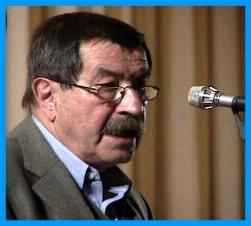
The big news story of the moment is Gunther Grass' admission that he was a member of the Waffen SS during the Second World War. Grass, one of my own favourite writers and certainly the most esteemed German writer of the late twentieth century, has confessed in a forthcoming memoir that he was a member of the Nazi Secret Service military wing and not a Wehrmacht conscript as he had previously claimed. Naturally people, particularly members of the Christian Democrats, whom he mercilessly pilloried for years over their incorporation of ex-Nazis into their party, are on the offensive, and with reason: Grass' principled stands and accusations in the past now appear hypocritical and self-serving to say the least. Those that claim he should return the Nobel Prize for Literature that he won in 1999 do have a point (though I am not sure if Knut Hamsun, the 1912 laureate and later Nazi supporter was urged to do the same thing before his death in 1950). Grass' reputation is certainly tarnished and he would have been better advised to have come out with this a lot earlier in his life. But at the same time I do not find the revelation terribly surprising, and though Grass was certainly wrong in his choice of career, no matter how young he was, there is no proof that he was an enthusiastic Nazi, nor that he committed any atrocities. If his literary and political career since then has been motivated by expiation, then I think it has been successful, though an earlier disclosure would have been more honourable.
There is a tendency among us these days to view former Nazi associations as the ultimate in evil. This is not entirely objectionable but if one persists in this idea, it is far too easy to caricature the Nazis as abominable villains, which in turn obscures a true understanding of how they rose to power. In Spike Lee's film of this year Inside Man, the central plot motive is exposition of the Nazi past of a prominent New York banker, a device that was so banal as well as predictable that the film lost steam well before its midway point. When people as varied as the current Pope and Gunther Grass reveal their past in Nazi organisations, and others such as Ingmar Bergman and IKEA founder Ingmar Kamprad reveal their past support for the Nazis, it is instructive for us to question what it is that makes ordinary people, of certain decent values do such things. I myself had a great-uncle, whom I never met, who flirted, at a great distance with Nazism in the 1930s, going so far as to have received official party literature. He was motivated more by Anglophobia and muddled thinking than by genuine conviction but it is not something that I am proud of. It is best that Gunther Grass disclosed this information now rather than after his death, when his reputation would have been irremiadebly marred. He should have done all this a long time ago, but in my opinion neither his work nor his analysis of the German Twentieth Century is devalued by this news. Don't be put off reading Gunther Grass because of dubious decisions he took in his youth.
Labels:
Germany,
Literature,
Politics
Wednesday, July 26, 2006
Menschen und Übermensch

Lucy, a film by the German director Henner Winckler (no relation to Henry, aka the Fonz) is a film of the sort familiar to regular viewers of contemporary European cinema. It's not particularly bad; the acting is good (from a largely teen cast), the direction is assured and the film's overall argument is intelligent and hearfelt. The Lucy of the title is a baby, born to Maggy, a teenage mother played by the excellent 19-year-old Kim Schnitzer, herself the daughter of a youthful mother (Feo Aladag, the actress that plays her is a mere 33). Maggy has left the equally young father of the child and shacks up with a barman and cyberspace barrow-boy, who has so much the face of a ne'er-do-well that it's probably a registered trade-mark. There is little of consequence in the plot, other than the use of the baby of the title as a potential plot catalyst, like the Chekovian gun on the wall in the first act that perforce must go off in the third. One awaits continually disaster to befall the young mother, given her fecklessness and her entrusting the baby rather foolishly with disinterested teenage boys. But this film is not Ken Loach's Ladybird, Ladybird, not unthankfully, and the action continues boiling slowly beyond the film's end. The main fault I can find with the film though is the overall good taste and the good intentions. There is too little conflict to raise the interest at any time. One can credit Winckler for using a cast of real teenagers (as opposed to twenty-something actors) well; underdeveloped both physically and socially, they fumble around the screen sheepishly, desperately trying to fill the adult roles allotted to them. Winckler also does not feel the need, unlike a career perv such as Larry Clark, to get them to simulate fellatio to demonstrate that teenagers do that sort of thing, you know. But ultimately the film is too indulgent of everybody in the film; there are too many nice guys and girls. Winckler should tap the depths of at least one blackguard in his next film.
Now to Superman. The caped crusader was the first ever brand I fell for. At the age of three, I fell asleep at a screening of Richard Donner's 1977 film version, but enough was imprinted on my mind to ruin my parents financially for the next five or six years and also for me to harbour some unrealistic career hopes. All the other big brands, the Holy Cross, McDonald's, Coca-Cola, even Marlboro (despite some astute and prominent product placement in Superman II) never got me but Superman was a brand I identified with for some time, before cruelly dumping it at the age of eight for Manchester United, which, believe me, in 1984 was an act of masochism, one that came disturbingly natural to a child so young.
I watched the first three Superman films over and over again, my favourite still being Dick Lester's second one, with Terence Stamp and Susannah York as gloriously devilish baddies. The special effects look a bit ropey these days but so will, very soon, the CGI many of today's films. I was a bit disturbed, but ultimately intrigued, by the darker side of Superman III, where Superman, laden down with a kryptonite depression and lack of self-esteem following a bungled rescue, turns against, well, the world. Richard Pryor, plays Gus a computer genius, a basically good sort roped into working for the baddie played by Robert Vaughan (a man I never had any respect for following this film and his character's cowardly showing in The Magnificent Seven). I passed on Superman IV, made in 1987, and an entry for Superman into the nuclear age, because MU was by now the brand leader. Not even topless photographs of its co-star Mariel Hemingway in The News of the World could get me interested, though this same tabloid article did introduce me for the first time to her grandfather Ernest.
Superman Returns begins with the return of Superman to his mid-west home-from-home, having gone back to his home planet Krypton five years previously and having stayed away despite there being nothing left there. It transpires that he may also have been fleeing alimony payments. There is a touch of the Victorian novel about this opening but it is soon diffused when Clark Kent resumes his job at the Daily Planet, doing nothing really it seems, and Superman/Clark fits back seamlessly enough into a world of plasma screens, the Internet (strangely underused in the film), mobile phones (Clark has given up on finding a phone booth to change in, presumably they are all demobilised), child food allergies and dreadlocked bicycle courriers (surely an emblem of the age if there ever were one).
Superman's first sortie is to save his dear old Lois Lane from a crashing plane where she has been covering the launch of a new space shuttle, the launch-pad being the roof of the plane (given NASA's poor track record on safety, I imagine they will be watching this very closely). Poor Lois has not managed to buckle her safety belt and while everyone else is fitting their oxygen masks on their faces, she is being hurtled about the cabin with such violence that one wonders if Lars von Trier had stepped in at the last minute to direct the film. When Superman restores equilibrium however, she momentarily regains composure, seeming unusually comfortable even, before swooning. And so begins a strange tale of fully-clothed sado-masochism that can be enjoyed by all the family. It is really the only remotely interesting thing about the film.
Lois is compromised on two fronts, having started a relationship with the nephew of the legendary Planet editor Perry White (sagely made to look like Ben Bradlee), and she has also won the Pulitzer Prize for an article 'Why the World Doesn't Need Superman' (oh, you tryin' too hard baby). She reluctantly takes on the Superman lead once again, while shrewdly seeing that a number of strange black-out and eruptions are the real story, caused by the return of criminal mastermind Lex Luthor, played by Kevin Spacey, the only person, along with his moll Parker Posey, to bring the camp quotient anywhere near the level of the old films. It's nice to see Posey in a film again, little has been seen of her since Hal Hartley was forced to down-size some years ago.
The real action starts when Lois does a Veronica Guerin and brings her young son on a seemingly dicey assignment. It all gets messy as Luthor reacts rather badly to finding an investigative journalist on his premises. He then talks her through his plan to submerge most of North America (but not California, it appears) by creating a rival contintent, that will make him his fortune in real estate. The continent though is generated from the crystals of kryptonite stolen from the meteors that broke off Superman's home planet and the topography is like a huge Giant's Causeway. Great for Caspar David Friedrich but I couldn't see much beach-front property going up there. Anyway, Superman survives a callous kryptonite stabbing by his nemesis and saves the day eventually, even stranding Luthor on a tiny desert island for good measure.
Superman Returns is possibly one of the most visually unattractive big-budget films ever to have been made; the mise-en-scène is strafed with badly focussed shots, cheaply unconvincing CGI effects (the scene where Superman stops a bullet with his eye is supremely idiotic and unimpressive). The director Bryan Singer, whose flashy but exhilarating The Usual Suspects is now but a distant memory, continually employs the same battery of annoying gimmicks, foregrounding grosso modo objects rattling on a table to indicate the onset of a tremor, tsunami, explosion etc. The director of photography uses so much low-contrast light at times that the film has the look of an old porn film.
Of course people will say that a comic book adaptation is primarily for kids; which is questionable considering how many people will go see this out of nostalgia for the comics they bought as a child (and sometimes still buy). I would sooner watch animated kids' films like the Incredibles or Shrek, which at least acknowlege that not only are kids not stupid, but that their accompanying elders might need a little bit to keep the interest up. In this film it seems that only grown-up idiots are being targeted.
That said, I cannot say that I disliked Superman Returns more than last year's overweeningly pious and pretentious Batman Begins. Of course, objectively speaking, Christopher Nolan's film is far more accomplished, better directed, scripted and acted. But the conception of Batman as a muscular liberal capitalist in that film, tough on terrorism but soft on third-world sweatshops, was a bit too much for me to take. I can imagine the constitutional carve-up of two years ago: the neo-cons saying "we'll take the legislature, the judiciary and the executive and you guys can have Batman". Of course we know what the Democrats went for. Superman doesn't even mention the American way in this one. Globalisation, I suppose.
Subscribe to:
Posts (Atom)