Showing posts with label Travel. Show all posts

Tuesday, October 09, 2007

Bye for Now


It has been almost a month since my last post and the long-planned slowing-down of this blog has appeared to have been realised. Many people have probably given up on it by now and one or two readers have made queries in person about it so apologies to all for not having signed off in a more graceful way before now. As I had said before the blog, originally started to give me something to write about, has since become a distraction, as has the Internet itself. So, taking advantage of a fortuitous boredom with the WorldWideWeb I have decided to put Underachievement to one side for some time. This is not to say that this is the end of the blog - I will certainly be posting before the end of the year - but such posts will be sporadic. Those smart readers that subscribe to RSS feeds will know when there is life here again.

Such disillusion is not uncommon among bloggers - Sinéad Gleeson, for example put here excellent blog on hold for almost a year - and I may be returning permanently to the fold in the future. But for the moment blogging is not a priority, whereas other writing is, and I will be trying to capitalise on the freedom from posting to do that. The signs were surely there when most of the posts over the past couple of months have been about football and film, the two subjects I find easiest to write about. So, I guess my heart was no longer in it.

Not that I have been lacking in things to enthuse about, such as Anton Corbijn's magnificent Ian Curtis biopic Control, the brilliant novels of the Portuguese writer António Lobo Antunes, whom I have only recently discovered, and a trip I took to Lisbon last week, which I thoroughly enjoyed and which allowed me to watch two excellent matches: Shaktiar Donetsk's 1-0 defeat of Benfica at the Estadio da Luz and Bayern Munich's slick 2-0 victory over a gallant Belenenses side in the UEFA Cup. Of course, while watching the Benfica-Shaktiar game, I missed the dramatic incidents in the other game in that group, where Celtic gained a thrilling 2-1 victory over Milan, only for the result to be put in doubt by Robert McHendry's idiotic antics after Scott McDonald's winning goal. My thoughts were however more on a more famous Celtic win over a Milanese club, that of the 25th of May 1967 when Jock Stein's bhoys beat Inter to take the Champions' Cup. I visited the Estadio Nacional Jamor (pictured) a beautiful, if by now impractical arena a few miles west of Lisbon, where the match took place. It has hardly changed since the day it hosted its biggest ever match (the only time it's ever used these days is for the Portuguese Cup final every year). Here's a snippet of the famous match, where Celtic's champagne football deservedly conquered the sterile negativity of Helenio Herrara's team. Like most football videos posted on YouTube it is marred by an awful soundtrack but it can still bring a tear to your eyes. Best of luck everyone, I'll be back again sometime.

Saturday, February 10, 2007

Vienna Cafés

Vienna still retains many of the old cafés that it was famous for in the Imperial era. The most famous one of these is Café Central, on Herrengasse, which has been a meeting place for intellectuals and politicians since the early 19th century, being located a stone's throw from the Ministry for Foreign Affairs. It is an impressively plush café divided into two rooms, one of which has a large glass cupola above it that floods the room with natural light. The place is surprisingly comfortable and welcoming for a café of such vaunted reputation and, unlike Parisian cafés of similar renown, is not absurdly expensive. Leon Trotsky, during his pre-revolutionary exile, used to spend a lot of time on the café's red banquettes, chatting about art and literature (but, never, I imagine about politics) under the assumed name Bronstein. According to Claudio Magris, whose section on Vienna in Danube is a superb tour guide to the city, when a Habsburg cabinet minister was informed of the imminent revolution in Russia, he answered: 'And who is going to carry out this revolution? I suppose you're going to tell me that Bronstein, who sits all day in Café Central, is plotting it?'

Café Hawelka, on Dorotheegasse, right up the street from the Dorotheeum, a famous old upmarket pawn shop, is renowned for its intellectual millieu of the 1950s and 1960s. It appeared briefly in the video for Kraftwerk's 'Trans-Europe Express' but according to Martin, a Viennese photographer, whom my friend Ashley put me in touch with, it is overrun with tourists these days. I found this strange as I seemed to be the only non-German speaker there on the two occasions I popped in for a beer, but then I realised that they were German tourists. Apparently the place's cachet across the border is still presitigious. In any case I found it charming, down-at-heel yet fastidious - people in Dublin might think Mulligans crossed with Bewley's - with the waiters all dressed in red evening jackets and it had that most civilised feature of Central European cafés: the newspaper rack with about a dozen papers, in all the major Western European languages. Though Vienna is not the city it was, it still has a hearteningly cosmopolitan outlook.

Last and best of all is the beautiful smokey little Kleine Café, which Ashley, who lived here last year, tipped me off about. Located on Franziskanerplatz, opposite the Franciscan Church, the place is a grubby little comfortable den, with cheap beer and wine, a great place for a drink on a cold night.

The Third Man and Vienna


The Third Man is a cruel tale, not least because the Romantic anti-hero at its centre, Harry Lime, is a far more interesting and more colourful character than his good but undistinguished friend Holly Martins. In a way it is much the same as Graham Greene's other famous tale of beguiling criminality of that era, Brighton Rock, where the hapless reporter Kolly Kibber bears little comparison to the sadistic baby-faced Pinkie Smith. The Third Man is increasingly cruel for Lime's opening narration, delivered from beyond the grave, without a hint of regret and remorse, which sets his poor friend Martins up for an adventure of heartbreaking deception.

Walking around Vienna looking for the various locations of the film, one is struck at how close most of them are to one another; other than the trip out to the Zentralfriedhof (or Central Cemetery) for the two funerals and to the Ferris Wheel on the Prater Stern, the scene of Lime's famous 'cuckoo clock' speech, most of the action takes place in the Innere Stadt. Martins first arrives at Lime's apartment at 5, Josefsplatz, right beside the Spanish Riding School. The building is a neo-classical edifice called the Palais Pallavicini, dating from 1784, the portal of which is flanked by four enormous caryatids. As can be seen in the picture above, the door looks a bit unimpressive at the moment, having been temporarily replaced by a piece of plywood. That Lime should have landed such impressive digs in post-war Vienna is proof of the success of his black-market racketeering, though one imagines that the location was chosen by director Carol Reed as much for its ease of filming as for its impressiveness. The equestrian statue on the square in front is the location for Lime's putative death.

Just around the corner is the Hotel Sacher, behind the Staatsoper, where the Allied command was then stationed, and where Martins meets Trevor Howard's cynical and brusque Captain Calloway, who endeavours to open his eyes to the seamier side of Lime's character. Then a little further north on Nieurmarkt is the café terrace where Martins meets Kurtz, the Romanian confrère of Lime, who says that he may be identified by his 'holding a copy of your [Martin's] book'.

When Lime is chased down by the Military Police in the final reel, he descends into the sewers through a kiosk on Am Hof, which is about half a kilometer west of this; Lime's run through the sewers is not a long one, as he surfaces - or attempts to do so - on Minoritenplatzen, where his fingers slip from the bars of a man-hole grille, as he dies. I have to point out though in extremely nerdy fashion that the grilles on the square today are a lot thicker than the ones that Lime's fingers slip from. It's one of those things you can't help noticing. Thanks to this link for the information.

Wednesday, February 07, 2007

Viennetta


I was warned not to expect too much craic in Vienna and it does not have the most obvious allure of a party town. In fact it is literally the quietest city I've ever been; even on Saturday afternoons while walking among dozens of people in the city centre the predominant sound is one of trams gently humming as they make their way along the Rings. The scale of the city is also a big excessive, or at least for its present situation. The grandeur and pomp of Vienna dates from a time when it was the capital of an Empire that stretched from what is now northern Italy to the Black Sea. Vienna was the centre of it all and that grandeur far better suited such a large trans-national Empire than it does a relatively small modern-day Central European republic. In this way it is similar to Trieste, its former chief port, which I visited last year, and which also lost its significance after the break-up of the Empire in 1918. If Vienna were a company it would have downsized; if it were a stately home it would have opened its doors to the rabble of the general public. Though, then again, Vienna has done that; it is effectively a museum city, most of the huge buildings that it has inherited from the Hapsburg era no longer as vital as they once were. The adverts on the U-Bahn for the Museum of the Imperial Palace (pictured) state 'We don't have aristocrats, just their jewels', which carries a faint note of regret as well as impudence.

But the Austrians are not unduly nostalgic for the Empire, one which was probably the most tolerant and enlightened of the European empires (Joseph Roth prophesied correctly that the protection the Jews enjoyed under the Hapsburgs, would soon crumble as the old hatreds of Europeans gentiles were again unleashed). Compared to the Turks and the Spanish (or at least the right wing in those countries) there is no infantile breast-beating about the long-lost historical might of the Austrian Empire. They are content with their modest, extremely well-administered Republic yet the street names are all the same from Imperial times, and there is no iconoclastic bent among present-day Austrians. Some people argue that the country has yet to come clean on its support for the Nazis, which may be true, but its Imperial past is something to be much less ashamed of.

Tuesday, August 29, 2006

Slovenia, not Slovakia


I promised that I would post something on Ljubljana and Slovenia, and it is now over two weeks since I got back from there. The moment has passed but I will try to gather up some impressions. The most lasting one, unfortunately, was the weather. For the first two days of my stay there was almost constant rain. Apparently it is quite common in the city, especially in August. I missed the local version of the July heatwave where it was 4o˚every day. Walking around looking for a department store to buy a change of socks is not the most pleasurable way of seeing a city, and is ever less so when you are trying to find a place open after 1pm on a Saturday afternoon - the Slovenian people two years back voted in a referendum to close shops at that time. Thankfully the bars, restaurants and museums stay open. And they were of a generally high standard as long as one's feet were dry.

Slovenia has the misfortune to be often confounded with the other Slavic country further to the north, Slovakia (as it was by none other than George W. Bush during his election campaign in 2000) and the countries' two flags are also remarkably similar. Slovenia is a much more prosperous country though, the richest of the ten newest EU members, and it was historically the richest of the Yugoslav Republics. Its Mitteleuropean civic sense, as suggested by that referendum mentioned above, set it apart from the corruption and factionalism of Croatia and Serbia in the final days of the Federal Republic. According to an exhibition on Slovenian independence in the superb Museum of Modern History the Slovenians countered Milošović's plan for a Greater Serbia with a programme for the democratic reform of the Federation. When they realised that these efforts were doomed to failure, they declared independence (after a plebiscite, of course) on December 23rd, 1990. There then followed six months later a nine-day war with the Yugoslav army, which was largely bloodless and barely impinged on any of the country's cities. Since then the country has integrated itself almost seamlessly into Western Europe; apart from a few examples of Socialist-era architecture, it is almost unrecognizable as a former Communist country.

Because of the rain, I spent most of my time in the city's museums, which are not of the greatest general interest, but the Architectural Museum was fascinating for its focus on Jozé Plečnik, the man who almost single-handedly redesigned Ljubljana in the mid-twentieth century, having a hand in everything from parks and squares to churches to bridges to war memorials and arcades, and his most famous building, the National and University Library (pictured above on the left), built on the ruins of a palace destroyed in the 1895 earthquake. It is justifiably renowned worldwide as a masterpiece, and it is similar to the romanticism and sleek lines of other centres of learning of the same period, such as Gunnar Asplund's Stockholm Municipal Library and Charles Rennie Mackintosh's Glasgow College of Art. Ljubljana is probably the only city that has as an indelible a stamp of a single architect. He designed the main bridges that cross the Ljubljanica river, including the triple bridge that links Prešernova Trg with the Old Town, and the market arcades that line the river both above and under ground, (one of these houses the best bar I was in, called Makalonca, which throws up a gobsmacking riverside view, after a descent of a staircase into what at first appears to be a cellar; the barmaid there also used to live in Lucan, of all places).

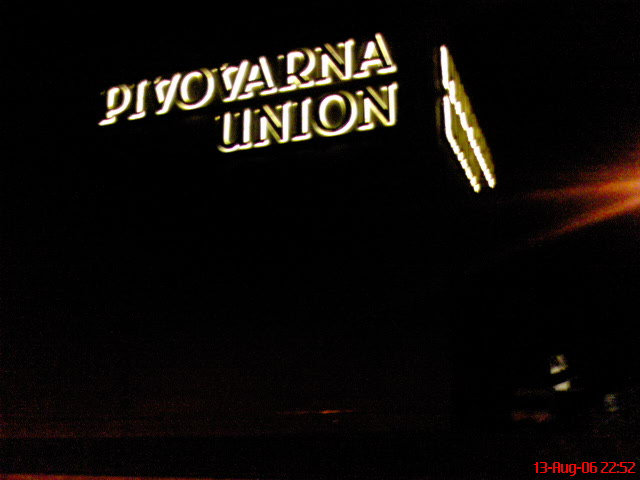
The Old Town is charming and beautiful, in a similar way to Prague or Cracow, though much smaller (the population of the city is just 330,000, with not much more than that in the greater urban area), and it is lined with bars and restaurants, whose terraces are about three times the size as their tiny indoor areas. One regrettable tendency of bar owners in the town is to pipe MTV or local radio all over their premises, including the terrace. In the age of iPods and radioblogs, you wonder is this really necessary. The beer, either Union, the local (the newly-designed brewery is pictured, at night) or Laško, from the eponymous town in the east of the country, is on a par with Czech and Slovak beer, which is the highest of praise, and is cheap, about €2 for a 50cl bottle.

Because of the rain I decided not to head off to Bled, the town and lake in the Southern Alps about an hour north of Ljubljana. It is the country's biggest tourist attraction, but I was more interested in seeing Tito's summer home, which is now a luxury hotel. Having seen the Hotel Dajtla in Tirana a couple of years back, I have developed a bit of a taste for Communist-era chic. The rain cleared up on Sunday afternoon but by then I would have been left with only an hour in Bled so I stayed in town and visited the Castle, which like the fortress in Trieste, is built on the summit of a steep hill in the centre of the town. Architecturally it is less interesting than the castle in Trieste but it was at least open. From the clock-tower there was a panoramic view of almost the whole country (it is quite small, about the size of Leinster and Munster combined). Upon descending the mount, it was time for a burek (a sort of Albanian deep-fried pizza and one of the world's great junk foods) and a beer. Some of the locals eat this stuff for breakfast and like the Italians, the Slovenes are not shy of having a beer before 11am, which took a bit of adjusting to, as none of the people I saw tippling looked either dishevelled or as if they had been out all night.

Of the few Slovene writers I am familiar with, Slavoj Žižek is the most famous, mainly because of his fame on US campuses and because he writes in English (as well as French, German and his native language). A Lacanian Marxist, known to lazy journalists as the 'wild man of critical theory' (presumably because he has a full beard), he has long resisted attempts by US universities to capitalise on his fame and get him to accept tenure. He prefers instead to work as a researcher at the National Centre for Social Research at the University of Ljubljana, located in the Faculty of Philosophy building, just around the corner from Plečnik's library. It is a dull, functional building similar to hundreds other campus buildings worldwide but it is strikingly big for a Philosophy faculty. A piece of graffito on the side proclaimed, in English: 'Fuck Marx, I love Slovenia'. Žižek has no doubt seen it and was probably amused.

I hope to go back to Ljubljana, as it is a good spot for a weekend break (to such an extent that it now unfortunately becoming a destination of choice for English stag parties) but the weather is hard to divine. A bit like back home, only more so.

Thursday, August 17, 2006

The Holy Seat


Just as some gay men and women know from an early age that they are homosexual so I knew quite young, despite my Catholic upbringing that I was an atheist, or at least inhabiting that ante-room to atheism, agnosticism. (I know that my Dad is going to scroll down through that last sentence way too quickly and cheerily announce to everyone that I have outed myself on the Internet, but alas the Lord is going to have to damn me on lack of faith rather than anything proscribed in Leviticus). That said I am drawn to churches and other places of worship, probably because of their calm and grace and also because, from long before Christ to the present day, temples, mosques and churches have usually been able to guarantee a high standard of architecture. I have many favourites, such as the Romanesque churches of Cologne; a more recent post-war Church of Sankt Jakob in the same city; Sigurd Lewerentz's wonderful Markuskyrkan (pictured) in the suburbs of Stockholm; Chartres Cathedral (one of the most stunning works of art I have ever seen); two beautiful parish churches in Donegal from the 1960s, at Burt and Creeslough and churches I have more recently seen such as the Cathedral of San Giusto in Trieste and the Franciscan Church on Presernov Trg in Ljubljana.

One thing I noticed in Italy however is the religious' real annoyance at their sites of worship being visited for nothing but their artistic merit, or more often simply because of their banal fame. Italian churches famously ban women in halter tops and men in shorts from their premises and in the Church of Santa Maria Maggiore, beside Santa Lucia Station in Venice, one sandwich board posted beside the front door scolded potential visitors in five languages, reminding them that churches are not art galleries or museums. Fair enough, but there are churches that have no problem in charging admission fees to defray parochial and maintenance costs. The Churches have always had a mercantile side to them but they usually prefered gather money from the faithful rather than from uninterested outsiders. The churches' real problem was crystallised in something I saw in Santa Maria Maggiore. I noticed the door to an old oaken confessional ajar and inside I saw, instead of a old wooden bench for the priest to sit on, a standard revolving office chair. It is hard to remain nonchalantly in the sacral domain when quotidian furniture design is itself irreducibly profane.

Wednesday, August 16, 2006

Difficult From Here

As I remarked in the last post, Trieste's second train station, the Campo San Marzio, has been closed for a long time so there is now no direct connection to nearby Ljubljana, save for a nightly train to Budapest that goes via Zagreb, quite a detour. I asked a the man at the enquiries desk at Centrale station if there were any other connections, and he said that in good English, that "it is difficult from here." He told me to take a train to Monfalcone but gave me the impression that there was only one per day, thereby necessitating another afternoon in Trieste.

I decided to get a second opinion at the ticket office, and while waiting for a French-speaking teller to come free, another teller, speaking nothing but Italian succeeded in getting me to buy a ticket for the Slovenian capital via Monfalcone the following morning, as I required. Sometimes not speaking a language at all is more useful than speaking half a language.

A Quiet City


Trieste is a city that willingly chose the quiet life. A vibrant port, the main sea-portal of the Austro-Hungarian Empire until it joined the Kingdom of Italy in 1919, today it is a sleepy, if pleasant city that is not quite dead, but certainly has none of the bustle that it would have had when James Joyce lived there a century ago. In the hands of the Austrians since the fifteenth century, the city remained culturally Italian (though it is also on the border with Slovenia and there is a significant Slovene-speaking minority living in the city's hinterland) and the city's wealthy merchants, made rich by trade with the Hapsburg Empire, were for the most part irredendist, and upon the collapse of that Empire after the First World War, Trieste and the peninsula of Istria to the south rejoined Italy. (It is strange how the word 'irredentist' is not as common in usage in Ireland as it is in Italy, considering how appropriate it is to the Irish situation.) Istria later reverted to Yugoslavia after the next war and now forms part of both Slovenia and Croatia, but Trieste is still Italian.

As the train swung south from Monfalcone, the most familiar Triestine characteristic, the rain, made an appearance and did not stop for another 24 hours. The city is not too eager to attract tourists; there is no tourist office and the only map I could find was so old that Slovenia was referred to as Yugoslavia. It also included the disused Campo San Marzio railway station, detailing its connections to Klagenfurt and Ljubljana. When I finally found the hotel I was staying in, right beside the first of Joyce's many addresses in the city, I found that it was practically empty.

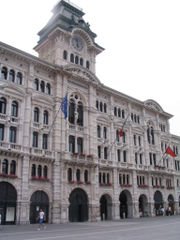
Trieste has a dramatic setting, the hills of the Karst rising to the north and the east and the city itself is quite hilly, with the old Venetian-build castle and the charming Romanesque Cathedral of San Giusto sitting on a height that towers over the seafront streets below. The harbour is practically unused these days, Italy had less urgent use for a new port than the inland Austrians did, a few fishing trawlers and some pleasure boats being the only vessels to be seen. Only in the marina to the south of the Old Port was there a sign of any activity. But the city, apart from the derelict dockyard buildings, does not look like it is suffering too badly. The city has a range of impressive Belle Époque architecture bequeathed it by the Austrians - stout, ornate Central European buildings, and the main square, Piazza de la Unità d'Italia, with the City Hall and a number of old merchant's mansions is beautiful. There is a lot of interesting Fascist-era modern architecture too; it is as if Mussolini was spoiling the lost child that had just returned to the family.

Joyce left Trieste when war broke out in 1914, even though Italy did not enter it until the following year, and when he returned in 1919 he found that the old glory of the city had vanished and he went off again to Paris. He is the writer most closely associated with the city, though the locals, apart from one statue and a small museum in the Municipal Library do not seem too bothered by the connection. Much more revered are the Triestine writers, such as Italo Svevo, who was taught English by the young Joyce and eventually championed in France by the Dubliner, and even more so the poet Umberto Bava. I had a bit of bad luck with the city as many of the museums were closed for the month of August, as was the famous Caffè San Marco, which was frequented by both Joyce and Svevo, and which gets a chapter to itself in the Triestine writer Claudio Magris' superb Microcosms. So instead I took a look at the city's synagogue, built in 1914 and which survived the Nazi occupation. It is reputedly one of the biggest in Europe and I would well believe it, it is a huge edifice, modelled on ancient Syrian temples, that dominates the small street on which it is located. The closest thing I have seen like it is the Portuguese Synagogue in Amsterdam, though this is a neater, more clinical work, though every bit as impressive.

The best museum I saw on my trip was a small one housed in the city's enormous Post Office. It was the Postal Museum of Mitteleuropa, and was a fascinating documentation of the history of Post in the Austro-Hungarian Empire. Even better than the permanent collection, which includes postmen's uniforms from the 19th century and old telegraph machines, was the collection of stamps and first-day issues from around the world that told the story, comic-strip style of the Friulian earthquake of 1976. Also included are postcards to and from the stricken region shortly after the quake, all of them stamped with the haunting 'Zona Torrematta'.

The beer is better in Trieste than elsewhere in Italy because of the historical connections with Central Europe, but the problem is trying to get a place that stays open after 10pm. As I said, they like the quiet life here. Two days was enough. I can't imagine I will be going back, but a pleasant city, one that has stepped into the slow lane of History.

Saturday, August 12, 2006

Breaking the Law

Ljubljana is an admirable little city, of which I will speak more in later posts. I did have my first brush with the local law last night when I absent-mindedly jaywalked an empty thoroughfare, only to see two patrolling officers in front of me. I feared the worst, which was really only a fine, I know enough about Slovenia to know that it is not ridden with institutional corruption, like Russia or Belarus. They took a high hand though, asking me in roughly-Slavic English, if I knew what a pedestrian crossing was, and then if I knew what the penalty for not using one was? Ten thousand tolars they said, alternating the above comments like the Knights that Say 'Ni' in Monty Python. The fine in reality is not so fearsome, €40.60 to be precise, and the good officers let me off, telling me that I should carry an original of my passport, which was held as security in my hotel, though they did compliment me on my foresight to carry a photocopy. Slovenia is more like Austria or Switzerland than the Balkans, or Sweden even, as a young Swedish couple I met today approvingly remarked. I'm on my last chance now though and I am standing stock still with all those Slovenians until I see that little green man...

Wednesday, August 09, 2006

High Campanile

Venice was the unwanted child on this trip; I only spent a day here due to the fact that a flight to Treviso was the cheapest way of getting to Trieste and Ljubljana. Not that I don't find the city charming, but in August, overrun as it by tourists it is not near as pleasant as it might otherwise be. I want to save it for another time, like not wanting to know the score before watching the edited highlights of a football game. It will probably be a windy November afternoon when I will be up to my ankles in floodwater from the swollen canals (St. Mark's Square is invaded by water a staggering 250 days per year). But in some way I would find that more enjoyable than standing in the interminable queues for St. Mark's Basilica and the Doge's Palace. The latter being the only thing I wanted to see, because of its marked influence on Ragnar Östberg's Stockholm City Hall, I was a bit dismayed. The queue for the Campanile was much shorter and so I took the lift up. Once up there the meridonal aspect of the city explodes in a mass of terracotta roofs and countless other campaniles that make you really feel that you have been conned into paying 6 euros just to get to the top of this one, until you realise then that the campanile, which has always had architectural cachet in English, means merely 'belltower' in Italian. More fool we.

On the ground I took a more unorthodox approach to exploring the city, by just getting lost. Except that you never really get lost in Venice. There is no point in using a map for anything more than the most basic of landmarks; the streetnames are only to be used as a last resort and in fact do not figure in postal addresses at all, each of the siesti or districts function in that way with the houses individually numbered in a fashion that is indiscernible to the untrained eye. But even so, you are never too far from emerging in a place that you will recognise (for all its labyrithine character the city is very small). And just as one is said to be never more than ten feet away from a rat in London, so you are never more than a street away from a tourist in Venice, no matter how isolated you think the street you are wandering on is. On some of the less glamorous squares in San Polo, where the price of everything suddenly plummets, could be seen people, mainly foreigners sketching. The squares look like a quietly morose di Chirico tableau, with the shadow cast by a crumbling building drawing the campo into its stern geometry. The town is messy, like much of the rest of Italy but it is never ugly. It wears the urban nuisances of fly-posting and grafitti well; they suit it even.

But the expense of Venice is the most frustrating, if hardly surprising thing. Though it is no more costly than most Western European capitals, the fact remains that it is a small provincial city, albeit a unique one. It is hard to filter out the rubbish from the genuine, particularly foodwise (OK, I could have bought a guidebook but I didn't really feel the need for one day, least of all spoiling my unwanted child like that) and the food in the main was mediocre. Passing by one trattoria I saw the blackboard advertising the day's fish special, in English: 'Today. Flounder, Venetian style.' Quite. Hit and miss I suppose, but the Venetians built their city on commerce and, even if the trade these days is less vaunted and less exotic than in the past, they are unlikely to change soon. And why, you can ask yourself, would they? It's not a bad pay-off for having your town overrun by strangers for most the year.

Wednesday, August 02, 2006

Des Res


The day-trip ended up being to Fontainebleau, a pleasant but sleepy town about 40 minutes south of Paris, best known historically for being home to the most important royal château after Versailles, and these days for being the location for France's football academy, through whose doors most of their stars of the past few years have passed.

Though the château is not the only thing of note in the town - there are one or two interesting-sounding museums, including France's National Prison Museum - to be honest, had King François I not decided almost 500 years ago to establish the country seat of the Bourbons there, there would be little reason to go anywhere near the place today. The town is small, about 17,000 people, and the best-known non-royal landmark seems to be the enormous vintage carousel planted in the middle of the main square. It has probably been there longer than any of the town's citizens and no doubt kept going all the way through the Nazi occupation too. The sound of that generic organ-ground carnavel music generates an eerie effect as you eat your lunch on a restaurant terrace; it reminded me a bit too much of that spooky Disney movie, Something Wicked This Way Comes, and The Lady from Shanghai too, if my memory serves me right.

The château is less physically imposing than Versailles and its gardens are more peripheral. It is also less pristinely symbolic as, unlike Versailles, it continued to be used long after being the Revolution, being the favoured residence of all the Napoleons, from Bonaparte on. But for this reason, it is more interesting, as the building, often-extended and re-built is physical testimony to changing tastes and regimes. Though on the outside, the structure was maintained throughout its renovations as classically, even academically, baroque, the inside is like a living museum of additions and revisions, as one moves from stucco and fresco to wood-pannelled, porcelain-encrusted passages, to lush tapestries, to the splendid 80-metre long Diana Room, which was the royal, and later imperial, library. The centre-piece is Napoleon's enormous marble globe, which I think I have seen before but it may have been a similar contraption in a Vermeer tableau.

An unexpected impression I got was one of comedy. Reading the caption cards about the incessant extensions and renovations, the last major one being as recent as the 1920s, I could see a macro-version of the Irish Big House comedy, such as Castle Rackrent, in which the grand designs and the pomp of successive conceptions were forever being undermined by the bathetic changes of regime and allegience. Or maybe it was more like a novel by Günther Grass. I could hear History laughing down through the ages. Another amusing sight was Bonaparte's bed. It is usual for historical beds to be smaller and shorter than modern ones, as we have managed to outstrip our ancestors in average height. Bonaparte's bed however, at scarcely 5'6" long came as a bit of a shock. Even better was its height, cruelly elevated for such a short man, necessitating a couple of ornate steps to reach it. Perhaps that is why he might have turned out the man he did.