No postings in the past few days, even the Croke Park/God Save the Queen 'controversy' didn't tempt me into the ring. I found the story a bit fatuous, especially as the Irish rugby fraternity has rarely been home to hardcore Republicans. It was to be expected that Republican Sinn Féin would muster a gaggle of protesters but I don't really see what the problem was there. This issue was decided long ago when the GAA voted to allow football and rugby into Croker; they debated it then and the outcome was that having the British monarchy's anthem played at a rugby match was not going to unduly bother them, especially with the prospect of two and a half million euros to soften the blow. The incident would have been a lot more fraught had the match been a soccer international - rugby fans are such polite sorts that it would be hard to imagine them booing anybody's national anthem - but I still think that God Save the Queen would have been respected by the Irish soccer crowd, though this respect would have been leavened by an appropriate amount of slagging too.
Anyway both Amhran na bhFiann and God Save the Queen are god-awful dirges when examined from a musical point of view and the previous should be replaced (not because of its violent lyrics - listen to the Marseillaise or dozens of other anthems for that matter) but because it is a drearily unmotivating piece of music. And, no Ireland's Call is not a suitable replacement (only the rugby shower could concoct a palliative as dull and unimaginative as this one), nor is The Fields of Athenry, a piece of plastic Paddywhackery that best symbolises the Irish people's loss of any remaining connection with genuine Irish culture. But given what passes for 'Civic' songwriting in Ireland these days any possible replacement would no doubt be something like John Waters and Tommy Moran's composition which will represent Ireland at this year's Eurovision. This piece of pan-European piffle demonstrates how truly toothless the Castlerea autodidact really is. When Slovenia gained its independence in 1991 it chose for its national anthem a verse of 'Zdravljica', a celebrated poem by national poet, the 19th century Romantic, France Prešeren, which begins with the most generous line: 'God's blessing on all nations'. The verse had already been set to music by Stanko Premerl, there presumably being no Slovene equivalent of Phil Coulter. It is a national anthem to envy, one that bears comparison with the best, such as the Marseillais, Brazil's and the Russian/former Soviet one. Ireland's choice would no doubt be selected by a Louis Walsh-chaired phone-in contest. It really doesn't bear thinking about. Better the devil you know.
Showing posts with label Slovenia. Show all posts
Showing posts with label Slovenia. Show all posts
Sunday, February 25, 2007


Wednesday, January 03, 2007
Two Weeks Off
An enforced absence over the Christmas period, my Internet access hampered by the near impossibility to get free wi-fi in Dublin (and any wi-fi there is is prehistorically slow and temperamental). A stupid technical error on my part prevented me from being able to use dial-up on my laptop so a large number of posts, that might otherwise have been effected, such as a review of the years' films, have had to be either shelved or deferred. Some of them should appear in some form over the next week.
And so I missed the demises of James Brown, self-effacing Turkmen dictator Saparmurad Niyazov (who, with regard to the prevalence of his image everywhere in the country, on everything from vodka bottles to statues, said 'it embarrasses me seeing my image everywhere but that's what the people want') and, of course Saddam Hussein. The latter I will shed no tears for but it is interesting reading a statement by US Lieutenant-General William Caldwell, who insists that the US had no part in his execution. Well, he would, wouldn't he? Sounds like the words of an earlier occupying functionary in the region, Pontius Pilate. Not that I would dare to impute Christ-like status to Saddam. But the good people of Chile might be rueing the fact that they did not succeed in extraditing their own homegrown, and recently departed, despot Augusto Pinochet, to the new democratic Iraq, where the justice, and execution thereof has proven to be refreshingly summary and swift.
Slovenia, meanwhile, became the thirteenth country to adopt the Euro as its currency; when I was there last August, prices everywhere were already being displayed everywhere in both Tolars and Euros, a piece of organisation and economic transparency to shame bigger, more illustrious countries further to the west. Slovenia is cast-iron proof that countries with a communist past need not be free-market whores for global capital or economic basketcases riven by corruption and the shoring-up of the same vested interests as prevailed under the hammer and sickle. Two other former communist countries, Bulgaria and Romania, have joined the EU and the huge influx of migrant workers predicted by the British right-wing media has failed to materialise, mainly because the Romanians and Bulgarians are more attracted by the culture and lifestyle of southern European countries. Like the fat, sweaty homophobe that is convinced that every gay man he comes into contact with wants his botty, this rejection, for the Daily Mail et al must be devastating.
And, last but not least, Irish yesterday became the 23rd official language of the EU, albeit on a second-tier level, comparable to Catalan (a minority langauge that numbers more native speakers than either Danish, Norwegian or Finnish) or Basque. After the brouahaha of a couple of years back of Gaeilgeoirí campaigning for the elevation of Irish to official-language status, the news has been largely unreported in Ireland. I have to say I have a pragmatic stance on this issue: there is no need for Irish to be an official language and its being one is not going to do anything for the promotion for the language, which I fully support. It is typical of the Irish's fondness for pride in symbols without investing any real effort in turning those talisman into a thing of tangible cultural worth. Irish should remain a compulsory language at school (anything that makes a nation of spoilt brats miserable can only be a good thing in my book) but it should benefit from a more practical pedagogical agenda with its cultural importance emphasised. Some of the newer Gaelscoileanna are doing their best in this respect but they are still stymied by Department of Education guidelines (a body so ill-equipped to instruct in the teaching of the Irish language that its Irish name is the grammatically incorrect An Roinn Oideachais rather than Roinn an Oideachais). I could suggest that Dorothy Parker's quip that 'you can lead a horse to culture but you can't make it think' might be particularly pertinent to modern Ireland, but that might be a bit mean.
A Happy New Year to all.
And so I missed the demises of James Brown, self-effacing Turkmen dictator Saparmurad Niyazov (who, with regard to the prevalence of his image everywhere in the country, on everything from vodka bottles to statues, said 'it embarrasses me seeing my image everywhere but that's what the people want') and, of course Saddam Hussein. The latter I will shed no tears for but it is interesting reading a statement by US Lieutenant-General William Caldwell, who insists that the US had no part in his execution. Well, he would, wouldn't he? Sounds like the words of an earlier occupying functionary in the region, Pontius Pilate. Not that I would dare to impute Christ-like status to Saddam. But the good people of Chile might be rueing the fact that they did not succeed in extraditing their own homegrown, and recently departed, despot Augusto Pinochet, to the new democratic Iraq, where the justice, and execution thereof has proven to be refreshingly summary and swift.
Slovenia, meanwhile, became the thirteenth country to adopt the Euro as its currency; when I was there last August, prices everywhere were already being displayed everywhere in both Tolars and Euros, a piece of organisation and economic transparency to shame bigger, more illustrious countries further to the west. Slovenia is cast-iron proof that countries with a communist past need not be free-market whores for global capital or economic basketcases riven by corruption and the shoring-up of the same vested interests as prevailed under the hammer and sickle. Two other former communist countries, Bulgaria and Romania, have joined the EU and the huge influx of migrant workers predicted by the British right-wing media has failed to materialise, mainly because the Romanians and Bulgarians are more attracted by the culture and lifestyle of southern European countries. Like the fat, sweaty homophobe that is convinced that every gay man he comes into contact with wants his botty, this rejection, for the Daily Mail et al must be devastating.
And, last but not least, Irish yesterday became the 23rd official language of the EU, albeit on a second-tier level, comparable to Catalan (a minority langauge that numbers more native speakers than either Danish, Norwegian or Finnish) or Basque. After the brouahaha of a couple of years back of Gaeilgeoirí campaigning for the elevation of Irish to official-language status, the news has been largely unreported in Ireland. I have to say I have a pragmatic stance on this issue: there is no need for Irish to be an official language and its being one is not going to do anything for the promotion for the language, which I fully support. It is typical of the Irish's fondness for pride in symbols without investing any real effort in turning those talisman into a thing of tangible cultural worth. Irish should remain a compulsory language at school (anything that makes a nation of spoilt brats miserable can only be a good thing in my book) but it should benefit from a more practical pedagogical agenda with its cultural importance emphasised. Some of the newer Gaelscoileanna are doing their best in this respect but they are still stymied by Department of Education guidelines (a body so ill-equipped to instruct in the teaching of the Irish language that its Irish name is the grammatically incorrect An Roinn Oideachais rather than Roinn an Oideachais). I could suggest that Dorothy Parker's quip that 'you can lead a horse to culture but you can't make it think' might be particularly pertinent to modern Ireland, but that might be a bit mean.
A Happy New Year to all.
Tuesday, August 29, 2006
Slovenia, not Slovakia

I promised that I would post something on Ljubljana and Slovenia, and it is now over two weeks since I got back from there. The moment has passed but I will try to gather up some impressions. The most lasting one, unfortunately, was the weather. For the first two days of my stay there was almost constant rain. Apparently it is quite common in the city, especially in August. I missed the local version of the July heatwave where it was 4o˚every day. Walking around looking for a department store to buy a change of socks is not the most pleasurable way of seeing a city, and is ever less so when you are trying to find a place open after 1pm on a Saturday afternoon - the Slovenian people two years back voted in a referendum to close shops at that time. Thankfully the bars, restaurants and museums stay open. And they were of a generally high standard as long as one's feet were dry.
Slovenia has the misfortune to be often confounded with the other Slavic country further to the north, Slovakia (as it was by none other than George W. Bush during his election campaign in 2000) and the countries' two flags are also remarkably similar. Slovenia is a much more prosperous country though, the richest of the ten newest EU members, and it was historically the richest of the Yugoslav Republics. Its Mitteleuropean civic sense, as suggested by that referendum mentioned above, set it apart from the corruption and factionalism of Croatia and Serbia in the final days of the Federal Republic. According to an exhibition on Slovenian independence in the superb Museum of Modern History the Slovenians countered Milošović's plan for a Greater Serbia with a programme for the democratic reform of the Federation. When they realised that these efforts were doomed to failure, they declared independence (after a plebiscite, of course) on December 23rd, 1990. There then followed six months later a nine-day war with the Yugoslav army, which was largely bloodless and barely impinged on any of the country's cities. Since then the country has integrated itself almost seamlessly into Western Europe; apart from a few examples of Socialist-era architecture, it is almost unrecognizable as a former Communist country.
Because of the rain, I spent most of my time in the city's museums, which are not of the greatest general interest, but the Architectural Museum was fascinating for its focus on Jozé Plečnik, the man who almost single-handedly redesigned Ljubljana in the mid-twentieth century, having a hand in everything from parks and squares to churches to bridges to war memorials and arcades, and his most famous building, the National and University Library (pictured above on the left), built on the ruins of a palace destroyed in the 1895 earthquake. It is justifiably renowned worldwide as a masterpiece, and it is similar to the romanticism and sleek lines of other centres of learning of the same period, such as Gunnar Asplund's Stockholm Municipal Library and Charles Rennie Mackintosh's Glasgow College of Art. Ljubljana is probably the only city that has as an indelible a stamp of a single architect. He designed the main bridges that cross the Ljubljanica river, including the triple bridge that links Prešernova Trg with the Old Town, and the market arcades that line the river both above and under ground, (one of these houses the best bar I was in, called Makalonca, which throws up a gobsmacking riverside view, after a descent of a staircase into what at first appears to be a cellar; the barmaid there also used to live in Lucan, of all places).
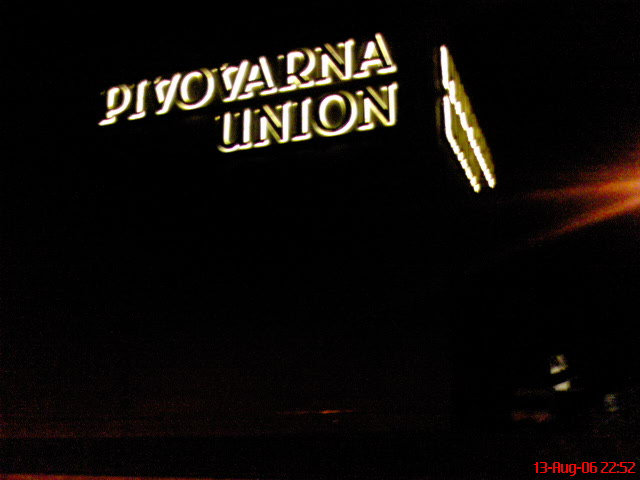
The Old Town is charming and beautiful, in a similar way to Prague or Cracow, though much smaller (the population of the city is just 330,000, with not much more than that in the greater urban area), and it is lined with bars and restaurants, whose terraces are about three times the size as their tiny indoor areas. One regrettable tendency of bar owners in the town is to pipe MTV or local radio all over their premises, including the terrace. In the age of iPods and radioblogs, you wonder is this really necessary. The beer, either Union, the local (the newly-designed brewery is pictured, at night) or Laško, from the eponymous town in the east of the country, is on a par with Czech and Slovak beer, which is the highest of praise, and is cheap, about €2 for a 50cl bottle.
Because of the rain I decided not to head off to Bled, the town and lake in the Southern Alps about an hour north of Ljubljana. It is the country's biggest tourist attraction, but I was more interested in seeing Tito's summer home, which is now a luxury hotel. Having seen the Hotel Dajtla in Tirana a couple of years back, I have developed a bit of a taste for Communist-era chic. The rain cleared up on Sunday afternoon but by then I would have been left with only an hour in Bled so I stayed in town and visited the Castle, which like the fortress in Trieste, is built on the summit of a steep hill in the centre of the town. Architecturally it is less interesting than the castle in Trieste but it was at least open. From the clock-tower there was a panoramic view of almost the whole country (it is quite small, about the size of Leinster and Munster combined). Upon descending the mount, it was time for a burek (a sort of Albanian deep-fried pizza and one of the world's great junk foods) and a beer. Some of the locals eat this stuff for breakfast and like the Italians, the Slovenes are not shy of having a beer before 11am, which took a bit of adjusting to, as none of the people I saw tippling looked either dishevelled or as if they had been out all night.
Of the few Slovene writers I am familiar with, Slavoj Žižek is the most famous, mainly because of his fame on US campuses and because he writes in English (as well as French, German and his native language). A Lacanian Marxist, known to lazy journalists as the 'wild man of critical theory' (presumably because he has a full beard), he has long resisted attempts by US universities to capitalise on his fame and get him to accept tenure. He prefers instead to work as a researcher at the National Centre for Social Research at the University of Ljubljana, located in the Faculty of Philosophy building, just around the corner from Plečnik's library. It is a dull, functional building similar to hundreds other campus buildings worldwide but it is strikingly big for a Philosophy faculty. A piece of graffito on the side proclaimed, in English: 'Fuck Marx, I love Slovenia'. Žižek has no doubt seen it and was probably amused.
I hope to go back to Ljubljana, as it is a good spot for a weekend break (to such an extent that it now unfortunately becoming a destination of choice for English stag parties) but the weather is hard to divine. A bit like back home, only more so.
Saturday, August 12, 2006
Breaking the Law
Ljubljana is an admirable little city, of which I will speak more in later posts. I did have my first brush with the local law last night when I absent-mindedly jaywalked an empty thoroughfare, only to see two patrolling officers in front of me. I feared the worst, which was really only a fine, I know enough about Slovenia to know that it is not ridden with institutional corruption, like Russia or Belarus. They took a high hand though, asking me in roughly-Slavic English, if I knew what a pedestrian crossing was, and then if I knew what the penalty for not using one was? Ten thousand tolars they said, alternating the above comments like the Knights that Say 'Ni' in Monty Python. The fine in reality is not so fearsome, €40.60 to be precise, and the good officers let me off, telling me that I should carry an original of my passport, which was held as security in my hotel, though they did compliment me on my foresight to carry a photocopy. Slovenia is more like Austria or Switzerland than the Balkans, or Sweden even, as a young Swedish couple I met today approvingly remarked. I'm on my last chance now though and I am standing stock still with all those Slovenians until I see that little green man...
Subscribe to:
Posts (Atom)

 Posts
Posts





